AuthBridge-footer-logo
The Rise of Leadership Due Diligence: Trust as a Boardroom Imperative

The Rise of Leadership Due Diligence: Trust as a Boardroom Imperative

The Rise of Leadership Due Diligence: Trust as a Boardroom Imperative

The Rise of Leadership Due Diligence: Trust as a Boardroom Imperative

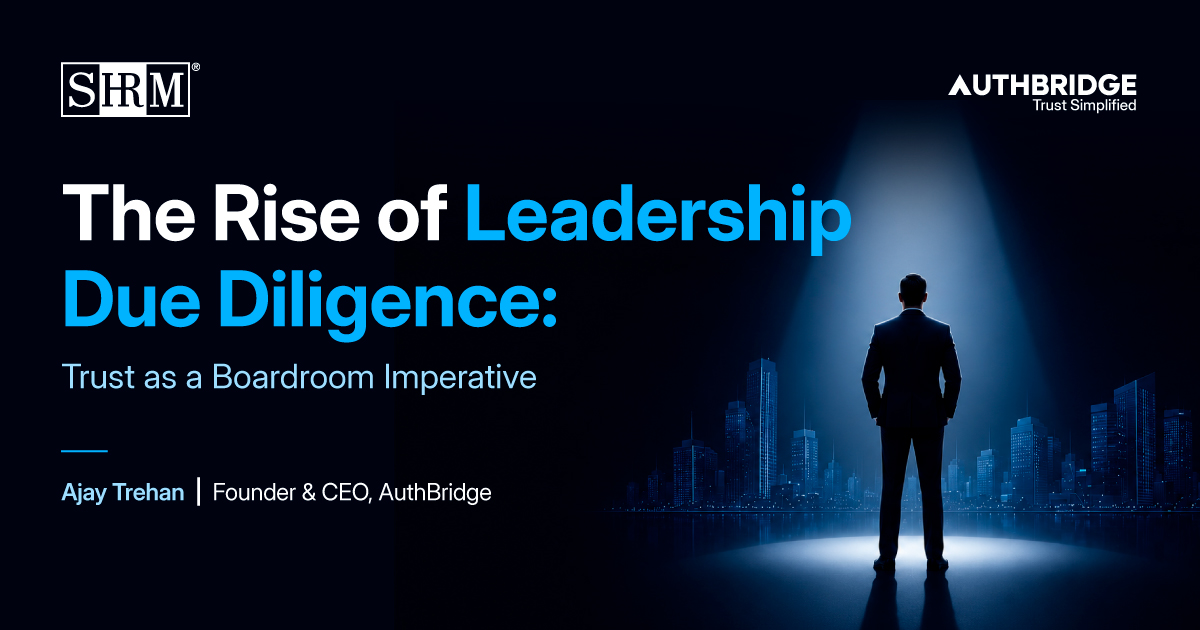
For a long time, due diligence was largely viewed as an operational exercise, primarily relevant at the hiring stage, focused on verifying credentials, and often limited to mid-level roles. That equation is now changing.

In today’s environment of heightened scrutiny, leadership decisions are no longer confined to internal impact. They shape market perception, investor confidence, regulatory standing, and long-term enterprise value. As a result, due diligence is moving beyond HR workflows and into the boardroom, where leadership credibility is directly linked to the credibility of the organisation itself.

AI in Hiring: Speed vs Trust in the Age of Intelligent Screening

AI in Hiring: Speed vs Trust in the Age of Intelligent Screening

AI in Hiring: Speed vs Trust in the Age of Intelligent Screening

AI in Hiring: Speed vs Trust in the Age of Intelligent Screening

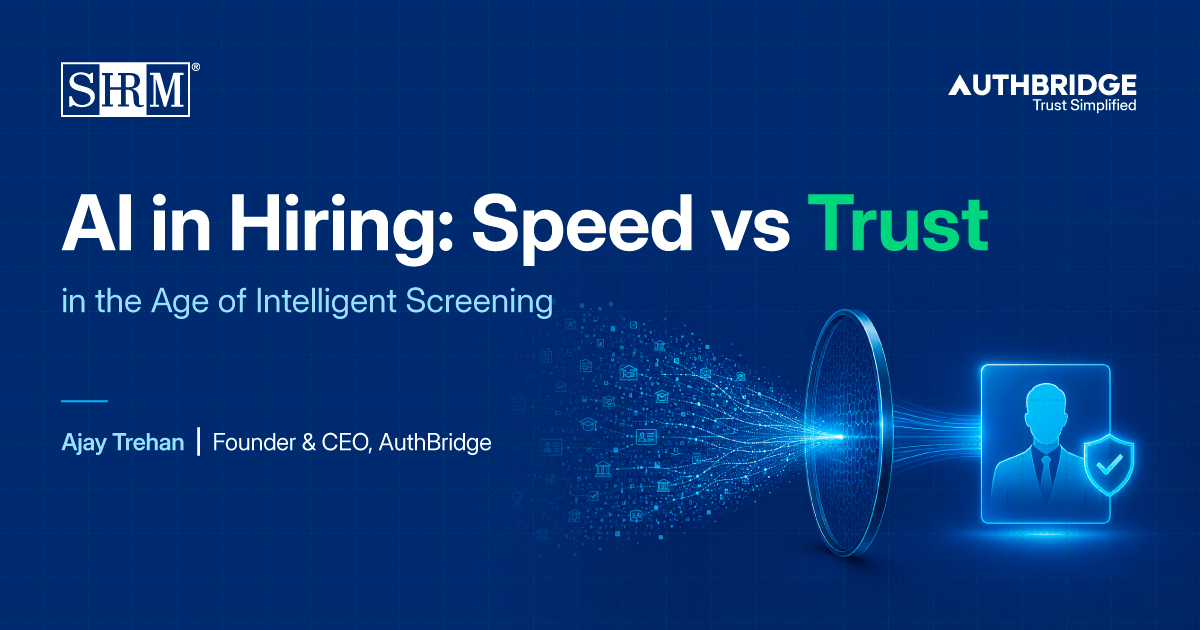
In most organisations today, a candidate can be screened, ranked and shortlisted before a recruiter has read a single resume. What once took hiring teams several days now happens in minutes. While the operational advantage is obvious, the more difficult question is whether organisations fully trust the systems making those early judgments. Artificial intelligence is now changing this balance in a visible way.

Across sectors, AI is being used to source candidates, screen resumes, assess role fit and support early-stage risk evaluation. Work that earlier took days can now be completed in hours. For companies hiring at scale, this efficiency is significant. The question is whether or not trust can keep pace with that speed.

The Rise of Leadership Due Diligence: Trust as a Boardroom Imperative

The Rise of Leadership Due Diligence: Trust as a Boardroom Imperative

The Rise of Leadership Due Diligence: Trust as a Boardroom Imperative

The Rise of Leadership Due Diligence: Trust as a Boardroom Imperative

For many years, due diligence was treated as a process that sat largely within HR or operations. It was seen as something to be done at the time of hiring, mostly to verify documents, credentials and past employment.

In several organisations, it was applied more rigorously at junior and mid-management levels than at the top. Senior leaders were often assessed through reputation, references, networks and past titles. That approach is no longer enough.

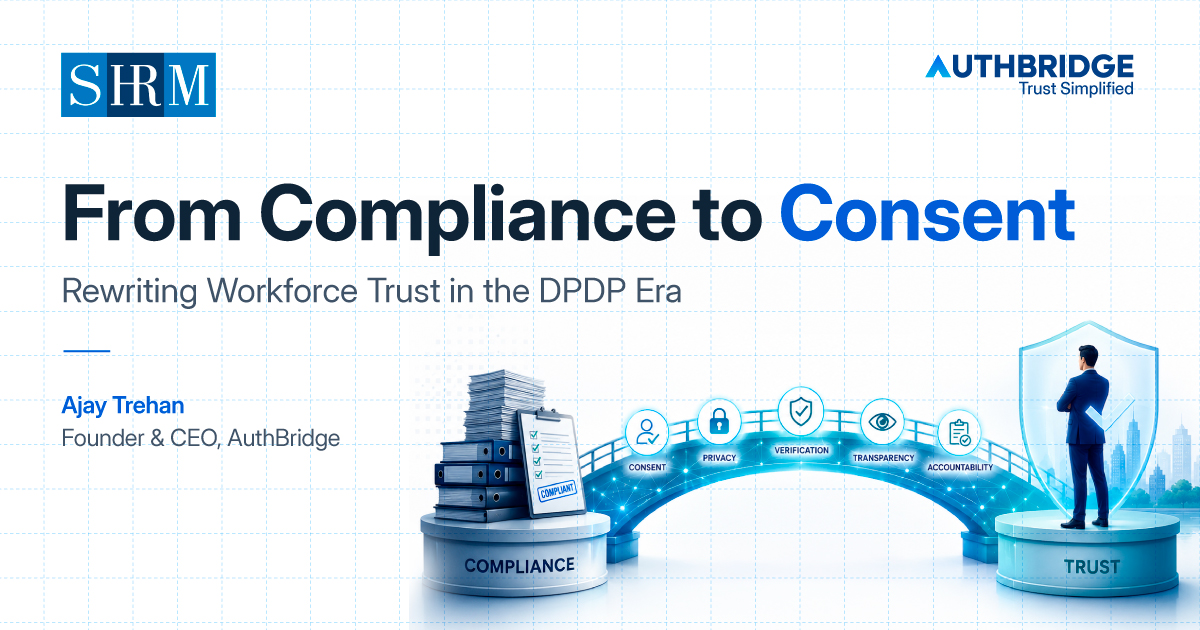
From Compliance to Consent: Workforce Trust in the DPDP Era

From Compliance to Consent: Rewriting Workforce Trust in the DPDP Era

From Compliance to Consent: Rewriting Workforce Trust in the DPDP Era

From Compliance to Consent: Workforce Trust in the DPDP Era

India’s workplaces are entering a new phase of data responsibility. For many years, employee data practices were built around compliance. Organisations collected what was required, stored it, protected it, and produced it when needed. That approach served a certain purpose. But it is no longer enough.

With the Digital Personal Data Protection framework taking shape, the question before organisations is not whether they are following the law. It is whether employees understand, trust and accept the way their personal data is being used.

Qurating Pharma Leadership: India Must Start Within to Heal the World

Qurating Pharma Leadership: India Must Start Within to Heal the World

Qurating Pharma Leadership: India Must Start Within to Heal the World

Qurating Pharma Leadership: India Must Start Within to Heal the World

As India advances toward becoming a global pharmaceutical powerhouse, trust and transparency will define the industry’s long-term leadership. Ajay Trehan highlights why compliance in pharma must evolve beyond products and processes to include continuous workforce integrity, proactive governance, and real-time risk monitoring.

The article explores how strengthening human oversight, alongside operational excellence, is critical to safeguarding patient trust and reinforcing India’s position as the “pharmacy of the world.”

“India’s position as the ‘pharmacy of the world’ is built on both scale and trust. Yet, trust is fragile,” said Ajay Trehan, Founder & CEO, AuthBridge. 

Building a More Secure and Sustainable Future for India’s Gig Workforce

Building a More Secure and Sustainable Future for India’s Gig Workforce

Building a More Secure and Sustainable Future for India’s Gig Workforce

Building a More Secure and Sustainable Future for India’s Gig Workforce

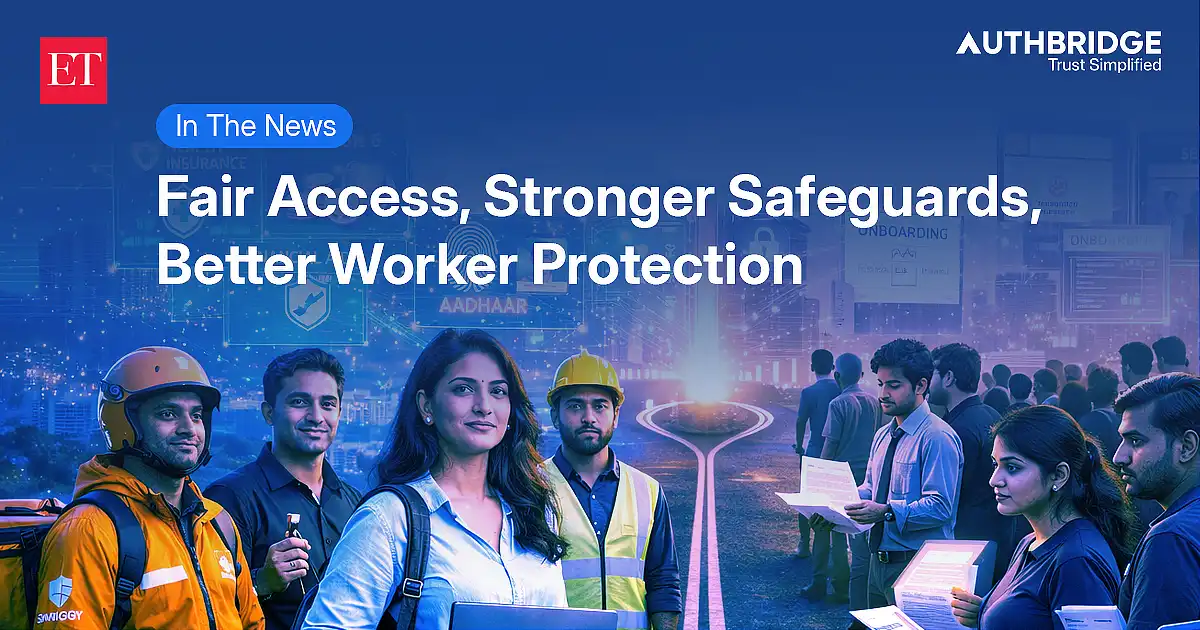
Speaking on India’s evolving social security framework for gig workers, Ajay Trehan highlighted the need for a more structured and scalable ecosystem to support the country’s growing gig workforce. He noted that gig workers have long powered sectors such as last-mile delivery, mobility, logistics, home services, and digital commerce, even as the social security framework supporting them has remained fragmented.

“For many years, this workforce has powered last-mile delivery, mobility, logistics, home services and digital commerce, but the social security architecture around them has remained fragmented. A defined eligibility threshold, along with aggregator contributions, brings more structure to worker welfare and creates accountability for platforms,” said Ajay Trehan, Founder & CEO, AuthBridge. 

Trehan further emphasised that as gig workers frequently move across platforms, cities, and job categories, systems related to identity verification, work-history tracking, contribution management, and benefit portability must function efficiently at scale. He also highlighted the role of technology in building trusted, consent-led systems that protect workers while enabling aggregators to meet compliance obligations effectively.

In conclusion, he stated that the long-term growth of India’s gig economy will depend on creating a framework where flexibility, trust, compliance, and worker protection move together.

Read the complete article here. 

India’s Gig Workforce Enters the Social Security Framework

India’s Gig Workforce Enters the Social Security Framework

India’s Gig Workforce Enters the Social Security Framework

India’s Gig Workforce Enters the Social Security Framework

“Registration, worker IDs, contribution records, and benefit portability should not become separate silos across states. Ideally, the central framework should act as the common digital and legal spine, while states can build additional welfare layers on top,” said Ajay Trehan, Founder & CEO, AuthBridge.

Commenting on India’s newly introduced social security framework for gig workers, Ajay Trehan highlighted several operational and structural challenges that could impact effective implementation. He highlighted how the current eligibility model places an unfair burden on workers, as only completed tasks are counted toward eligibility, despite work allocation being heavily influenced by platform algorithms, demand fluctuations, and platform-side controls.

Trehan also emphasised that accountability for worker welfare should remain with the platforms that exercise functional control over onboarding, work allocation, payment visibility, and worker engagement, regardless of whether third parties are involved. Additionally, he stressed the importance of establishing stronger safeguards around sudden account suspension and deactivation, as workers risk losing both income continuity and social security eligibility if their accounts are blocked/removed midway through the year.

In conclusion, he stated that while the new framework marks an important step toward recognising gig workers within India’s social security ecosystem, our country needs a more unified, transparent, and worker-centric approach to ensure meaningful and long-term protection for the gig workforce.

Read the complete article here. 

Explore how Human-in-the-Loop AI enhances identity verification and fraud prevention by balancing automation, human oversight, and transparency.

Human-in-the-Loop AI: Why the Future of Automation Still Needs Human Judgment

Rebuilding Trust in BFSI with AI-Powered Onboarding

Explore how Human-in-the-Loop AI enhances identity verification and fraud prevention by balancing automation, human oversight, and transparency.

In a recent podcast feature, Amit Balwani, Senior Vice President of Technology, AuthBridge, shares his perspective on why Human-in-the-Loop (HITL) AI is emerging as a fundamental design principle rather than just a safety mechanism.

Artificial intelligence (AI) is rapidly reshaping how enterprises approach identity verification, fraud detection, and decision-making at scale. From reducing operational costs to accelerating onboarding, AI-powered systems are enabling organisations to process vast volumes of data with speed and efficiency.

However, as automation becomes more deeply embedded in critical workflows, the impact of errors, whether false positives or missed risks, has grown significantly.

In domains such as financial services, compliance, and digital trust, decision-making cannot rely on automation alone.

He further explains that the future of enterprise AI lies in collaborative intelligence, where human judgment and machine efficiency work together. While AI excels at processing large datasets and identifying patterns, humans bring contextual understanding, ethical reasoning, and nuanced decision-making, especially in high-stakes scenarios.

A key theme highlighted in the discussion is the importance of risk-tiered decision frameworks:

  • Low-risk, high-volume decisions can be fully automated
  • Medium-risk scenarios benefit from AI-led systems with human validation triggers
  • High-risk decisions require human-led oversight, supported by AI insights

This approach ensures that organisations can maintain speed without compromising trust.

Another critical aspect is transparency and explainability. As AI systems produce probabilistic outcomes, human involvement helps create a clear audit trail, documenting not only what decision was made but also how and why it was validated. This layered accountability is increasingly important in light of evolving global regulations and the growing demand for responsible AI practices.

Ultimately, the conversation reinforces a powerful idea:
It’s no longer AI versus humans; it’s AI with humans, by design.

As enterprises continue to scale their AI adoption, embedding human judgment into automated systems will be essential for building resilient, ethical, and trustworthy digital ecosystems.

Digital Fraud in India Up 30%: How DPDP Is Forcing a Rethink of Identity Verification

Digital Fraud in India Up 30%: How DPDP Is Forcing a Rethink of Identity Verification

Rebuilding Trust in BFSI with AI-Powered Onboarding

Digital Fraud in India Up 30%: How DPDP Is Forcing a Rethink of Identity Verification

In an exclusive feature with FEFutech, Ajay Trehan, Founder and CEO of AuthBridge, highlights how digital fraud in India has surged by 30%, driven largely by advancements in Generative AI (GenAI) and evolving attack methods.

The Rise of AI-Driven Fraud

As AI technologies become more accessible, fraudsters are leveraging them to create highly convincing fake identities, documents, and even biometric data.

  • 74% of Indian organisations report a rise in GenAI-driven fraud
  • 69% say their current KYC systems cannot detect AI-generated documents

This signals a structural weakness; not at the edges, but within the identity verification layer itself.

DPDP Act: A Turning Point for Businesses

With the introduction of the Digital Personal Data Protection (DPDP) Rules, 2025, the regulatory landscape is shifting from passive compliance to active accountability.

Key implications:

  • Businesses must implement reasonable security safeguards
  • Mandatory transparent breach notifications
  • Penalties up to:
    • ₹250 crore for security failures
    • ₹200 crore for breach notification failures

This marks a fundamental shift from “Was data collected properly?” to “Was risk actively understood and managed?”

Why Traditional KYC Is No Longer Enough

Conventional KYC systems were built for a static world:

  • Verify once
  • Store documents
  • Move forward

But today’s fraud ecosystem is dynamic and adaptive.

Challenges with static KYC:

  • Cannot detect post-onboarding account compromise
  • Vulnerable to deepfakes and synthetic identities
  • Over-reliance on data collection without actionable insights

Adding more checks or manual reviews often increases friction without improving accuracy.

The Shift to Identity Intelligence

The future lies in identity intelligence: a continuous, multi-signal approach to verifying users.

This includes biometric authentication, liveness detection, device intelligence, behavioural analytics, and real-time risk scoring. 

Instead of isolated checks, these elements work together to create a dynamic trust framework.

Business impact:

  • Faster onboarding for genuine users
  • Reduced fraud risk
  • Improved conversion rates
  • Stronger regulatory compliance

The message is clear:

Identity verification is no longer a checkbox, it is a living trust infrastructure.

Organisations that embrace this shift will:

  • Strengthen user trust
  • Protect business growth
  • Stay ahead of evolving fraud threats

Those that don’t risk falling behind in a landscape where fraud evolves as fast as technology itself.

AuthBridge partners with Redacto for DPDP Consent Governance

AuthBridge Partners with Redacto to Solve Consent Governance for India’s DPDP Era

AuthBridge Partners with Redacto to Solve Consent Governance for India’s DPDP Era

AuthBridge partners with Redacto for DPDP Consent Governance

New Delhi, April 15, 2026: AuthBridge, India’s leading provider of digital trust and identity verification solutions, today announced a strategic partnership with Redacto, a privacy-first technology company specialising in data redaction and consent governance. The partnership aims to help Indian enterprises operationalise consent management and strengthen compliance with the Digital Personal Data Protection (DPDP) Act.

Through this partnership, AuthBridge and Redacto will combine identity intelligence with real-time consent governance and automated data redaction capabilities to help organisations embed consent across the entire data lifecycle from onboarding and identity verification to data access, processing, and sharing.

The collaboration addresses a critical gap emerging in India’s consent-led digital economy, where organisations have advanced in data collection and identity verification but continue to face challenges in governing how personal data is used with valid consent, clear purpose limitation, and auditability, exposing enterprises to compliance and operational risks.

The collaboration will particularly support organisations in regulated sectors such as BFSI, healthcare, and digital platforms, where consent-driven data governance is becoming central to compliance and trust. By integrating identity verification with consent enforcement and data protection, the partnership aims to help enterprises move from fragmented compliance processes to a unified privacy and trust infrastructure.

As sectors such as BFSI, healthcare, and digital platforms navigate increasing regulatory scrutiny, the need for consent-driven data governance is becoming central to how trust is built and maintained for 1.4B people of India. The partnership enables enterprises to align with these requirements by transforming consent from a static checkbox into a dynamic, enforceable layer of trust infrastructure.

Commenting on the partnership, Mr Ajay Trehan, CEO and Founder of AuthBridge, said,

“India is entering a new regulatory and digital reality where consent is no longer a formality, it is the foundation of trust. While verification has evolved significantly, the real gap lies in how enterprises govern data post-collection. This partnership with Redacto is focused on solving that challenge. By integrating identity with consent governance and privacy controls, we are enabling organisations to operationalise DPDP compliance in a way that is both practical and scalable. Our vision is to help enterprises move from compliance-led approaches to trust-by-design systems.”

Responding to the partnership, Mr Amit Kumar, CEO, Redacto, said,

“India has solved the identity layer: AuthBridge has made verification seamless. What hasn’t been solved is what happens after. Once you know who someone is, do you have consent to use their data? For how long? For what purpose? Can you prove it under audit? The DPDP Act makes these questions non-negotiable. This partnership connects the identity layer to the consent layer for the first time, turning verification from a one-time event into the starting point of governed, accountable data use.”

Building Trust for 1.4B people of India: With the DPDP Act accelerating the shift towards consent-led frameworks, enterprises are increasingly recognising that trust cannot be built through siloed systems. The AuthBridge–Redacto partnership reflects a broader industry shift towards unified trust infrastructure, where identity, consent, and privacy function as interconnected layers rather than independent processes.

Through this collaboration, AuthBridge aims to strengthen its role in India’s evolving digital trust ecosystem, enabling enterprises to build consent-driven, privacy-first systems that redefine how trust is delivered in the DPDP era.

About AuthBridge

For more than 20 years, AuthBridge has been a leader in identity management, onboarding & verification, and business intelligence. Its future-ready, AI-powered technology and alternative data analytics solutions serve more than 3,000 clients across 30+ industries, covering 140+ countries. From Fortune 500 giants to India’s fastest-growing unicorns, AuthBridge ensures secure and seamless operations worldwide.

For more information, visit: AuthBridge Website

About Redacto

Redacto is an AI-first data privacy and governance platform that helps enterprises operationalise compliance with India’s DPDP Act. Its platform covers consent management, data discovery, vendor risk, and breach response, enabling organisations to embed privacy across the data lifecycle, from onboarding to processing to downstream use. Built for regulated sectors like BFSI, healthcare, and digital platforms, Redacto bridges the gap between compliance intent and operational execution. 

For more information, visit: Redacto Website

Hi! Let’s Schedule Your Call.

To begin, Tell us a bit about “yourself”

The most noteworthy aspects of our collaboration has been the ability to seamlessly onboard partners from all corners of India, for which our TAT has been reduced from multiple weeks to a few hours now.

- Mr. Satyasiva Sundar Ruutray
Vice President, F&A Commercial,
Greenlam

Thank You

We have sent your download in your email.

Case Study Download

Want to Verify More Tin Numbers?

Want to Verify More Pan Numbers?

Want to Verify More UAN Numbers?

Want to Verify More Pan Dob ?

Want to Verify More Aadhar Numbers?

Want to Check More Udyam Registration/Reference Numbers?

Want to Verify More GST Numbers?