AuthBridge-footer-logo
How to choose the best BGV vendor

Best BGV Vendor: How to Choose the Right Background Verification Partner (2026 Guide)

Introduction

Choosing a BGV vendor may seem like a routine step in hiring. However, the impact of a wrong choice can be serious. A delayed report, missed employment verification, or an undetected fake certificate can lead to poor hiring decisions, compliance issues, and reputational damage. Because of this, background verification plays a key role in reducing risk and building trust.

At the same time, many vendors promise fast and accurate BGV verification, which makes it hard to differentiate them. But not all deliver the same results.

This guide will help you understand what to look for, what to avoid, and how to choose the background verification partner that supports safe, reliable, and efficient hiring.

How to Choose the Best BGV Vendor

Choosing the right BGV vendor is not just about cost or speed. It is about finding a partner who can deliver accurate, compliant, and scalable background verification without disrupting your hiring process. Here are the key factors you should evaluate:

a. Industry & Domain Expertise

Start by understanding the vendor’s experience. A vendor who has worked across industries will better understand different risk levels and verification needs.

For example, senior roles require deeper employment verification and detailed reference checks, while high-volume hiring needs speed.

An experienced BGV vendor knows where discrepancies usually occur and can adjust their approach based on role, industry, and risk level. This leads to more relevant and reliable BGV verification, not just basic document checks.

b. Technology & Automation in BGV

Technology plays a big role in speeding up background verification. However, automation alone is not enough. The best vendors combine digital checks with manual verification for accuracy.

When choosing the best BGV vendor, look for features like:

  • Easy integration with your ATS or HR systems to avoid manual follow-ups
  • Real-time dashboards to track verification status
  • Mobile-friendly platforms for candidates so they can easily upload documents

Because when systems work together, your hiring process becomes faster and more efficient.

c. Data Security & Compliance Standards

Handling sensitive candidate data comes with responsibility. A reliable BGV vendor follows strict data privacy laws and ensures secure data handling at every step.

Instead of just asking if they are compliant, ask for:

  • Compliance with data protection standards (such as GDPR, ISO, etc.)
  • Defined workflows for handling disputes and corrections
  • Clear consent-based data collection process

This is extremely important because poor compliance can expose your company to legal and reputational risks.

d. Verification Coverage

Not all vendors verify information the same way. Some providers rely only on documents submitted by candidates. Others go a step further by verifying information directly from original sources like institutions and employers.

A strong vendor must include:

Because deeper verification gives you more confidence in your hiring decisions.

e. Turnaround Time (TAT) vs Accuracy

Fast hiring is important, especially in competitive hiring. However, accuracy should never be compromised. Many vendors promise “instant” BGV verification, but that often means relying only on databases.

A good vendor balances:

  • Speed through automated checks
  • Accuracy through on-ground or source-based verification

Always ask for the actual TAT for different checks. This balance helps you plan hiring timelines better and avoid rushed decisions based on incomplete data. 

f. Candidate Experience & Transparency

The verification process is one of the first interactions a candidate has after selection. A poor experience can create frustration and affect your employer brand.

Choose a BGV vendor who:

  • Communicates clearly with candidates at every step
  • Explains what data is being collected and why
  • Avoids repeated or unnecessary document requests

This ensures a smooth and respectful candidate journey throughout the background verification process.

g. Customer Support & Escalation Handling

Discrepancies are extremely common in BGV verification, and even with the best systems, issues can arise. What matters is how quickly and clearly they are resolved.

A strong vendor will:

  • Provide clear explanations, not just flag mismatches
  • Add context, severity, and possible reasons for discrepancies
  • Offer structured escalation support for faster resolution

Because hiring decisions depend on timely and accurate information.

h. Customisation & Scalability

Every organisation has different hiring needs. A one-size-fits-all approach does not work in background verification.

A strong BGV vendor should:

  • Offer flexible verification packages based on role and risk
  • Allow customisation of checks
  • Scale easily as your hiring volume grows

This ensures that your verification process stays consistent, even as your business expands.

BGV Vendor Comparison Framework

This comparison helps you quickly evaluate and shortlist the best BGV vendor: 

FactorGood VendorPoor Vendor
TATRealistic Timelines"Instant" promises
AccuracySource-based verificationDatabase-only checks
ComplianceGDPR, ISO CertifiedNo clarity
Fraud DetectionDetects fake certificateMisses inconsistencies
Candidate ExperienceTransparentConfusing

Must Ask Questions Before Finalising a BGV Vendor

Even after shortlisting a BGV vendor, your decision should not rely solely on proposals. The real difference shows up when you ask the right questions. These questions help you understand how the vendor actually performs during background verification, not just what they promise.

a. Discrepancy Handling

Discrepancies are common in BGV verification. For example, there may be gaps in employment verification or mismatches in documents.

The key is how the vendor handles them:

  • Do they only flag issues, or do they explain them?
  • Do they provide context, severity, and possible reasons?
  • How do they resolve errors or incorrect data?

This is extremely important because hiring teams need clarity, not just alerts. A good BGV vendor turns discrepancies into actionable insights.

b. Digital Vs Physical Verification

Verification today depends on both speed and depth. Digital checks are fast, especially for identity verification, but they may rely on limited or outdated databases.

Ask the vendor:

  • Do they verify information directly from employers and institutions?
  • When do they use on-ground verification?

A reliable background verification partner uses a hybrid approach. This helps detect risks like a fake certificate, which may not appear in digital records alone.

c. Customisation Depth

Not every role requires the same level of verification. For example, senior roles may need deeper checks, while high-volume hiring needs faster processes.

Ask:

  • Can they customise checks based on role and risk?
  • Do they offer flexible packages for different hiring needs?

A strong BGV vendor adapts their process instead of offering a fixed solution. This ensures your verification remains relevant and efficient.

d. Candidate Experience

The verification process is part of your hiring journey. Poor communication or repeated document requests can frustrate candidates and affect your employer brand.

Ask the vendor:

  • How do they communicate with candidates?
  • Do they provide clear instructions and timelines?
  • How do they ensure a smooth and transparent process?

A good background verification partner treats candidates with respect and clarity. This improves trust and keeps the hiring process smooth.

Red Flags to Watch Out for in a BGV Vendor

Not every BGV vendor delivers what they promise. In fact, some warning signs are easy to miss during evaluation but can create serious risks later. Knowing these red flags can help you avoid poor background verification decisions.

a. Over-Promised TAT

If a vendor promises “instant” or extremely fast verification for all checks, it’s a warning sign.

High-quality verification, especially employment verification or education verification, often requires direct source checks. These take time because they involve contacting institutions or employers. Vendors who rely only on databases may deliver faster reports, but those reports can be incomplete or outdated.

b. Lack of Compliance

A reliable BGV vendor must follow strict data protection and privacy laws. If a vendor cannot clearly explain their compliance framework, it is a major risk.

Background verification involves sensitive personal data. Poor handling of this data can lead to legal penalties and reputational damage. Vendors should comply with regulations like GDPR and follow secure data handling practices.

c. Poor Fraud Detection

One of the key goals of BGV verification is to detect fraud, including fake certificate submissions. If a vendor relies only on documents provided by candidates, they may miss critical discrepancies.

Strong vendors verify information directly from issuing institutions or use multiple data sources. This reduces the risk of fraud going unnoticed.

d. No Audit Trails

Transparency is essential in background verification. If a vendor cannot provide clear records of how data was verified, it becomes difficult to trust the results.

Audit trails help you understand:

  • What sources were checked
  • How discrepancies were identified
  • What steps were taken during verification

Without this, your hiring decisions rely on unclear or incomplete data.

Conclusion

Choosing the right BGV vendor is not just a hiring step; it is a long-term decision that affects your risk, compliance, and overall hiring quality. A reliable partner ensures accurate background verification, faster decisions, and a smooth candidate experience. However, the wrong choice can lead to delays, missed red flags, and costly hiring mistakes.

By focusing on key factors like verification depth, compliance, technology, and transparency, you can make a more informed decision. Ask the right questions, watch for red flags, and avoid choosing based only on cost. Because in the end, strong BGV verification is not just about checking details, it is about building trust and making confident hiring decisions.

Frequently Asked Questions (FAQs)

Background verification is the process of validating a candidate’s identity, employment history, education, and credentials before hiring.

A BGV vendor ensures accurate, scalable, and compliant verification, especially for large hiring volumes.

Continuous verification, AI-based checks, and digital verification systems are shaping the industry.

Costs vary based on verification depth, volume, and services offered.
Resume Verification in India: Complete Guide to Detect Fraud & Hire Safely (2026)

Resume Verification in India: Complete Guide to Detect Fraud & Hire Safely (2026)

Introduction

Hiring today isn’t just about finding the right candidate; it’s about ensuring the information they provide is accurate. Resume verification has become a critical step in modern hiring, especially as resume fraud continues to rise in India. Studies suggest that 30–35% of resumes contain discrepancies, ranging from exaggerated job titles to completely fabricated experience and credentials. 

The impact of a wrong hire goes far beyond just rehiring. Research shows that a bad hire can cost companies at least 30% of an employee’s annual salary

This is why resume validation and background verification are now extremely essential. By validating a candidate’s identity, employment history, and education before onboarding, organisations can reduce hiring risks, ensure compliance, and make more confident, data-backed decisions.

What is Resume Validation & What Should Be Verified?

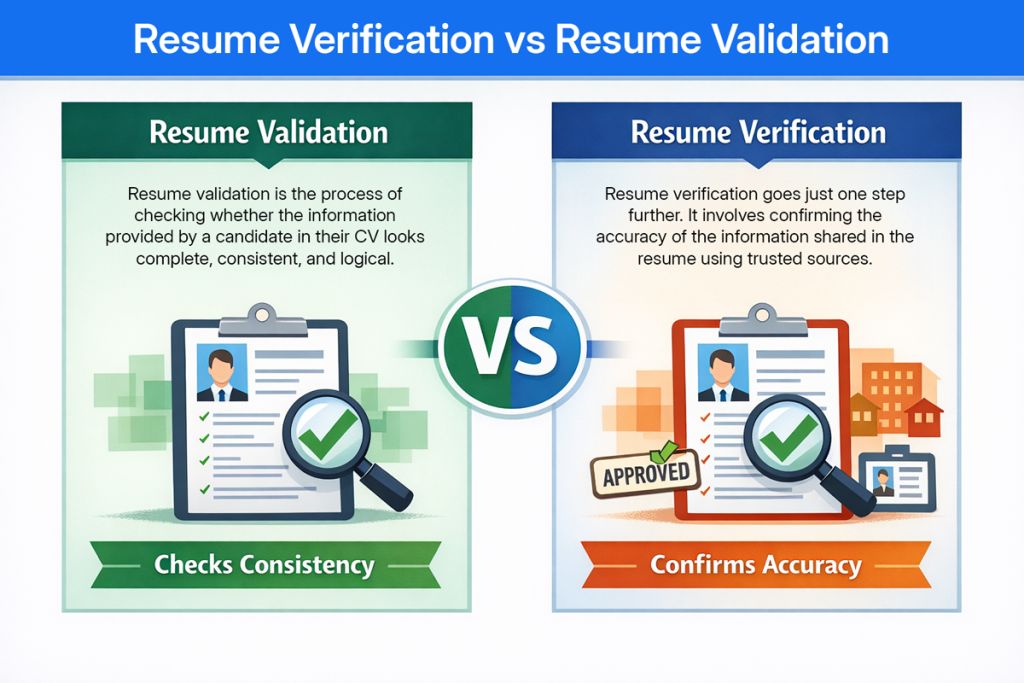
Resume validation is the process of checking the validity of information provided by a candidate in their CV. This includes details such as educational qualifications, employment history, references, skills, certifications, and any criminal records

Resume-Validation_vs_Resume-Verification

What Needs to Be Verified in a Resume?

a. Identity Verification

This confirms that the candidate is who they claim to be. It includes checking government-issued IDs and basic personal details.

b. Employment Verification

This involves confirming past job roles, employment dates, and responsibilities with previous employers.

c. Education Verification

This step involves verifying the academic qualifications of a candidate, such as degrees, certifications, and academic records.

d. Reference Checks

This involves speaking with past managers or colleagues to understand the candidate’s performance and behaviour at work.

Step-by-Step Resume Verification Process for HR Teams

A complete resume verification process is a series of checks that work together to reduce hiring risks. 

a. Data Collection & Candidate Consent

The resume verification process begins with collecting the candidate’s details and getting their consent. 

This step is extremely important because, in many cases, you cannot legally verify someone’s background without their approval.

HR teams usually collect:

Getting accurate information at this stage is critical. If the data is incomplete or incorrect, the entire verification process can slow down or fail.

b. Identity Verification

Once the data is collected, the first check performed by organisations is identity verification.

This step ensures that the candidate is who they claim to be.

Common methods include:

  • Checking government-issued IDs
  • Verifying passport details
  • Matching address records
  • Validating digital identity

This step is important because it helps prevent cases where candidates use fake or stolen identities during hiring.

c. Education Verification

In this step, HR teams confirm whether the candidate has actually completed the qualifications mentioned in their resume.

This usually involves:

  • Contacting universities or institutes
  • Verifying certificates or degrees
  • Confirming course completion dates

This step is important because education fraud is one of the most common discrepancies found during background checks.

d. Employment Verification

After education, the focus shifts to employment history.

HR teams verify whether the candidate’s work experience is accurate and genuine.

This includes checking:

  • Past job titles
  • Employment dates
  • Roles and responsibilities/ KRAs
  • Salary details (in some cases)
  • Reasons for leaving

However, this step can be challenging because some candidates may alter dates or exaggerate roles, and previous employers may not always respond quickly.

e. Criminal Record Checks

In many roles, especially in sensitive industries, a criminal background check is also conducted.

This helps employers identify any potential risks before hiring.

Typical checks include:

  • Criminal records
  • Court cases
  • Legal disputes
  • Regulatory violations

This step is particularly important in sectors like finance, healthcare, and government, where trust and compliance are critical.

f. Reference Checks

This involves speaking with previous managers or colleagues to understand the candidate better.

These conversations help verify:

  • Work performance
  • Professional behaviour
  • Reliability
  • Work ethic

Reference checks add a human perspective to the verification process, which documents alone cannot provide.

g. Final Verification Report

Once all checks are complete, the findings are compiled into a final report.

This report highlights:

  • Verified information
  • Any discrepancies found
  • Risk indicators

Based on this, HR teams can make a more informed hiring decision.

Resume Verification Checklist

Verification AreaWhat to Check
Candidate ConsentSigned consent form
Identity VerificationName, DOB, ID proof (Aadhaar, PAN, Passport
Address VerificationCurrent and permanent address
Employment VerificationCompany names, job titles, employment dates
Roles & ResponsibilitiesActual work done vs claimed
Salary DetailsLast drawn salary (if required)
Education VerificationDegrees, certifications, course completion
Criminal Record CheckAny legal, criminal, or court history
Reference ChecksFeedback from previous managers, Reliability
Gap AnalysisUnexplained employment gaps
Final ReviewAll checks completed and verified

Common Resume Red Flags HR Teams Must Watch For

A resume might look perfect at first glance. However, not every polished resume tells the full story. This is why resume screening needs careful attention. If you miss early warning signs, you may end up spending time and resources on the wrong candidate.

Instead of relying solely on keywords or quick scans, HR teams should look more deeply. Small inconsistencies or vague details can often point to bigger issues.

Following are the most common red flags HRs must watch for and what they actually mean:

a. Fake Experience

One of the biggest risks in hiring is fake or exaggerated work experience. Some candidates may list companies they never worked for or extend their employment duration.

Because of this, always verify:

  • Company name and existence
  • Employment dates
  • Nature of work

If details seem unclear or too perfect, it’s worth investigating further.

b. Inflated Job Titles

Sometimes, candidates present themselves with senior titles that don’t match their actual responsibilities.

For example, someone may claim a leadership role in a very small company where the title does not reflect real experience.

To handle this:

  • Compare the title with the company size
  • Check responsibilities instead of just designation

This helps you understand the true scope of their role.

c. Fake Certifications or Qualifications

Education fraud is another common issue. Candidates may list degrees or certifications that are incomplete or not genuine.

You should always:

  • Verify certificates with institutions
  • Check completion dates
  • Confirm course legitimacy

This step is important because missing or false qualifications can directly impact job performance.

d. Proxy References

Reference checks are meant to give honest feedback. However, in some cases, candidates may provide contacts who are not actual managers or colleagues.

To avoid this:

  • Ask role-specific questions
  • Cross-check reference details with company records

If responses feel scripted or vague, it may indicate a proxy reference.

Industry-Wise Fraud Patterns

Resume fraud often varies by industry because hiring needs and pressures are different.

  • In the IT sector, where demand is high and hiring is fast, candidates may inflate work experience, list skills they do not fully possess, or even rely on proxy interviews.
  • The BFSI (Banking, Financial Services, and Insurance) sector faces more serious risks because roles involve sensitive data and strict compliance, so issues like fake qualifications, undisclosed criminal records, or misrepresented job roles can have major consequences.
  • In the startup ecosystem, fast hiring and flexible roles often lead to inflated job titles, unclear company backgrounds, or overstated achievements without measurable results.

Because of these differences, HR teams should adapt their verification approach based on the industry. 

Top Challenges in Resume Verification

Resume verification can become complex because real-world hiring situations are rarely straightforward. Here are some of the most common challenges HR teams face and how to handle them effectively:

a. Fake or Unregistered Companies

Candidates may list companies that do not exist or are difficult to trace. 

How to solve:

  • Cross-check company registration and online presence
  • Verify through multiple sources (LinkedIn, official websites, databases)
  • Ask for supporting documents like offer letters or payslips

b. Closed Organisations

Previous employers may have shut down, making direct verification difficult.

How to solve:

  • Request alternative proof (salary slips, bank statements, experience letters)
  • Contact former managers or colleagues
  • Use third-party verification databases where available

c. Unresponsive Employers

Past employers may delay or ignore verification requests.

How to solve:

  • Follow up through multiple channels (email, phone)
  • Set internal timelines for responses
  • Use professional verification agencies to speed up the process

d. Remote Hiring Complexities

Remote hiring relies heavily on digital documents, which can be manipulated.

How to solve:

  • Use digital verification tools and APIs
  • Validate document authenticity carefully
  • Conduct video-based identity checks when needed

e. International Employment Verification

Different countries have different verification processes and compliance rules.

How to solve:

  • Work with global verification partners
  • Understand country-specific requirements
  • Allow extra time for cross-border checks

What Happens If a Candidate Fails Resume Verification?

When you review a resume or CV, everything may look perfect at first. The format may be clean, maybe even built using a resume maker or a ready-made resume template, and it might follow an ATS-friendly resume format.

However, once you move from resume screening to actual verification, gaps or mismatches can appear. Because of this, it’s important to handle such cases carefully instead of making quick decisions.

a. Discrepancy Handling: Understand the Issue Clearly

The first step is to identify what exactly went wrong.

Not all discrepancies are serious

For example, a small mismatch in dates in a simple resume format is very different from a fake company or a fake certificate.

Common issues you may find during resume screening

  • Incorrect employment dates
  • Missing details in a resume for freshers
  • Overuse of generic resume words without proof
  • Claims that do not match during employment verification or education verification

Always verify before deciding

Cross-check details through identity verification, company records, or documents

Give the candidate a chance to explain

Sometimes errors happen because of formatting issues (for example, while using a resume format word file) or a misunderstanding. A quick conversation can help clarify intent.

b. HR Actions: Take the Right Decision Based on Severity

Once the issue is clear, the next step is to decide what action to take.

For Minor Discrepancies

  • Small errors in formatting or structure (common in resumes created using free online resume creation tools)
  • Minor date mismatches or missing details
Action:
  • Document the issue
  • Accept explanation, if valid
  • Move forward carefully

For Moderate Discrepancies

  • Incomplete information
  • Gaps that were not explained clearly
  • Mismatch between resume and actual experience
Action:
  • Ask for additional proof
  • Conduct a deeper reference check
  • Re-evaluate before shortlisting

For Major Discrepancies

  • Fake experience or companies
  • False claims in ATS resume profiles
  • Fake degrees or certifications
Action:
  • Reject the candidate
  • Record the reason internally
  • Follow company policy for future hiring

If Issues Are Found After Hiring

Sometimes discrepancies are discovered after onboarding.

In such cases:

  • Conduct an internal review
  • Compare findings with the original resume format submitted
  • Take action based on company policy (warning or termination)

c. Legal Considerations: Stay Safe and Fair

Handling verification failures also involves legal responsibility.

  • Take proper consent: Always get approval before starting verification.
  • Keep records: Maintain documentation of resume screening results, verification findings, and candidate communication.
  • Avoid assumptions: Decisions should be based on verified facts, not guesswork.
  • Protect candidate data: Handle personal details securely during identity verification and other checks.

How Long Does Resume Verification Take in India?

After resume screening, one of the most common questions HR teams ask is: how long does it actually take to verify a resume or CV?

The answer depends on how the process is handled. While a well-structured resume helps speed things up, the real time depends on how quickly each verification step is completed.

Typical Timelines: Manual Vs Automated Verification

The turnaround time (TAT) can vary based on whether you follow a manual process or use automated tools. 

  • Manual verification usually takes around 5 to 10 working days and includes steps such as employment verification, education verification, identity verification, and reference checks. 
  • Automated verification can take around 24 hours to 5 days and uses digital tools and databases to validate resume details faster. 

Factors Affecting Delays

Even with a good process, delays can happen. Here are the most common reasons: 

  • Unresponsive Employers: Previous companies may take time to reply during employment verification. 
  • Data Mismatch: Differences between the resume and actual records can slow down verification. 
  • Incomplete Information: Missing details in resumes can lead to back-and-forth communication. 
  • Fake or Suspicious Documents: Cases involving a fake certificate or unclear records require deeper checks. 
  • International Employment History: Verifying global experience takes longer due to different processes and time zones. 

How to Reduce Turnaround Time (TAT)

To speed up resume verification, HR teams can take a few simple steps:

  • Collect complete information upfront: Ensure the resume includes accurate and detailed data
  • Standardise resume screening: Use structured formats and avoid vague resume words that lack clarity
  • Use automated tools: Platforms for resume validation online help verify details faster
  • Set clear timelines for responses: Follow up with employers and references regularly

How AuthBridge Helps You Detect Resume Fraud Before Hiring

Today, almost every candidate submits a polished resume or CV. Many use a resume maker, a ready-made resume template, or even tools to create a resume online for free. While this improves presentation, it also makes it easier to hide errors or exaggerate details.

That’s why companies need more than just basic resume screening; they need a structured system to validate resume information before hiring. This is where AuthBridge helps.

a. End-to-End Verification Process

AuthBridge follows a clear, step-by-step approach to verify every important detail, no matter what the candidate uses.

Data Collection

  • Collects candidate details and documents securely
  • Works across all profiles, including resume for freshers and experienced hires
  • Ensures complete and accurate data before starting verification

Verification

AuthBridge verifies every key part of the resume:

  • Identity Verification: Confirms that the candidate is genuine
  • Employment Verification: Checks job roles, companies, and timelines
  • Education Verification: Validates degrees and certifications, helping detect any fake certificate cases
  • Reference Check: Connects with past employers to understand real performance

This ensures that the actual data is verified, even if a resume uses strong resume words or looks perfect in an ATS resume. 

Reporting

  • Provides a clear and detailed verification report
  • Highlights discrepancies and risk indicators
  • Helps HR teams make faster and more confident decisions

b. Use Cases Across Industries

AuthBridge supports different hiring needs across industries:

  • IT Hiring: Verifies technical experience and detects skill exaggeration
  • Gig Workforce: Enables quick checks for high-volume and fast hiring
  • Enterprise Hiring: Handles large-scale verification with consistency and compliance

This flexibility is important because fraud patterns differ across industries.

c. Key Metrics That Matter

AuthBridge focuses on outcomes that directly impact hiring quality:

  • Accuracy: High verification accuracy ensures reliable hiring decisions
  • Turnaround Time (TAT): Faster verification helps reduce delays in hiring
  • Fraud Detection Rate: Identifies discrepancies early, before onboarding

AuthBridge helps you move beyond just reading resumes and start trusting your hiring decisions.

Case Study: How a Leading IT Company Avoided a High-Risk Hire

Hiring for senior roles often starts with a strong resume or CV. The profile may look impressive, well-structured using a resume template or even an ATS-friendly resume, and filled with strong resume words. However, this case shows why resume screening alone is not enough.

The Problem

A leading IT solutions company was hiring for a senior role and came across a candidate with a highly impressive resume and CV.

The profile looked polished and followed an ATS-friendly resume format with strong words and global credentials.

However, during initial resume screening, there were small inconsistencies. Because of this, the company decided to validate resume details before moving forward.

How AuthBridge Helped

AuthBridge conducted a detailed verification process, including identity verification, employment verification, education verification, and a reference check. During this process, multiple red flags were identified.

The candidate had different profiles under different names, overlaps in employment timelines, and, most importantly, a fake certificate, falsely claiming a degree from IIM-A.

Key Results

Because of this verification, the company avoided hiring a high-risk candidate.

By using structured resume validation online, the company was able to make a safe and informed decision.

It highlights why resume verification is essential, and how AuthBridge helps organisations hire with confidence.

Conclusion

Hiring today is not just about finding the best-looking resume or CV. Many candidates now use tools which make their profiles look polished and structured. However, a clean resume does not always mean the information is accurate. 

This is where resume verification becomes essential. By conducting proper identity verification, employment verification, education verification, and a thorough reference check, organisations can go beyond surface-level information and confirm what is actually true. This process not only helps detect issues like fake experience or a fake certificate, but also builds a stronger and more reliable workforce. It also ensures that hiring decisions are fair, consistent, and based on verified data.

In the end, the goal is simple: hire the right people with confidence. When you take a structured approach, you reduce risks, save time, and improve hiring outcomes. As hiring continues to evolve, companies that invest in verification will always stay one step ahead.

Ready to make safer hiring decisions? Talk to our experts and see how AuthBridge can help you verify resumes faster and more accurately.

Frequently Asked Questions (FAQs)

Yes, most companies in India verify resumes, especially for mid-level and senior roles.

Employers typically verify employment history, education qualifications, identity details, and references. 

Verification is usually done before final hiring or after offer rollout, depending on the company policy.

The cost depends on the type of checks, volume of hiring, and turnaround time. 

However, it is always lower than the cost of a bad hire, making it a high-ROI investment.

Outsourcing resume verification is most effective when your organisation faces high-volume hiring, limited HR capacity, strict compliance requirements, or needs faster turnaround times. 

To ensure candidate information is accurate.

Yes, with candidate consent.

PAN card verification_blog image

PAN Card Verification: Common Errors, Fixes & API Solutions (2026 Guide)

Introduction

PAN card verification is a critical part of customer onboarding and KYC in India. According to the Reserve Bank of India, verifying identity documents like PAN is mandatory for many financial processes. This makes PAN verification both an operational and compliance necessity for businesses. 

However, many organisations face recurring issues such as invalid PAN status, data mismatches, and delays in verification. These issues slow down onboarding and increase manual effort, especially when handling large volumes.

Today, businesses need fast, accurate, and scalable PAN verification methods. This is why automated and API-based verification systems are becoming the preferred approach. 

In this guide, we will cover how to verify PAN card online, common PAN verification errors and fixes, NSDL and UTI verification methods, and how businesses can scale verification using APIs. 

What is PAN Card Verification?

PAN card verification is the process of validating a PAN number against official records maintained by the Income Tax Department.

It helps confirm whether the PAN is valid, active, and if the details match official records. 

Types of PAN Cards and How to Verify Them Online

NSDL-Issued (Protean) PAN Card

An NSDL-issued PAN card is a PAN that is processed and managed by Protean eGov Technologies Limited, which was earlier known as NSDL e-Governance.

This organisation is one of the two agencies authorised by the Income Tax Department to handle PAN-related services in India.

NSDL’s role is not to issue PAN numbers independently. Instead, it manages the process on behalf of the government.

UTI-Issued PAN Card

A UTI-issued PAN card is a PAN that is applied for through UTI Infrastructure Technology and Services Limited. This organisation is a government-owned company that supports public sector services, including PAN card processing.

It works under the authorisation of the Income Tax Department, which is the actual issuing authority for all PAN cards in India.

UTIITSL manages the application process for PAN cards. However, it does not issue PAN numbers independently.

How to Verify PAN Cards Issued by NSDL and UTI

Businesses and individuals can do online PAN verification through the official portals provided by authorised agencies. The process is simple and helps confirm whether a PAN is valid and correctly recorded.

Steps to do NSDL PAN Verification (Protean)

For PAN cards processed through Protean eGov Technologies Limited, the process is also straightforward:

  • Visit the NSDL (Protean) portal and choose the PAN application type
  • Enter the application number or coupon number
  • Click on submit
  • Check the verification status displayed on the screen

Steps to do UTI PAN Card Verification

If a PAN card was applied through UTI Infrastructure Technology and Services Limited, you can verify it online by following these steps:

  • Visit the UTIITSL website and select the relevant PAN service
  • Enter your PAN number (for reprint) or coupon number (for new application)
  • Fill in the captcha code shown on the screen
  • Submit the details to view the verification status

Once submitted, the system displays the current status of the PAN.

Why is PAN Card Verification Important for Businesses Today

PAN verification plays an important role in how businesses manage compliance, reduce risk, and maintain accurate records. It is not just a routine check. It plays a direct role in how businesses stay compliant, prevent fraud, and run operations smoothly, especially in sectors that deal with financial data and customer onboarding.

a. Ensures Compliance with Regulations

Businesses must follow rules set by the Income Tax Department. PAN is required for key activities such as:

  • Filing taxes
  • Opening bank accounts
  • Processing high-value transactions

Because of this, verifying PAN details helps businesses avoid errors and penalties. It also ensures that all financial records match official data.

b. Helps Prevent Fraud

PAN verification reduces the risk of fake or incorrect identities. Verification helps businesses:

  • Detect fake identities
  • Avoid financial fraud
  • Reduce risks during onboarding

As a result, companies can make safer decisions while dealing with customers or vendors.

c. Improves Data Accuracy

Accurate data is important because businesses rely on it for reporting and audits. If PAN details are incorrect, it can lead to issues in:

  • Tax filings
  • Financial reports
  • Compliance checks

By verifying PAN early, businesses can keep their records clean and consistent.

How PAN Verification Fits Into KYC and Background Verification

PAN verification plays a central role in both KYC and background verification processes. It helps businesses confirm identity at the very first step, which is important because all further checks depend on accurate basic details.

PAN as a Primary Identity Check in KYC

In KYC, businesses need to confirm that a person is real and their details are correct. PAN helps with this because it is a unique identifier linked to an individual’s financial records.

For example, when a customer signs up for a financial service:

  • PAN helps verify their name and identity
  • It supports checks required under KYC guidelines
  • It reduces the chances of duplicate or fake accounts

Because of this, PAN verification often acts as the starting point in the KYC process.

Role in Background Verification (BGV)

  • PAN is one of the most trusted ID documents in India. It helps businesses confirm basic details such as name and date of birth. Because of this, companies can match user details with official records, reduce the risk of identity fraud, and ensure the person is genuine. This step becomes important because all further checks depend on the correct identity data.
  • PAN does more than just verify identity. It also helps businesses connect different records linked to the same individual. For example, companies can use PAN to cross-check UAN and employment records, validate payroll or banking details, and ensure consistency across systems. This makes the overall verification process more accurate and reliable.

Common PAN Verification Errors

Why Does PAN Show Invalid Even When It Is Correct?

Many businesses face a common issue where a PAN shows as invalid, even when the number seems correct. This usually happens because of data mismatches or compliance-related problems.

a. Mismatch in Personal Details

One of the most common reasons is incorrect or inconsistent data. Even a small difference can cause verification to fail.

For example:

  • Name spelling does not match official records
  • Date of birth is entered incorrectly
  • Other details differ from government data

Because of this, the system cannot confirm the PAN, even if the number itself is valid.

b. PAN Not Linked with Aadhaar

The government requires PAN to be linked with Aadhaar for it to remain active. If this step is not completed, verification may fail.

As a result:

  • The PAN may not pass validation checks
  • Businesses may see it as invalid during KYC

c. PAN Marked as Inactive or Inoperative

In some cases, the Income Tax Department may mark a PAN as inactive due to non-compliance.

This can happen if:

  • Aadhaar linking is not completed
  • Required updates are not made

Because of this, the PAN exists but cannot be used for verification or transactions.

Can a PAN Card Be Fake Even If It Looks Valid?

Yes, a PAN card can appear valid but still be fake.

This happens because visual checks alone are not enough to confirm authenticity. Many counterfeit cards are designed to look almost identical to real ones.

a. Looks Can Be Misleading

Fake PAN cards may include features that look genuine at first glance. For example:

  • A hologram or laminated finish
  • Proper formatting of the PAN number
  • Clean and professional printing

However, these elements can be copied. Because of this, a card that looks real may not exist in official records.

b. Check Security Features Carefully

A genuine PAN card usually includes certain security elements. These help in basic verification:

  • A holographic image
  • Clear and sharp printing
  • A watermark visible under light

Even then, these checks are not fully reliable because advanced fakes can replicate them.

c. Verification with Official Records Is Key

The most reliable way to confirm a PAN is to verify it with the Income Tax Department.

This helps because:

  • It confirms whether the PAN exists
  • It matches details with official data
  • It removes guesswork from visual checks

Manual vs API-Based PAN Verification

Difference Between Manual Verification and API-Based Verification

Manual PAN verification involves reviewing documents without any automated systems. Teams collect PAN details, review them visually, and enter data into systems. This method can work for small volumes. However, it often takes more time and may lead to errors. Even small mistakes in name or date of birth can cause verification failures. As onboarding increases, managing this process becomes difficult and slows down operations.

API-based PAN verification, on the other hand, uses secure automated systems to validate details instantly from authorised databases. Because the process is real-time, businesses can verify PAN details within seconds. This improves accuracy, reduces manual effort, and helps detect fraud more effectively. In addition, automated systems create proper records, which makes compliance and audits easier. As a result, most growing businesses prefer API-based verification because it is faster, more reliable, and easier to scale.

Why Businesses Prefer PAN Verification APIs

Faster Onboarding

Manual PAN verification takes time because teams need to check each record one by one. This can take hours or even days, especially when the volume is high.

In contrast, API-based verification delivers results in seconds because it connects directly with authorised databases.

Faster verification helps businesses complete onboarding quickly and improves the overall customer experience.

Better Fraud Detection

Accuracy also differs between the two methods.

Manual checks depend on human review and judgment, so even small errors in spelling or data entry can lead to mismatches.

However, API-based systems validate structured data directly, which reduces errors and improves consistency.

Scalability

Scalability is another key factor.

Manual processes become difficult to manage as the number of verifications increases because they require more time and resources.

API-based verification, on the other hand, can handle large volumes without adding extra workload, making it a better choice for growing businesses.

Which Method Is Better for Businesses?

The right method depends on the size and needs of the business.

Manual PAN verification can still work for small teams with limited onboarding. It may also be useful in low-risk situations where the volume of checks is low. However, as operations grow, manual processes become slower and harder to manage.

Most businesses today prefer API-based verification because it offers faster and more reliable results. It enables instant validation, improves accuracy, and helps detect fraud more effectively. In addition, it supports compliance by maintaining proper records and scales easily as verification volumes increase.

Because of these advantages, API-based verification has become the preferred choice for industries like fintech, NBFCs, and HR platforms that handle large and continuous onboarding.

How Businesses Can Verify PAN Cards at Scale

Is There a Faster Way to Verify PAN numbers in bulk?

Yes, businesses can do PAN number verification in bulk using automated systems. This process allows companies to check hundreds or even thousands of PANs at once by validating them directly against the Income Tax Department database.

Instead of verifying each PAN one by one, businesses can upload a list and get results instantly. This helps confirm whether each PAN is valid, active, and correctly linked to the individual.

Bulk PAN Verification Use Cases

  • Banks and lending companies use bulk PAN verification to check customer details during loan applications and account opening
  • E-commerce platforms need to verify sellers and users before allowing transactions. Bulk verification helps confirm seller identities, prevent fraudulent activities, and maintain platform trust. 
  • HRs and staffing companies use PAN verification during hiring to confirm employee details. This is useful because identity checks become faster, background verification becomes more reliable, and manual effort is reduced for HR teams
  • Telecom companies must verify users before activating services like SIM cards. Bulk PAN verification helps speed up customer onboarding, ensure compliance with KYC rules, and reduce the chances of fake registrations. 

Benefits of Real-Time PAN Verification APIs

a. Faster Customer Onboarding

Speed matters because customers expect quick and smooth sign-ups. Real-time PAN verification reduces onboarding time from minutes or hours to just a few seconds.

This helps because:

  • Users do not face delays
  • Drop-offs during onboarding reduce
  • Overall customer experience improves

b. Better Fraud Prevention

Fraud is a major concern, especially in sectors like fintech and e-commerce. Real-time verification checks PAN details instantly against official records.

As a result, businesses can:

  • Detect fake or incorrect identities early
  • Prevent fraudulent users from entering the system
  • Protect revenue and brand trust

c. Improves Compliance and Reduces Risk

Many financial processes require accurate PAN verification. Automated systems ensure that every check is done correctly.

This helps businesses:

  • Stay compliant with regulations
  • Avoid penalties and legal issues
  • Maintain proper audit records

d. Saves Time and Operational Costs

Manual verification takes time and requires resources. However, APIs automate the entire process.

Because of this:

  • Manual effort reduces
  • Employees can focus on important tasks
  • Operational costs go down

How PAN API-Based Verification Works

Step 1: Integration with Your System

The process starts when the API is integrated into your platform. This can be a website, mobile app, or internal system used for onboarding.

Because of this, verification becomes part of the user journey and does not require separate steps.

Step 2: PAN Details Are Entered

During registration or verification, the user enters their PAN number. This step usually happens as part of the onboarding process.

Step 3: Secure API Request Is Sent

Once the PAN is entered, the system sends a secure request to the verification API. This request connects with authorised databases for validation. This ensures that the data is checked against official records.

Step 4: Real-Time Verification

The API then cross-checks the PAN number with the database managed by authorised agencies such as Protean eGov Technologies Limited.

Because the process is automated, the verification happens in real time.

Step 5: Response Is Returned Instantly

The system receives a response within seconds. This response usually includes:

  • PAN validity status
  • Basic details linked to the PAN

Step 6: Next Action Based on Result

Based on the response, the system decides the next step. For example:

  • Proceed with onboarding if details match
  • Ask for correction if there is a mismatch
  • Trigger additional checks if needed

This step-by-step process makes PAN verification faster, more accurate, and easier to manage at scale.

Key Features Businesses Should Look For in PAN Verification API

a. Real-Time PAN Status Validation

A good API should verify PAN details instantly. This means checking whether the PAN is valid and active in real time.

Because of this:

  • Businesses avoid using outdated or incorrect data
  • Onboarding becomes faster and more reliable

b. Name Matching and Identity Verification

The API should return the official name linked to the PAN. This helps match user input with actual records.

For example:

  • Detect spelling errors early
  • Identify mismatches before onboarding

This improves accuracy and reduces risk during verification.

c. Supports Different Types of PAN

PAN is not just for individuals. It is also used by businesses, LLPs, and trusts. 

A strong API should handle all these cases in one system. This makes onboarding simpler and more scalable.

Conclusion

Manual PAN verification can still work for businesses with low onboarding volumes and simple processes. It may be suitable in low-risk scenarios where real-time checks are not required. However, as the number of verifications increases, manual methods become slower, less accurate, and harder to manage. Small errors in data entry or delays in processing can impact both compliance and customer experience.

As businesses grow, automated PAN verification becomes a better choice because it offers speed, accuracy, and scalability. API-based solutions enable real-time verification, improve fraud detection, and maintain proper audit records.

As businesses grow, automated verification systems become essential for building a reliable and future-ready onboarding process.

Frequently Asked Questions (FAQs)

Yes, a PAN card is extremely essential for completing KYC for most financial services in India. 

You can verify PAN online through NSDL (Protean) or UTIITSL portals by entering your PAN number.

Basic verification on official portals is free, but API-based services may have costs.

Validation checks format correctness, while verification confirms PAN against official records.

Best Background Verification Companies in Bangalore (2026)

Best Background Verification Companies in Bangalore (2026)

Introduction

Hiring in Bangalore is fast and competitive because companies are always looking for the right talent. The city has a mix of startups, large enterprises, and global firms, so hiring never really slows down. However, speed can often create risks. Many organisations still face issues such as fake resumes, incorrect job details, or missing information. At the same time, compliance rules are getting stricter across industries.

Because hiring mistakes can lead to financial loss and reputational damage, companies can no longer rely only on what candidates share. That’s when background verification helps confirm key details like identity, past work, and education before onboarding.

This is why employee background verification has become a standard part of the hiring process. In this blog, we will look at the best background verification companies in Bangalore to help you choose the right partner.

Top 5 Background Verification Companies in Bangalore

a. AuthBridge Research Services Private Limited

AuthBridge Research Services Private Limited

AuthBridge is one of India’s leading background verification and authentication service providers. With their local operations and on-ground presence, they have established a strong trust across industries.

What sets AuthBridge apart is its strong focus on artificial intelligence (AI). The platform uses AI across all its workflows to automate data collection, flag discrepancies, and speed up decision-making. Instead of relying heavily on manual checks, their system is designed to handle verification in a smarter and more efficient way. 

Services and Checks Covered: It verifies identity, address, employment history, education, criminal records, credit details, and much more. This makes it suitable for different workforce types, including corporate employees, gig workers, and frontline staff.

Best for: Enterprises and fast-growing companies that need fast, scalable, and tech-driven verification. 

Why Companies Choose AuthBridge:

  • AI-driven processes for faster and more accurate checks
  • Strong presence for quick on-ground verification
  • Covers multiple verifications in one place
  • High focus on data security and compliance

Website: www.authbridge.com 

b. Millow

Millow has built a strong presence in Bangalore by focusing on accurate and reliable background verification. The company combines skilled professionals with modern technology to help businesses reduce hiring risks and make better decisions. 

What sets Millow apart is its focus on detail and accuracy. The platform also uses automation to speed up processes, which helps reduce delays in hiring. Because of this, companies can complete verification faster without losing quality.

Services and Check Covered: Millow offers a wide range of verification services. These include employment checks, education verification, criminal record checks, address verification, identity checks, and reference checks. 

Best for: It is a good fit for companies that want detailed background checks and need support across multiple verification types, including vendor and compliance screening.

Why Companies Choose Millow:

  • Strong focus on accuracy and detailed verification
  • Wide range of services covering both employees and vendors
  • Use of automation to improve speed and efficiency
  • Helps meet compliance and regulatory requirements

Website: www.millow.io 

c. Cfirst Background Checks India

Cfirst Background Checks India Private Limited is a trusted background verification provider known for combining technology with a strong focus on compliance, supporting organisations that want a reliable and structured screening process in Bangalore. 

What sets cFirst apart is its technology-first approach. They use AI-powered screening and analytics to improve speed and accuracy. Because of this, companies can onboard candidates faster while maintaining quality.

Services and Checks covered: Cfirst offers a broad set of verification services. These include identity checks, employment history verification, reference checks, address verification, and drug testing.

Best for: It is a strong fit for organisations that need both domestic and global verification, especially those with distributed teams or international hiring needs.

Why Companies Choose cFirst:

  • AI-powered screening for faster turnaround time
  • Global coverage across multiple countries
  • Strong focus on compliance and data security (ISO certified)
  • API-based integration for smooth onboarding workflows

Website: cFIRST Background Checks

d. Verifyin by Gigin

Verifyin by Gigin offers a modern approach to background verification with a strong focus on speed and automation. 

What sets Verifyin apart is that they use an AI-powered engine to automate large parts of the verification process. Because of this, checks are completed faster and with less manual effort. 

Services and Checks Covered: Verifyin provides a wide range of verification services. These include employment history checks, criminal and court record screening, education verification, and address and identity validation using documents like Aadhaar and PAN. Each check is designed to give clear and usable insights to hiring teams.

Best for: It is a good fit for startups and companies with high hiring volumes that need fast, digital-first verification without complex processes.

Why Companies Choose Verifyin:

  • AI-powered automation for faster verification
  • Strong support for high-volume hiring
  • Covers key checks like employment, education, and criminal records
  • Simple and scalable platform for growing teams

Website: Gigin.ai

e. Pietos

Pietos

Pietos is known for delivering quick and accurate background checks with a simple, tech-enabled process. 

What sets Pietos apart is its focus on speed and ease of use. Its platform offers automated onboarding links, which make it simple for candidates to complete verification steps. 

Services and Checks Covered: Pietos offers key background checks such as employment verification, education checks, identity validation, address verification, and criminal record screening. 

Best for: It works well for startups and mid-sized companies that need quick turnaround times and a straightforward verification process.

Why Companies Choose Pietos:

  • Dedicated Bangalore support for smoother operations
  • Easy candidate onboarding through automated links
  • Covers all major verification checks in one place

Website: Pietos

Why is Background Verification Important in Bangalore

Hiring in Bangalore is fast because the city is a major hub for IT companies, startups, and global capability centres. Companies often hire in large numbers to meet business demand. However, this speed can create gaps if checks are skipped or rushed.

a. Fast Hiring Leaves Less Room for Checks

Many companies move quickly from interview to offer. Because of this, verification sometimes happens late or is limited to basic checks. This means that when hiring speeds increase, the chances of missing critical details also rise.

b. Resume Fraud and Mismatched Information Are Common

Incorrect or misleading information in resumes remains a major issue. Around 15–20% of candidates show some form of discrepancy in their details. These issues include wrong job titles, fake experience, or incomplete disclosures. Because of this, companies cannot rely only on interviews or documents shared by candidates.

c. Vendor and Third-Party Risk Is Increasing

Hiring risk is not limited to employees. Many companies in Bangalore work with vendors, delivery partners, and contract staff. Without proper verification, businesses may onboard partners with hidden risks. This can impact operations, compliance, and brand reputation.

d. Compliance Requirements Are Getting Stricter

Hiring today also involves handling personal data. Therefore, background checks must follow data protection laws, candidate consent requirements, and industry-specific regulations. 

Failure to follow these can lead to penalties and legal issues. Because of this, companies now treat verification as part of compliance, not just hiring.

How to Choose the Right Background Verification Company

Choosing the right background verification partner is important because it directly affects how safely and efficiently you hire. Different companies offer different strengths, so it helps to look at a few key factors before making a decision.

a. Coverage of Checks

Begin by understanding the services and checks every company offers. Most organisations need identity, employment, education, and criminal record verification.

Because different roles require different checks, you should always choose a provider that matches your hiring needs. 

b. Accuracy and Data Sources

Verification is useful only if the data is correct and the results are reliable. Some providers rely on limited or outdated databases, which can lead to errors.

c. Turnaround Time (TAT)

Hiring timelines are often tight, so speed matters. However, fast results should not reduce quality.

Companies should evaluate whether a provider can meet deadlines consistently without compromising accuracy. Because delays in verification can slow down onboarding, choosing a provider with reliable timelines helps maintain hiring momentum.

d. Technology and Integration

Modern hiring processes rely on automation. Many background verification platforms now offer digital workflows, real-time tracking, and API integrations.

Thus, it is recommended to choose providers with technology features like mobile-friendly workflows and real-time tracking, as they simplify the process and reduce manual effort.

Why Businesses Choose AuthBridge

After evaluating different providers, many companies prefer platforms like AuthBridge because they combine technology, scale, and on-ground execution in one system.

a. AI Improves Speed and Accuracy

AuthBridge uses AI across its workflows to automate data collection, detect discrepancies, and reduce manual effort. This helps businesses complete verification faster while maintaining accuracy, especially during high-volume hiring.

b. End-to-End Coverage in One Platform

Instead of managing multiple vendors, companies can handle identity checks, employment verification, address checks, and more in one place. This simplifies operations and keeps the hiring process organised.

c. Strong On-Ground Capabilities

For physical verification, local presence matters. AuthBridge has strong on-ground capabilities, especially in cities like Bangalore. This helps complete address checks and field verification faster.

d. Focus on Compliance and Data Security

AuthBridge follows strong data protection and compliance standards. Because background verification involves sensitive personal data, businesses need to handle it carefully and stay aligned with regulatory requirements.

Conclusion

Hiring in Bangalore is fast and competitive, but it also comes with real risks. Because companies are hiring at scale, even small gaps in verification can lead to bigger problems later. This is why background verification is no longer just an option, it has become a basic step in the hiring process.

Choosing the right background verification partner helps you move faster without compromising on accuracy. It ensures that the people you hire are verified, reliable, and aligned with your organisation’s standards. For example, a strong verification process can help you avoid delays, reduce fraud, and stay compliant at the same time.

While there are several background verification companies in Bangalore, the right choice depends on your hiring needs, scale, and industry. However, platforms like AuthBridge stand out because they bring together technology, AI-driven workflows, and on-ground capabilities in one place.

In the end, the goal is simple: hire with confidence, reduce risk, and build a workforce you can trust.

New Income Tax Rules 2026_blog image

New Income Tax Rules 2026: Key Changes Explained

Introduction

The Central Board of Direct Taxes has introduced a new income tax law from April 01, 2026. The goal is simple: reduce confusion and make tax compliance smoother for everyone.  

The previous law came into force in 1961. Over time, many changes were added, which made the system complex. Because of this, the law ended up with too many sections, rules, and exceptions, leaving taxpayers confused about what applied to them. 

To ease out the processes, the government has now simplified the structure so that people can read and understand the rules more easily. The updated Income Tax Act aims to make income tax return filing more straightforward for individuals and businesses alike.

Key Income Tax Rules Announced for 2026

Let’s look at the most important updates and what they mean for you. 

a. New Income Tax Act 2025

The new income tax act now replaces the earlier law that had been in place since 1961. 

The new law focuses on making the system simpler and easier to follow. It uses clearer language, removes outdated provisions, and brings related rules together

One important thing to note is that for AY 26-27, returns files up to July 31, 2026, will still follow the old 1961 law. The new law will fully apply to income earned from FY 26-27 onwards, and it aims to make the tax structure more structured, clearer, and aligned with current needs.

Benefit / ExpenseEarlier Limit (Old Rules)New Limit (From 2026)
Children’s Education Allowance₹100 per month per child₹3,000 per month per child
Hostel Allowance₹300 per month per child₹9,000 per month per child
Free Meals Provided by Employer₹50 per meal₹200 per meal
Gifts (Non-cash)₹5,000 per year₹15,000 per year
Car Lease (Engine below 1.6L)₹1,800 + ₹900 (driver)₹5,000 + ₹3,000 (driver)
Car Lease (Engine above 1.6L)₹2,400 + ₹900 (driver)₹7,000 + ₹3,000 (driver)
Overseas Medical TreatmentTax-free if income below ₹2 lakhTax-free if income below ₹8 lakh

b. Introduction of a Single "Tax Year" System

The government has now introduced a new term called the “Tax Year” to make things simpler. This will replace the earlier terms “Financial Year” and “Assessment Year,” which often confused taxpayers.

As a result, ITR filing becomes easier to understand because everything now follows a single timeline. 

c. New ITR Filing Deadlines

The deadline to file ITR-3 and ITR-4 has been extended to August 31 from the end of the tax year. This also applies to FY 25-26, which is AY 26-27. 

However, the deadline for ITR-1 and ITR-2 remains the same, i.e., July 31. Similarly, if your case requires a tax audit, the deadline stays October 31.

Because of this, income tax return filing timelines become more flexible for certain taxpayers.

d. Revised TCS and TDS Rules: What's New

The government has updated the TDS and TCS rules to make the system simpler and easier to follow. These changes focus on reducing confusion and improving tracking. 

Transaction TypeEarlier RateNew Rate (From April 2026)
Sale of alcohol (for consumption)1%2%
Sale of tendu leaves5%2%
Sale of scrap1%2%
Sale of minerals (coal, lignite, iron ore)1%2%
Foreign remittance for education/medical (LRS)5%2%
Overseas tour packages (LRS)5% up to ₹10 lakh, 20% aboveFlat 2%

These changes make the structure easier to understand. However, this also means deductions will be more visible and harder to miss. As a result, taxpayers need to stay aware of these deductions while planning their finances.

e. Changes in HRA (House Rent Allowance)

As per the new income tax HRA rules 2026, more cities now qualify for a higher HRA exemption. Earlier, only a few metro cities were eligible for a 50% exemption. Now, this benefit also applies to Bengaluru, Pune, Hyderabad, and Ahmedabad. 

As a result, taxpayers in these eight cities, Delhi, Mumbai, Chennai, Kolkata, Bengaluru, Pune, Hyderabad, and Ahmedabad, can now claim up to 50% HRA exemption.

This change can increase tax savings for people living in these cities, because a larger portion of their rent allowance may become tax-free.

However, the rules also introduce stricter verification. Taxpayers must now clearly disclose their relationship with the landlord. This is done to prevent false claims.

f. More Time to Revise Your Tax Return

Earlier, individuals could revise their return within 9 months from the end of the tax year. Now, this limit has been extended to 12 months, until March 31 of the following year. 

However, if you revise your return after December 31, you will need to pay an additional fee.

g. Higher STT (Securities Transaction Tax)

The government has increased the Securities Transaction Tax (STT) on certain market transactions from April 2026.

Here are the updated STT rates: 

Transaction TypeEarlier RateNew Rate (From April 2026)
Sale of options (premium)0.10%0.15%
Sale of options (intrinsic price)0.13%0.15%
Sale of futures0.02%0.05%

h. Changes in Buyback Tax and Sovereign Gold Bonds

Tax on Share Buybacks

Earlier, any amount received from a share buyback was treated like dividend income. Because of this, it was taxed based on your income slab.

Now, this has changed. From April 2026, buyback proceeds will be taxed as capital gains instead of dividends.

This brings buybacks in line with other investment income. However, the tax impact may vary. For example, individual promoters may face an effective tax rate of around 30%, while companies may see a lower rate of about 22%.

Changes in Sovereign Gold Bonds (SGB) Tax Rules

The tax benefit on Sovereign Gold Bonds has also been updated.

Earlier, investors did not pay capital gains tax if they held these bonds until maturity. Now, this benefit depends on how the bonds were purchased.

If you bought the bonds during the initial government issue, the exemption still applies. However, if you purchased them from the secondary market, the gains will now be taxed as capital gains.

i. New Income Tax Forms Introduced from 2026

The Central Board of Direct Taxes (CBDT) has introduced revised forms under the new Income Tax Rules, 2026.

Here are some of the key changes in form names:

Old Form NameNew Form Name
Form 16Form 130
Form 16AForm 131
Form 12BBForm 124
Form 26ASForm 168

These new forms will apply from Financial Year 2026–27 onwards.

What These Changes Mean for Individuals

For Salaried Individuals

For salaried individuals, these changes make tax filing simpler and more transparent. The new law uses clearer language and better-structured forms, so it becomes easier to understand salary components and deductions.

However, salaried employees may also notice closer tracking of income and deductions. Because of updated TDS rules and stricter reporting, take-home salary may change slightly in some cases. This means you need to review your salary structure and tax planning more carefully.

For Investors

Investors and traders may see a more direct impact. The increase in STT rates means higher costs for those trading in futures and options. Because of this, frequent traders may notice a reduction in overall returns.

However, there is a positive change as well. Buyback of shares will now be taxed as capital gains instead of dividends. This can be more favourable in some cases, depending on your tax bracket.

For Freelancers and Self-Employed Individuals

Freelancers and self-employed individuals already manage their own taxes, so the biggest benefit comes from simpler rules. The new system makes it easier to calculate income and file returns, especially when income is steady.

However, tax planning still requires attention. Choosing the right tax regime becomes important because deductions and expenses can affect the final tax amount. As a result, careful planning continues to play a key role.

For Businesses

For businesses, the focus shifts towards stronger compliance and better documentation. The new law introduces clearer reporting requirements, which makes processes more structured.

Because of this, companies need to ensure accurate employee data, salary details, and tax deductions. This also increases the need for proper verification and record-keeping across the organisation.

What You Should Do Now

These changes make the system simpler, but they also require you to stay updated and organised.

  • Start by keeping track of the latest rules and deadlines. Because timelines and formats have changed, missing an update can lead to delays or penalties.
  • Make sure you maintain proper documentation for all your claims. For example, keep rent agreements, investment proofs, and income records ready. This helps avoid issues during verification and makes filing smoother.
  • Review your tax planning regularly. Because deduction rules and tax treatments have changed, your earlier strategy may not give the same benefit now.

As a result, taking a proactive approach can help you stay compliant and avoid last-minute stress.

Conclusion

The new income tax rules from April 2026 bring a clear shift towards simplicity and transparency. The system is easier to understand because it removes unnecessary complexity and uses a more structured approach.

However, these changes also bring stricter tracking and better reporting. As a result, taxpayers need to stay more aware of their income, deductions, and deadlines.

In the end, the new system aims to make compliance easier for everyone. However, staying informed and organised will be the key to making the most of these changes.

Hi! Let’s Schedule Your Call.

To begin, Tell us a bit about “yourself”

The most noteworthy aspects of our collaboration has been the ability to seamlessly onboard partners from all corners of India, for which our TAT has been reduced from multiple weeks to a few hours now.

- Mr. Satyasiva Sundar Ruutray
Vice President, F&A Commercial,
Greenlam

Thank You

We have sent your download in your email.

Case Study Download

Want to Verify More Tin Numbers?

Want to Verify More Pan Numbers?

Want to Verify More UAN Numbers?

Want to Verify More Pan Dob ?

Want to Verify More Aadhar Numbers?

Want to Check More Udyam Registration/Reference Numbers?

Want to Verify More GST Numbers?