

Introduction
PAN card verification is a critical part of customer onboarding and KYC in India. According to the Reserve Bank of India, verifying identity documents like PAN is mandatory for many financial processes. This makes PAN verification both an operational and compliance necessity for businesses.
However, many organisations face recurring issues such as invalid PAN status, data mismatches, and delays in verification. These issues slow down onboarding and increase manual effort, especially when handling large volumes.
Today, businesses need fast, accurate, and scalable PAN verification methods. This is why automated and API-based verification systems are becoming the preferred approach.
In this guide, we will cover how to verify PAN card online, common PAN verification errors and fixes, NSDL and UTI verification methods, and how businesses can scale verification using APIs.
What is PAN Card Verification?
PAN card verification is the process of validating a PAN number against official records maintained by the Income Tax Department.
It helps confirm whether the PAN is valid, active, and if the details match official records.
Types of PAN Cards and How to Verify Them Online
NSDL-Issued (Protean) PAN Card
An NSDL-issued PAN card is a PAN that is processed and managed by Protean eGov Technologies Limited, which was earlier known as NSDL e-Governance.
This organisation is one of the two agencies authorised by the Income Tax Department to handle PAN-related services in India.
NSDL’s role is not to issue PAN numbers independently. Instead, it manages the process on behalf of the government.
UTI-Issued PAN Card
A UTI-issued PAN card is a PAN that is applied for through UTI Infrastructure Technology and Services Limited. This organisation is a government-owned company that supports public sector services, including PAN card processing.
It works under the authorisation of the Income Tax Department, which is the actual issuing authority for all PAN cards in India.
UTIITSL manages the application process for PAN cards. However, it does not issue PAN numbers independently.
How to Verify PAN Cards Issued by NSDL and UTI
Businesses and individuals can do online PAN verification through the official portals provided by authorised agencies. The process is simple and helps confirm whether a PAN is valid and correctly recorded.
Steps to do NSDL PAN Verification (Protean)
For PAN cards processed through Protean eGov Technologies Limited, the process is also straightforward:
- Visit the NSDL (Protean) portal and choose the PAN application type
- Enter the application number or coupon number
- Click on submit
- Check the verification status displayed on the screen
Steps to do UTI PAN Card Verification
If a PAN card was applied through UTI Infrastructure Technology and Services Limited, you can verify it online by following these steps:
- Visit the UTIITSL website and select the relevant PAN service
- Enter your PAN number (for reprint) or coupon number (for new application)
- Fill in the captcha code shown on the screen
- Submit the details to view the verification status
Once submitted, the system displays the current status of the PAN.
Why is PAN Card Verification Important for Businesses Today
PAN verification plays an important role in how businesses manage compliance, reduce risk, and maintain accurate records. It is not just a routine check. It plays a direct role in how businesses stay compliant, prevent fraud, and run operations smoothly, especially in sectors that deal with financial data and customer onboarding.
a. Ensures Compliance with Regulations
Businesses must follow rules set by the Income Tax Department. PAN is required for key activities such as:
- Filing taxes
- Opening bank accounts
- Processing high-value transactions
Because of this, verifying PAN details helps businesses avoid errors and penalties. It also ensures that all financial records match official data.
b. Helps Prevent Fraud
PAN verification reduces the risk of fake or incorrect identities. Verification helps businesses:
- Detect fake identities
- Avoid financial fraud
- Reduce risks during onboarding
As a result, companies can make safer decisions while dealing with customers or vendors.
c. Improves Data Accuracy
Accurate data is important because businesses rely on it for reporting and audits. If PAN details are incorrect, it can lead to issues in:
- Tax filings
- Financial reports
- Compliance checks
By verifying PAN early, businesses can keep their records clean and consistent.
How PAN Verification Fits Into KYC and Background Verification
PAN verification plays a central role in both KYC and background verification processes. It helps businesses confirm identity at the very first step, which is important because all further checks depend on accurate basic details.
PAN as a Primary Identity Check in KYC
In KYC, businesses need to confirm that a person is real and their details are correct. PAN helps with this because it is a unique identifier linked to an individual’s financial records.
For example, when a customer signs up for a financial service:
- PAN helps verify their name and identity
- It supports checks required under KYC guidelines
- It reduces the chances of duplicate or fake accounts
Because of this, PAN verification often acts as the starting point in the KYC process.

Role in Background Verification (BGV)
- PAN is one of the most trusted ID documents in India. It helps businesses confirm basic details such as name and date of birth. Because of this, companies can match user details with official records, reduce the risk of identity fraud, and ensure the person is genuine. This step becomes important because all further checks depend on the correct identity data.
- PAN does more than just verify identity. It also helps businesses connect different records linked to the same individual. For example, companies can use PAN to cross-check UAN and employment records, validate payroll or banking details, and ensure consistency across systems. This makes the overall verification process more accurate and reliable.
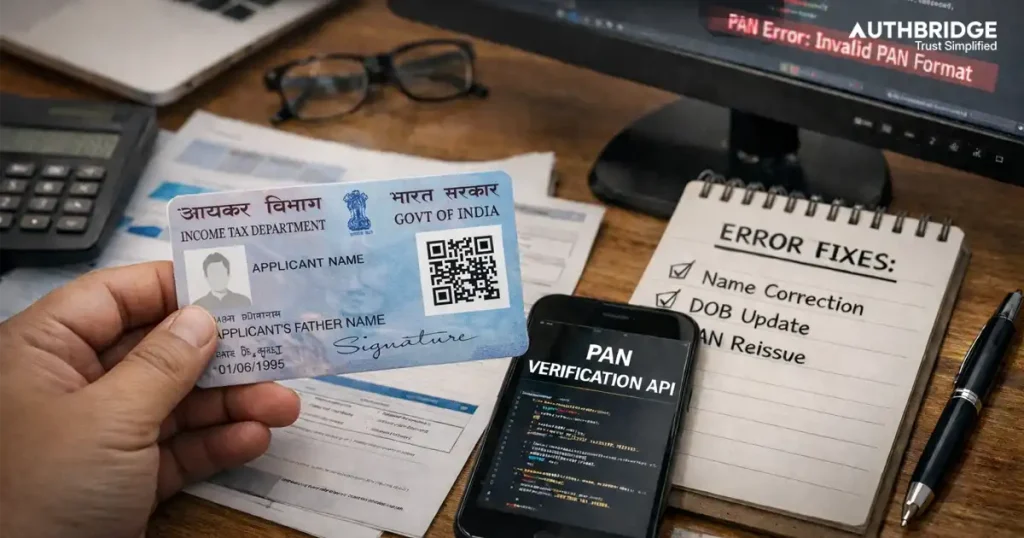
Common PAN Verification Errors
Why Does PAN Show Invalid Even When It Is Correct?
Many businesses face a common issue where a PAN shows as invalid, even when the number seems correct. This usually happens because of data mismatches or compliance-related problems.
a. Mismatch in Personal Details
One of the most common reasons is incorrect or inconsistent data. Even a small difference can cause verification to fail.
For example:
- Name spelling does not match official records
- Date of birth is entered incorrectly
- Other details differ from government data
Because of this, the system cannot confirm the PAN, even if the number itself is valid.
b. PAN Not Linked with Aadhaar
The government requires PAN to be linked with Aadhaar for it to remain active. If this step is not completed, verification may fail.
As a result:
- The PAN may not pass validation checks
- Businesses may see it as invalid during KYC
c. PAN Marked as Inactive or Inoperative
In some cases, the Income Tax Department may mark a PAN as inactive due to non-compliance.
This can happen if:
- Aadhaar linking is not completed
- Required updates are not made
Because of this, the PAN exists but cannot be used for verification or transactions.
Can a PAN Card Be Fake Even If It Looks Valid?
Yes, a PAN card can appear valid but still be fake.
This happens because visual checks alone are not enough to confirm authenticity. Many counterfeit cards are designed to look almost identical to real ones.
a. Looks Can Be Misleading
Fake PAN cards may include features that look genuine at first glance. For example:
- A hologram or laminated finish
- Proper formatting of the PAN number
- Clean and professional printing
However, these elements can be copied. Because of this, a card that looks real may not exist in official records.
b. Check Security Features Carefully
A genuine PAN card usually includes certain security elements. These help in basic verification:
- A holographic image
- Clear and sharp printing
- A watermark visible under light
Even then, these checks are not fully reliable because advanced fakes can replicate them.
c. Verification with Official Records Is Key
The most reliable way to confirm a PAN is to verify it with the Income Tax Department.
This helps because:
- It confirms whether the PAN exists
- It matches details with official data
- It removes guesswork from visual checks
Also Read: Linking PAN Card With Aadhaar Card
Manual vs API-Based PAN Verification
Difference Between Manual Verification and API-Based Verification
Manual PAN verification involves reviewing documents without any automated systems. Teams collect PAN details, review them visually, and enter data into systems. This method can work for small volumes. However, it often takes more time and may lead to errors. Even small mistakes in name or date of birth can cause verification failures. As onboarding increases, managing this process becomes difficult and slows down operations.
API-based PAN verification, on the other hand, uses secure automated systems to validate details instantly from authorised databases. Because the process is real-time, businesses can verify PAN details within seconds. This improves accuracy, reduces manual effort, and helps detect fraud more effectively. In addition, automated systems create proper records, which makes compliance and audits easier. As a result, most growing businesses prefer API-based verification because it is faster, more reliable, and easier to scale.
Why Businesses Prefer PAN Verification APIs
Faster Onboarding
Manual PAN verification takes time because teams need to check each record one by one. This can take hours or even days, especially when the volume is high.
In contrast, API-based verification delivers results in seconds because it connects directly with authorised databases.
Faster verification helps businesses complete onboarding quickly and improves the overall customer experience.
Better Fraud Detection
Accuracy also differs between the two methods.
Manual checks depend on human review and judgment, so even small errors in spelling or data entry can lead to mismatches.
However, API-based systems validate structured data directly, which reduces errors and improves consistency.
Scalability
Scalability is another key factor.
Manual processes become difficult to manage as the number of verifications increases because they require more time and resources.
API-based verification, on the other hand, can handle large volumes without adding extra workload, making it a better choice for growing businesses.
Which Method Is Better for Businesses?
The right method depends on the size and needs of the business.
Manual PAN verification can still work for small teams with limited onboarding. It may also be useful in low-risk situations where the volume of checks is low. However, as operations grow, manual processes become slower and harder to manage.
Most businesses today prefer API-based verification because it offers faster and more reliable results. It enables instant validation, improves accuracy, and helps detect fraud more effectively. In addition, it supports compliance by maintaining proper records and scales easily as verification volumes increase.
Because of these advantages, API-based verification has become the preferred choice for industries like fintech, NBFCs, and HR platforms that handle large and continuous onboarding.
How Businesses Can Verify PAN Cards at Scale
Is There a Faster Way to Verify PAN numbers in bulk?
Yes, businesses can do PAN number verification in bulk using automated systems. This process allows companies to check hundreds or even thousands of PANs at once by validating them directly against the Income Tax Department database.
Instead of verifying each PAN one by one, businesses can upload a list and get results instantly. This helps confirm whether each PAN is valid, active, and correctly linked to the individual.
Bulk PAN Verification Use Cases
- Banks and lending companies use bulk PAN verification to check customer details during loan applications and account opening.
- E-commerce platforms need to verify sellers and users before allowing transactions. Bulk verification helps confirm seller identities, prevent fraudulent activities, and maintain platform trust.
- HRs and staffing companies use PAN verification during hiring to confirm employee details. This is useful because identity checks become faster, background verification becomes more reliable, and manual effort is reduced for HR teams.
- Telecom companies must verify users before activating services like SIM cards. Bulk PAN verification helps speed up customer onboarding, ensure compliance with KYC rules, and reduce the chances of fake registrations.
Benefits of Real-Time PAN Verification APIs
a. Faster Customer Onboarding
Speed matters because customers expect quick and smooth sign-ups. Real-time PAN verification reduces onboarding time from minutes or hours to just a few seconds.
This helps because:
- Users do not face delays
- Drop-offs during onboarding reduce
- Overall customer experience improves
Also Read: Identity Verification Trends In 2026
b. Better Fraud Prevention
Fraud is a major concern, especially in sectors like fintech and e-commerce. Real-time verification checks PAN details instantly against official records.
As a result, businesses can:
- Detect fake or incorrect identities early
- Prevent fraudulent users from entering the system
- Protect revenue and brand trust
c. Improves Compliance and Reduces Risk
Many financial processes require accurate PAN verification. Automated systems ensure that every check is done correctly.
This helps businesses:
- Stay compliant with regulations
- Avoid penalties and legal issues
- Maintain proper audit records
d. Saves Time and Operational Costs
Manual verification takes time and requires resources. However, APIs automate the entire process.
Because of this:
- Manual effort reduces
- Employees can focus on important tasks
- Operational costs go down
How PAN API-Based Verification Works
Step 1: Integration with Your System
The process starts when the API is integrated into your platform. This can be a website, mobile app, or internal system used for onboarding.
Because of this, verification becomes part of the user journey and does not require separate steps.
Step 2: PAN Details Are Entered
During registration or verification, the user enters their PAN number. This step usually happens as part of the onboarding process.
Step 3: Secure API Request Is Sent
Once the PAN is entered, the system sends a secure request to the verification API. This request connects with authorised databases for validation. This ensures that the data is checked against official records.
Step 4: Real-Time Verification
The API then cross-checks the PAN number with the database managed by authorised agencies such as Protean eGov Technologies Limited.
Because the process is automated, the verification happens in real time.
Step 5: Response Is Returned Instantly
The system receives a response within seconds. This response usually includes:
- PAN validity status
- Basic details linked to the PAN
Step 6: Next Action Based on Result
Based on the response, the system decides the next step. For example:
- Proceed with onboarding if details match
- Ask for correction if there is a mismatch
- Trigger additional checks if needed
This step-by-step process makes PAN verification faster, more accurate, and easier to manage at scale.
Key Features Businesses Should Look For in PAN Verification API
a. Real-Time PAN Status Validation
A good API should verify PAN details instantly. This means checking whether the PAN is valid and active in real time.
Because of this:
- Businesses avoid using outdated or incorrect data
- Onboarding becomes faster and more reliable
b. Name Matching and Identity Verification
The API should return the official name linked to the PAN. This helps match user input with actual records.
For example:
- Detect spelling errors early
- Identify mismatches before onboarding
This improves accuracy and reduces risk during verification.
c. Supports Different Types of PAN
PAN is not just for individuals. It is also used by businesses, LLPs, and trusts.
A strong API should handle all these cases in one system. This makes onboarding simpler and more scalable.
Conclusion
Manual PAN verification can still work for businesses with low onboarding volumes and simple processes. It may be suitable in low-risk scenarios where real-time checks are not required. However, as the number of verifications increases, manual methods become slower, less accurate, and harder to manage. Small errors in data entry or delays in processing can impact both compliance and customer experience.
As businesses grow, automated PAN verification becomes a better choice because it offers speed, accuracy, and scalability. API-based solutions enable real-time verification, improve fraud detection, and maintain proper audit records.
As businesses grow, automated verification systems become essential for building a reliable and future-ready onboarding process.
Frequently Asked Questions (FAQs)
Yes, a PAN card is extremely essential for completing KYC for most financial services in India.
You can verify PAN online through NSDL (Protean) or UTIITSL portals by entering your PAN number.
Basic verification on official portals is free, but API-based services may have costs.
Validation checks format correctness, while verification confirms PAN against official records.