Introduction
Many MSMEs still see employee background checks as something meant for large companies. If a candidate comes through a trusted referral or has a good interview, verification can feel unnecessary.
But when it comes to small businesses, one wrong hire can affect the whole team.
When you have 20, 30, or 50 employees, one bad hire can mean extra work for the team, more time spent by managers fixing mistakes, delayed projects, or even unhappy customers. And if you have to replace that employee, you are back to spending time and money on recruitment, onboarding, and training.
A referral can tell you who recommended someone, but it cannot verify their identity, employment history, education, or other important details.
That is where employee background verification comes in. It helps you check the information that matters before making a hiring decision.
For an MSME, this doesn’t have to mean a long or expensive process. The right checks can help you make a more informed hiring decision without adding unnecessary cost or delay.
Because the cheapest time to discover a problem is before the employee joins.
What Can One Bad Hire Cost an MSME?
For an MSME, one bad hire can affect much more than the employee’s salary.
Let’s understand this with a simple example.
An MSME hires a manager at ₹30,000 a month. The candidate looks good during the interview and has the right experience on paper. But three months later, the business discovers that the candidate had overstated their previous experience. By then, the business has already spent money and time on the hire.
Real Cost of a Bad Hire
a. Recruitment Costs
You may have to spend again on job postings, recruiter fees, interviews, and the time your team spends finding and assessing another candidate.
b. Salary and Benefits
Even if the employee is not performing as expected, the business is still paying their salary and other employment costs during that period.
c. Confidentiality and Access Risk
Employee background verification involves personal information, so businesses should explain what information they plan to verify and handle candidate data securely. Your verification process should clearly define the checks being conducted, who can access the information, and how the information will be handled.
d. Team Disruption
When one employee does not deliver, other team members may have to take on extra work, provide additional support, or fix mistakes. Over time, this can affect teamwork and employee morale.
e. Productivity Drain
Missed deadlines, repeated work, errors, poor performance, or slower workflows can affect more than one person. The impact can spread across the team, especially in a small business where people often work closely together.
The risk goes beyond cost
Employees may also get access to customer information, financial records, internal systems, business credentials, or other sensitive information. For roles with this type of access, the consequences of a poor hiring decision can go beyond productivity and replacement costs.
A bad hire doesn’t create just one expense. It can create a chain of costs:
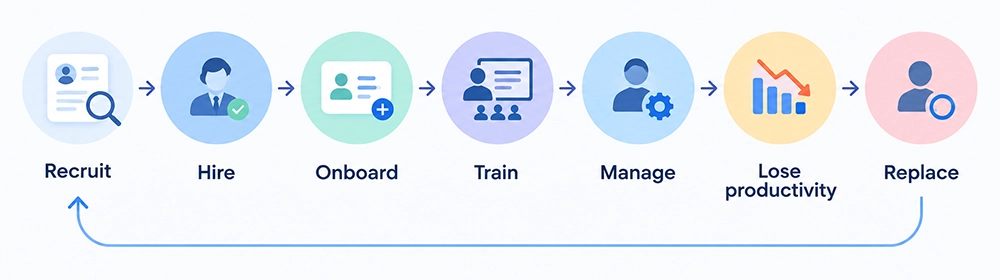
For an MSME with a small team, that chain can add up quickly.
That is why checking important candidate information before hiring can be a practical way to reduce avoidable hiring risk.
What Should an MSME Verify Before Hiring?
Employee background verification is not about checking everything you possibly can. It is about checking the information that matters before you make a hiring decision.
Depending on the role, an employee background check can help you verify details such as:
| Verification | What It Can Help Confirm |
|---|---|
| Identity | Whether the candidate's identity details match the information provided |
| Employment | Previous employers, job tenure, designation, and other employment details |
| Education | Whether the candidate's stated qualification can be verified | Address | Whether the candidate's stated address can be verified | Court Records | Relevant court-record information available through the selected check | Bank Account | Account ownership or account details, where applicable |
Pre-employment verification gives an MSME an opportunity to check important candidate information before the employee joins. The exact checks can vary based on the role and the level of access involved. These checks can help identify gaps or mismatches between the information provided by a candidate and the verification results.
Start with the checks that matter most
For a small business, the right checks can depend on what the employee will do and what they will have access to.
- For general roles, start with identity and employment verification.
- Qualified or specialised roles require education verification when the qualification matters to the job.
- For field or location-based roles, address verification may be useful.
- For finance or cash-handling roles, consider checks that help verify financial or account-related information, where relevant.
- For senior or sensitive roles, consider a broader set of checks because the employee may have greater access to people, money, systems, or confidential information.
Police verification and criminal record checks can help identify relevant information about a candidate’s record. However, they should not be treated as a one-size-fits-all requirement. The need for these checks should depend on the role, the level of access involved, and applicable legal and privacy requirements.
This approach helps an MSME focus its employee verification budget where it matters most instead of running every available check for every candidate.
The goal is simple: verify what matters before the risk becomes a cost.
Why Verification Should Happen Before Day One
Pre-employment verification should happen before an employee joins, not after a problem appears. If you discover a problem three months after an employee joins, you have already invested salary, training, manager time, and team effort into that hire.
The same issue is very different when you identify it before the employee joins.
A pre-employment verification process gives you an opportunity to review important information before giving a new employee access to your customers, systems, finances, or confidential business information. Background verification can help employers identify issues such as credential fraud, inaccurate employment history, or other discrepancies before making a final hiring decision.
So, before Day 01, it’s always important to ask:
- Who are we hiring?
- Does their important background information match what they told us?
- What will they have access to?
- Which checks make sense for this role?
These simple questions can help an MSME make a more informed hiring decision before the employee becomes part of the business.
Verification Can Continue After Day One
For some roles, verification does not have to stop once the employee joins. Continuous verification or monitoring can provide an additional layer of protection for roles where the risk or level of access may justify ongoing checks.
For example, MSMEs may consider continuous verification for employees who handle money, sensitive customer information, confidential business data, critical systems, or other high-risk responsibilities.
This does not mean every employee needs to be checked continuously. The approach should depend on the role, level of access, business requirements, and applicable legal and privacy requirements.
Think of employee verification as an ongoing approach:
Before Day One: Verify the information that matters before hiring.
After Day One: Continue monitoring where the role and risk make it relevant.
For an MSME, the goal is simple: verify what matters before the risk becomes a cost, and keep monitoring where the risk continues.
Conclusion
Hiring always comes with some uncertainty. You can conduct interviews, check references, review a resume, and still discover something later that changes your view of a candidate. No hiring process can remove every risk.
But you can take steps to reduce avoidable risk. Employee background verification is one of them.
For an MSME, the value is not in running the maximum number of checks. It is in running the right checks at the right time. Before an employee joins, verification can help you confirm important information about their identity, employment, education, address, or other relevant details. That gives you more information to consider before giving the person responsibility, access, and trust.
Because the cheapest time to discover a problem is before it becomes a cost.
Ready to make your next hire with more confidence?
Run your first employee background verification with AuthBridge.
Start your first verification free.
Frequently Asked Questions (FAQs)
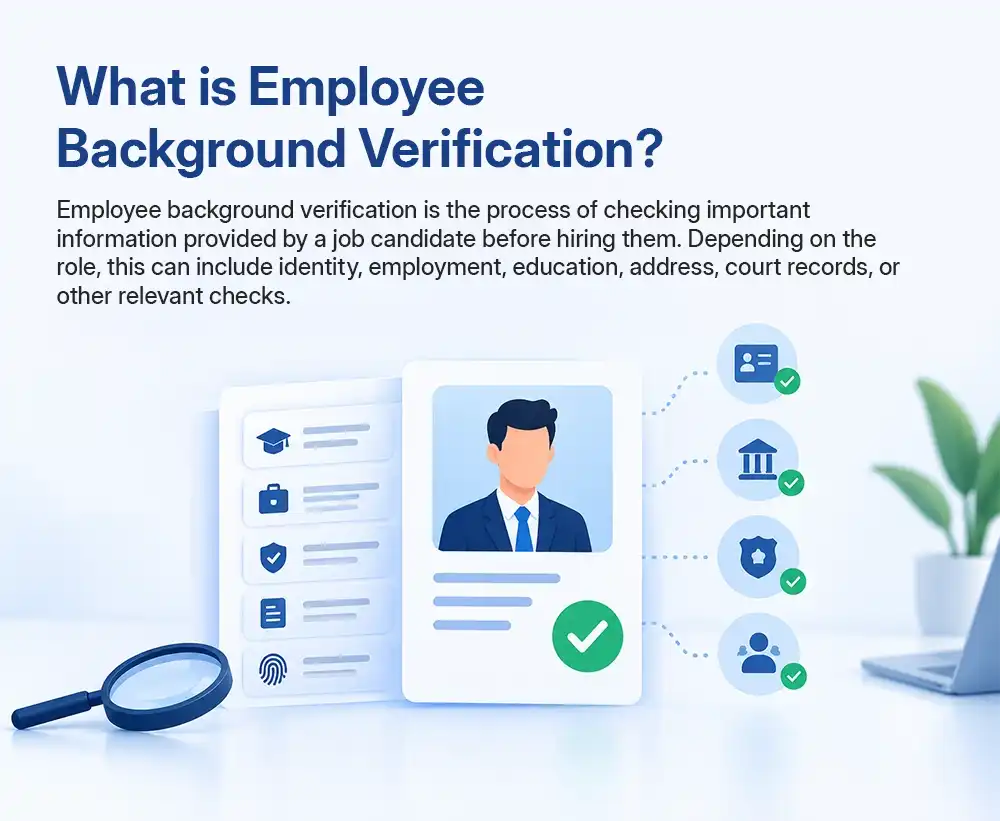
Employee background verification is the process of checking important information provided by a job candidate before hiring them. Depending on the role, an employee background check may cover identity, employment history, education, address, court records, or other relevant information.
The purpose is simple: to help an employer confirm that important information provided by the candidate is accurate and identify discrepancies before making a hiring decision.
For an MSME, this can provide an additional layer of confidence before giving a new employee responsibility or access to customers, money, systems, or business information.
There is no one-size-fits-all answer.
A small business may not need the same level of verification for every employee. The right approach depends on the role, responsibilities, industry, access, and risks involved.
For example, a role handling customer data or company finances may justify more checks than a role with limited access. Similarly, education verification makes more sense when a specific qualification is important to the job.
For employee verification for small businesses, the goal should not be to run every available check. It should be to identify the risks that matter and choose checks that help address them.
The checks can vary depending on the employer, role, and verification package.
Common employee background verification checks include:
- Identity verification — helps confirm the candidate’s identity details.
- Employment verification — helps confirm previous employers, job tenure, designation, and other employment information.
- Education verification — helps confirm stated qualifications and credentials.
- Address verification — helps verify a candidate’s stated address.
- Court or criminal record checks — can identify relevant court-record information, where the check is appropriate.
- Bank account verification — can help confirm account ownership or details where applicable.
- Reference checks — can provide additional information about a candidate’s previous work experience or professional conduct.
Not every candidate needs all of these checks. A good BGV process matches the checks to the role and the level of risk involved.
Ideally, pre-employment verification should happen before the employee joins, after the employer has decided which checks are relevant and has followed its applicable candidate notice, consent, and data-handling process.
The timing matters because discovering a discrepancy after three months can mean the business has already spent money on salary, onboarding, training, and management time.
Running relevant checks before Day One gives the employer information to consider before the employee receives responsibility or access to business systems, customer information, financial information, or other sensitive resources.
However, verification should not be treated as a substitute for interviews or other hiring assessments. It is another source of information that can support a better-informed hiring decision.
No.
The right checks depend on what the employee will do and what they will have access to.
For example:
- A general office role may need identity and employment verification.
- A specialised role may need education verification if the qualification is important.
- A field or driving role may require checks relevant to the employee’s location or driving responsibilities.
- A finance or cash-handling role may require additional checks based on the responsibilities involved.
- A senior or sensitive role may justify broader verification because of greater access to people, money, systems, or confidential information.
This role-based approach can help an MSME avoid spending money on checks that do not add meaningful value.
No.
Large companies may have dedicated HR and compliance teams, but small businesses can also use employee background verification.
In fact, verification can be particularly useful for an MSME because a small team has less room to absorb the impact of a poor hiring decision.
The key is to keep the process practical. An MSME does not need an enterprise-sized verification process for every hire. It needs the right employee background checks for the role and the risks involved.
No. A referral and verification serve different purposes.
A referral tells you that someone you know is willing to recommend a candidate. It does not independently confirm the candidate’s identity, employment history, education, or other information.
Even when a candidate comes through a trusted referral, the employer should still decide which verification checks are appropriate for the role.
A referral can be useful information. It should not be treated as proof of the candidate’s background.
No.
Background verification can help confirm specific information and identify discrepancies, but it cannot predict how an employee will perform or behave in the future.
A good hiring decision still depends on interviews, skills assessment, references, role fit, and the employer’s own judgement.
Think of verification as one layer of protection, not a guarantee.
Its value is in helping you make the hiring decision with more relevant information.
There is no single turnaround time for every employee background check.
Some digital identity checks can be completed quickly, while employment, education, address, and court-related checks may take longer depending on the verification method and the availability of records.
That is why businesses should not assume that every BGV report will be available instantly.
For an MSME, a digital platform can make the process easier to manage by showing the status of checks and making reports available as the relevant verification is completed.
It does not have to be.
The cost depends on the type and number of checks you choose. A business that runs only the checks relevant to a role can avoid paying for a large package that it does not need.
A self-serve digital process can also reduce manual work and make it easier to see what checks are being ordered and what they cost.
The better question for an MSME is not “How much does BGV cost?”
It is:
“Which checks do we actually need for this role, and what could the cost of not checking be?”
A discrepancy should not automatically mean that a candidate is unsuitable.
First, review what the discrepancy actually is. A difference in dates, spelling, address, or other information may have a simple explanation. More serious discrepancies may require additional verification or clarification from the candidate.
The important thing is to have a consistent process for reviewing results rather than making decisions based on assumptions.
This is another reason to match checks to the role and to consider the relevance of a finding to the actual job responsibilities. SHRM also highlights the importance of balancing screening with candidate privacy and avoiding excessive screening.
In most hiring contexts, the terms are used to describe the same general process: checking information about a candidate before or during employment.
Employee verification is the simpler term, while employee background verification (BGV) is commonly used in the HR and screening industry.
Both can refer to checks such as identity, employment, education, address, and other role-specific verification.
For an MSME, the important part is not the terminology. It is choosing the checks that provide useful information for the hiring decision.