
Remote hiring has fundamentally changed how HR teams operate. When you can onboard a software engineer in Austin without ever meeting them in person, or hire a financial analyst from Chicago while your office is in New York, the traditional handshake-and-resume approach no longer holds up. And that gap — the one between what a candidate claims and what’s actually true — is where degree fraud quietly thrives.
According to the Society for Human Resource Management (SHRM), nearly 85% of employers catch applicants lying on their resumes, with educational qualifications being among the most commonly falsified credentials. In a remote hiring environment, where face-to-face interaction is limited and hiring timelines are compressed, HR teams simply cannot afford to skip thorough degree verification.
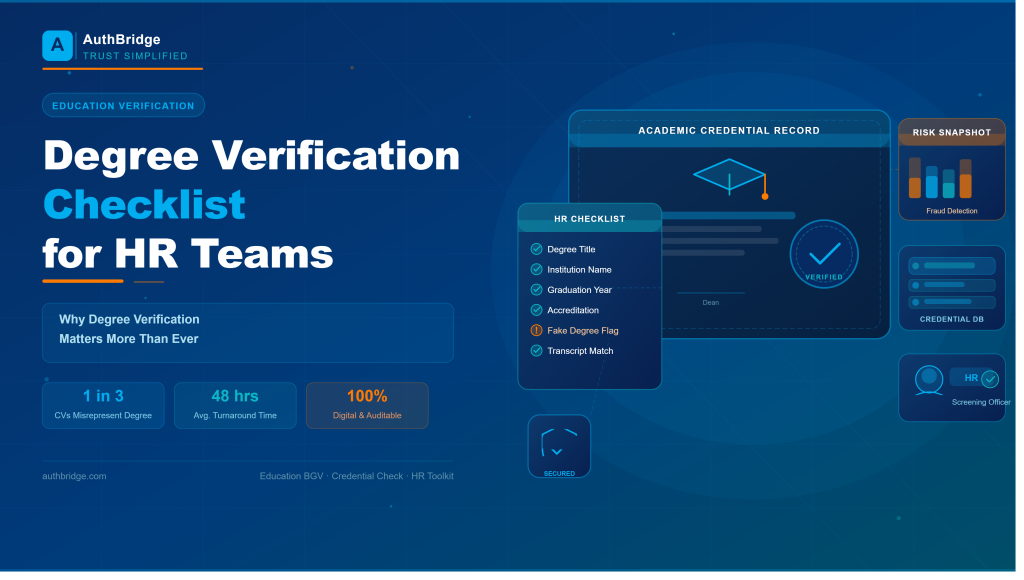
This checklist is built for HR professionals who want a structured, legally sound, and efficient process for verifying educational credentials — whether you’re onboarding five people or five hundred.
Why Degree Verification Matters More Than Ever
The stakes of hiring someone with a fraudulent degree aren’t just operational. They’re legal. A healthcare company that hires a clinical director without verifying a claimed nursing degree faces not just regulatory penalties, but serious liability if patient harm occurs. A financial services firm that skips verifying a CPA credential invites compliance nightmares down the road.
The U.S. Department of Education’s database shows over 130 accredited credential mills still operating domestically, churning out certificates and diplomas that look legitimate but carry no academic credibility. Internationally, the problem is even more complex — especially for companies hiring globally under remote hiring models.
This is why degree verification cannot sit in isolation. It works best as part of a broader pre-employment screening framework that includes:
- Employment Verification Check — confirms actual job titles and employment history
- Drug Screening Solution — mandatory for safety-sensitive roles
- Motor Vehicle Record (MVR) Check — essential for any driving-related position
- NATCRIM (National Criminal Database Check) — sweeps national crime records
- Education Verification Check — confirms degrees, institutions, and graduation dates
- Credit History and Bankruptcy Check — relevant for finance and fiduciary roles
- Criminal Background Check — jurisdiction-specific criminal history review
- Reference Check Service — validates character and professional conduct
- Introducing FIRM™ (Identity Fraud Solutions) — detects identity fraud at the point of hire
The Complete Degree Verification Checklist
Step 1: Collect Candidate Authorization and Consent
Before initiating any background screening process, HR teams must obtain written consent from the candidate. Under the Fair Credit Reporting Act (FCRA), this is non-negotiable when using a third-party screening provider.
- Provide a standalone disclosure document (not buried in the application)
- Collect a signed authorization form prior to any verification activity
- Inform the candidate of their rights under FCRA, including the right to dispute inaccurate findings
- Retain signed consent records for a minimum of five years
Step 2: Collect Complete Educational Information from the Candidate
Incomplete or vague educational entries are a red flag. Ask candidates to provide complete details for each institution listed:
- Full legal name of the institution (not abbreviations)
- Exact degree title and field of study
- Enrollment start and graduation end dates (month and year)
- Student ID number or registration number
- Official transcript, if applicable to the role
- Contact information for the registrar’s office
Step 3: Verify Institution Accreditation
Not all degrees are created equal. A diploma from an unaccredited institution may be technically “issued” but hold no professional or legal standing.
- Check the U.S. Department of Education’s database of accredited postsecondary institutions
- Verify regional vs. national accreditation (regional is the gold standard for most academic degrees)
- For international institutions, cross-reference with NACES (National Association of Credential Evaluation Services) member organizations
- Flag any institution that only operates online with no physical campus — this is a common trait of diploma mills
| Accreditation Type | Recognized By | Typical For | Red Flag Level |
|---|---|---|---|
| Regional Accreditation | U.S. Dept. of Education | Universities, colleges | Low |
| National Accreditation | U.S. Dept. of Education | Vocational/trade schools | Medium |
| Programmatic Accreditation | Professional bodies (ABA, AACSB) | Specific programs | Low |
| Unaccredited | Not recognized | Diploma mills | High |
| Foreign Credential (Evaluated) | NACES member orgs | International degrees | Varies |
Step 4: Contact the Registrar Directly
This step is often skipped due to time pressure — don’t skip it. Calling or emailing the registrar’s office of the institution listed is the most reliable way to confirm a degree was actually awarded.
- Contact the registrar, not the department head or professor
- Provide the candidate’s name, date of birth, and enrollment period
- Request confirmation of: degree type, major, graduation date, and honors (if claimed)
- For international institutions, work through an accredited credential evaluation service
- Document all correspondence, including date, time, and the name of the person spoken to
Step 5: Use a Technology-Enabled Verification Partner
Manual verification is time-consuming and inconsistent. For organizations with high hiring volumes — especially under remote hiring models — automated verification through a trusted partner significantly improves turnaround times and accuracy.
AuthBridge, for instance, offers dedicated Education Verification Check services that directly contact institutions on your behalf, flag inconsistencies, and deliver structured verification reports. This is particularly valuable when you’re running concurrent background checks across multiple candidates.
| Verification Method | Average Turnaround | Accuracy | Scalability | Best For |
|---|---|---|---|---|
| Manual (In-house HR) | 5–10 business days | Moderate | Low | Small teams, low volume |
| Direct Registrar Contact | 3–7 business days | High | Medium | Mid-size hiring |
| Third-Party Screening Partner | 1–3 business days | Very High | High | High-volume / Remote hiring |
| Automated Digital Verification | < 24 hours | Very High | Very High | Enterprise / Tech hiring |
Step 6: Review and Document Discrepancies
Not every discrepancy is fraud — sometimes candidates misremember graduation years or use informal degree names. But every discrepancy needs to be reviewed and documented.
- Compare claimed degree with verified findings side by side
- Note any variance in graduation dates, degree title, or institution name
- Contact the candidate for an explanation before making a final decision
- Document the discrepancy, the explanation, and the HR team’s decision in writing
- If fraud is confirmed, follow your organization’s adverse action process per FCRA guidelines
Step 7: Follow Adverse Action Procedures if Needed
If a discrepancy is material and the background check forms part of the hiring decision, FCRA mandates a two-step adverse action process:
- Step 1 — Pre-adverse action notice: Provide the candidate with a copy of the report and a summary of their rights
- Step 2 — Adverse action notice: If the decision stands after a reasonable waiting period (typically 5 business days), formally notify the candidate
- Retain all records related to the adverse action process for a minimum of five years
Common Degree Verification Mistakes HR Teams Make
| Mistake | Risk | How to Avoid |
|---|---|---|
| Relying solely on the diploma copy | Easy to falsify | Always contact the registrar directly |
| Skipping accreditation checks | Hiring diploma mill graduates | Verify with Dept. of Education database |
| Not verifying international degrees | Fraudulent foreign credentials | Use NACES-certified evaluation services |
| Missing FCRA consent requirements | Legal liability | Obtain written consent before initiating checks |
| Treating all discrepancies as fraud | Unnecessary candidate rejections | Interview the candidate before deciding |
| Manual tracking without documentation | Compliance gaps during audits | Use a centralized screening platform |
Building a Remote Hiring Policy Around Degree Verification
Remote hiring adds complexity to an already nuanced process. When a candidate is three time zones away and you’ve never met them in person, your verification processes need to be airtight.
Here’s a practical framework for embedding degree verification into your remote hiring policy:
- Make degree verification mandatory for all roles requiring a specific educational qualification, not just senior positions
- Set clear timelines — verification should not delay offers indefinitely; aim for completion within the candidate’s notice period
- Use a screening partner who specializes in cross-border verifications for remote roles that span multiple countries
- Integrate verification status into your ATS (Applicant Tracking System) so hiring managers have real-time visibility
- Train HR staff on FCRA compliance, adverse action protocols, and documentation standards annually
AuthBridge’s screening solutions are built with remote hiring workflows in mind, offering API integrations, automated candidate portals, and real-time dashboards that keep your team informed without slowing down the process.
Frequently Asked Questions (FAQs)
1. How long does degree verification typically take?
For domestic U.S. institutions, a third-party verification service can typically return results in one to three business days. International verifications may take five to ten business days depending on the country and institution’s responsiveness. Building this timeline into your offer process prevents delays.
2. Can a candidate refuse to consent to degree verification?
Yes — a candidate has the right to refuse. However, if the degree is a genuine requirement for the role, HR teams are within their rights to withdraw the offer or decline to proceed with the application. Always document the candidate’s refusal as part of your records.
3. What should I do if a candidate’s degree can’t be verified?
First, reach out to the candidate for additional documentation such as transcripts, diplomas, or enrollment letters. If the institution is closed or records are unavailable, work with a credential evaluation service. If verification genuinely cannot be completed and the degree is a job requirement, this should factor into your hiring decision — with proper documentation.
4. Are online degrees treated differently during verification?
Online degrees from regionally accredited institutions are verified through the same process as traditional degrees. The key distinction is accreditation — an online degree from an accredited university like Arizona State Online is fully valid. Degrees from unaccredited online institutions are not recognized professionally or legally in most fields.
5. How does degree verification differ for executive or C-suite hires?
Executive hires warrant additional scrutiny. Beyond standard degree verification, HR teams should verify any professional certifications (CPA, CFA, JD, MD), conduct global criminal background checks, and review international education records where applicable. AuthBridge’s comprehensive screening packages are designed specifically for high-stakes, senior-level appointments where a single oversight can carry significant organizational risk.
Final Thoughts
Degree verification isn’t a box-ticking exercise. Done properly, it’s a genuine risk management tool that protects your organization from legal liability, reputational damage, and the very real cost of a bad hire. The average cost of a mis-hire in the U.S. is estimated at 30% of the employee’s first-year salary — and that doesn’t account for the compounding cost when the hire was built on fabricated credentials.
In an era of remote hiring, where physical cues are absent and hiring decisions often move faster than verification timelines, HR teams need structured checklists, reliable partners, and the discipline to never skip steps that feel inconvenient. This checklist gives you a solid foundation. Build on it. Customize it for your industry. And lean on trusted screening solutions — like those offered through AuthBridge — to carry the operational load while you focus on finding the right people.