Introduction
Digital payments have made everyday transactions faster and more convenient. However, its growing popularity has also created new opportunities for fraudsters.
Fraudsters are now using fake payment screenshots, QR code scams, collection requests, phishing links, and impersonation tactics to trick individuals and businesses into losing money. Most of these scams succeed because they create confusion or make people act in a hurry. Knowing how these scams work can help you spot the warning signs and protect your money.
According to a report, UPI frauds have increased in India, with over 13.4 lakh cases reported in FY 2023-24, leading to losses of more than ₹1,087 crore.
In this guide, you’ll learn exactly how fake UPI payment scams work, how to identify them, how to verify payments correctly, and what businesses can do to prevent fraud.
What Is A Fake UPI Payment Scam?
A fake UPI payment scam is a type of fraud where scammers manipulate people into sending money, approving payment requests, sharing confidential information such as OTPs or UPI PINs, or accepting fake UPI payment confirmations as proof of payment. Their goal is to convince victims to take an action that results in financial loss.
It is important to understand that these scams do not hack the UPI system itself. Instead, they take advantage of human behaviour. Fraudsters rely on trust, a lack of awareness, and a sense of urgency to pressure people into acting without verifying the transaction. They may pretend to be genuine buyers, customer support executives, or representatives from trusted organisations to make their requests seem legitimate.
Understanding these tactics is the first step towards recognising fake UPI payment scams and avoiding costly mistakes.
Why Are Fake UPI Payment Scams Increasing?
Several factors have contributed to the rise in fake UPI payment scams:
a. Widespread Adoption of UPI
UPI has become one of the world’s largest real-time payment systems, processing billions of transactions every month. As more individuals and businesses rely on UPI for daily payments, fraudsters have a larger pool of potential victims to target.
b. Growing Shift Towards a Cashless Economy
Digital payments have become a part of everyday life because they are quick and convenient. This increased dependence on digital payments also means that users are more likely to encounter fraudulent payment requests, fake confirmations, or phishing attempts if they are not careful.
c. More First-Time Digital Payment Users
Millions of people have started using UPI in recent years. While this has improved financial inclusion, many first-time users may not be familiar with common fraud tactics. Fraudsters often take advantage of this lack of awareness by pretending to offer help or asking users to perform actions they do not fully understand.
d. Rise in Online Marketplace Transactions
Buying and selling through online marketplaces and social media platforms has become increasingly common. Fraudsters frequently pose as buyers or sellers on these platforms and use fake payment screenshots, collect requests, or refund scams to deceive people into handing over goods or transferring money.
e. Easy Access to Editing Tools and Fake Apps
Today, simple photo-editing tools and fake payment applications make it easier for fraudsters to create convincing payment screenshots or fake transaction screens. These images often look genuine, making it difficult to identify fraud without verifying the payment in your bank account or UPI app.
Fake UPI payment scams can take many forms. Fraudsters may use phishing links, fake QR codes, collect requests, or impersonate customer support representatives to trick people into making payments.
However, one of the most common and fastest-growing scams today involves the use of fake payment screenshots. These forged payment confirmations often look genuine and can easily mislead individuals and businesses that do not verify transactions.
Also Read: Identity Verification Trends In 2026
How Fake UPI Payment Scams Work
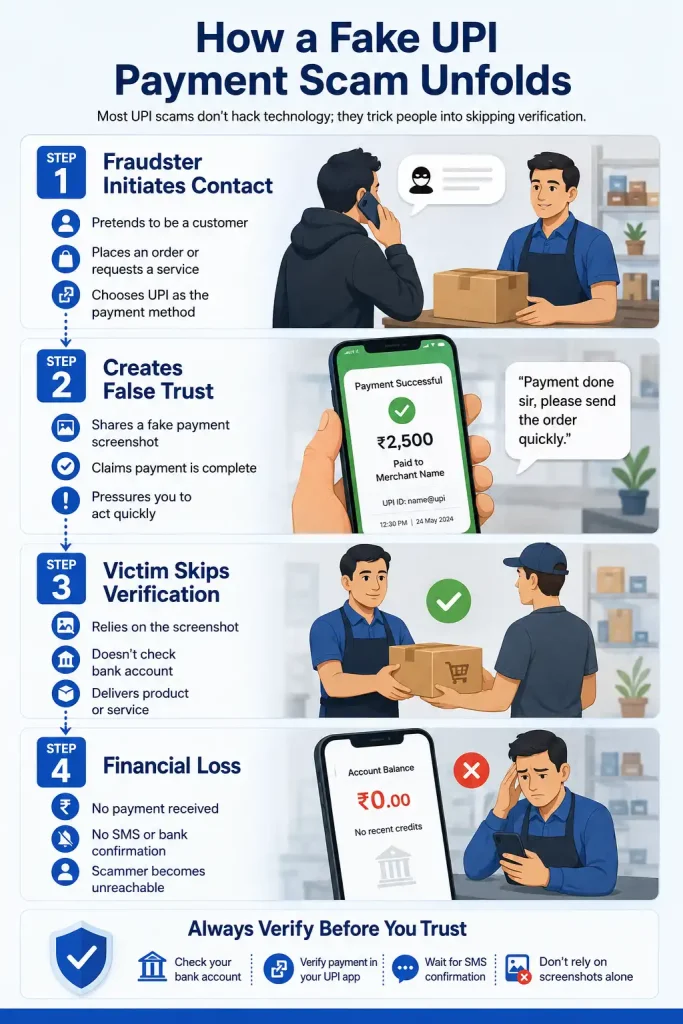
Fake UPI payment scams may use different tactics, but most of them follow a similar pattern. Instead of breaking into the UPI system, fraudsters manipulate people into taking actions that result in financial loss. They create trust, pressure victims to act quickly, and rely on the fact that many people do not verify payments before completing a transaction.
Step 1: The Fraudster Identifies a Target
Scammers usually look for individuals or businesses that regularly accept UPI payments. Shopkeepers, freelancers, delivery partners, online sellers, and small businesses are common targets because they often handle multiple transactions throughout the day.
Step 2: They Reach Out and Build Trust
The fraudster contacts the target through a phone call, WhatsApp message, social media platform, or an online marketplace. Their aim is to make the conversation feel legitimate before introducing the scam.
Step 3: They Use a Fake Payment Trick
Once they have gained the victim’s trust, the scammer uses a fraudulent payment method. One of the most common tricks is sharing a fake UPI payment screenshot that appears to show a successful transaction.
In other cases, fraudsters may send a fake collect request, ask the victim to scan a QR code, share a phishing link, or request sensitive information such as a UPI PIN or OTP.
Step 4: They Create a Sense of Urgency
To stop the victim from verifying the payment, scammers often create pressure. This sense of urgency increases the chances of the victim acting without checking their bank account or UPI app.
Step 5: The Victim Authorises the Transaction or Releases the Goods
Believing the request is genuine, the victim may approve a collect request, enter their UPI PIN, share confidential information, or hand over goods based only on the payment screenshot. In many cases, the actual payment has either never been made or has not been authorised.
Step 6: The Fraud Is Complete
Once the money has been transferred or the goods have been delivered, the scammer usually stops responding and becomes difficult to trace. The victim later discovers that no payment was received or that money has been debited from their account.
Types of Fake UPI Payment Scams
Fake UPI payment scams trick people into transferring money, sharing sensitive information, or handing over goods without receiving payment.
Here are some of the most common fake UPI payment scams you should know about:
a. Fake Payment Confirmation Scams
Fake UPI payment scams can take many forms. Fraudsters may use phishing links, fake QR codes, collect requests, or impersonate customer support representatives to trick people into making payments.
However, one of the most common and fastest-growing scams today involves the use of fake payment screenshots. These forged payment confirmations often look genuine and can easily mislead individuals and businesses that do not verify transactions.
Fake Payment Screenshot Scam
In this scam, fraudsters share an edited or fake payment screenshot that appears to show a successful UPI transaction. The screenshot may include details such as the payment amount, transaction ID, timestamp, and the logo of a popular UPI app, making it look genuine.
b. Payment Request & QR Code Scams
QR Code Scam
Fraudsters send a QR code claiming that scanning it will help you receive money. In reality, scanning the QR code and entering your UPI PIN authorises a payment from your account instead.
Collect Request Scam
Instead of sending money, scammers send a Collect Request to the victim. They may claim it is required to receive a payment, refund, or reward. When the victim approves the request and enters their UPI PIN, money is debited from their account.
Fake UPI Handle Scam
Scammers create UPI IDs that closely resemble those of trusted businesses or individuals. Victims may unknowingly transfer money to these fake handles without checking the recipient’s details.
c. Social Engineering & Impersonation Scams
Phishing Scam
Scammers send fake emails, websites, or messages that appear to come from banks or payment platforms. These links are designed to steal login credentials, UPI PINs, or other confidential information.
Fake Customer Care Scam
Scammers create fake customer support numbers online or on social media. When victims contact these numbers, fraudsters ask them to install apps, share confidential information, or make payments.
How To Identify A Fake UPI Payment Scam
Fake UPI payment scams often look convincing because fraudsters try to make their requests appear genuine. They may share fake payment confirmations, create urgency, or pretend to be from trusted organisations. However, there are several warning signs that can help you identify a fraudulent transaction before you lose money.
Here are some common signs of a fake UPI payment scam:
a. You Receive Only a Payment Screenshot Instead of Actual Confirmation
A screenshot showing “Payment Successful” is not proof that money has been credited to your account. Fraudsters can easily edit images or create fake transaction screens using online tools and fake payment apps.
Always verify the payment through:
- Your bank account balance
- Your UPI app transaction history
- Bank SMS notifications
- Merchant payment dashboard (if applicable)
Never release goods or services based only on a screenshot.
b. Someone Pressures You To Act Immediately
Fraudsters often create a sense of urgency to prevent you from verifying the transaction. They may say that the payment has already been made, that the transaction will expire, or that immediate action is required.
Be cautious if someone:
- Rushes you to deliver a product
- Insists that you approve a request quickly
- Discourages you from checking your account
A genuine payment does not require you to skip verification.
c. Someone Asks You To Enter Your UPI PIN To Receive Money
This is one of the biggest warning signs of a UPI scam.
Your UPI PIN is only required when you are making a payment. You never need to enter your UPI PIN to receive money.
If someone asks you to:
- Enter your UPI PIN to accept money
- Scan a QR code to receive payment
- Approve a request to get a refund
they are likely trying to make you authorise a payment from your account.
d. Someone Claims That Your Payment Is "Stuck" and Asks You To Verify
Scammers may pretend that a payment is pending or stuck and ask you to complete additional steps to fix it.
They may ask you to:
- Click on a link
- Share OTP details
- Install an app
- Approve a payment request
Banks and payment apps do not ask users to share OTPs, UPI PINs, or approve unknown transactions to resolve payment issues.
One Of The Most Common Scams: Fake Payment Screenshots
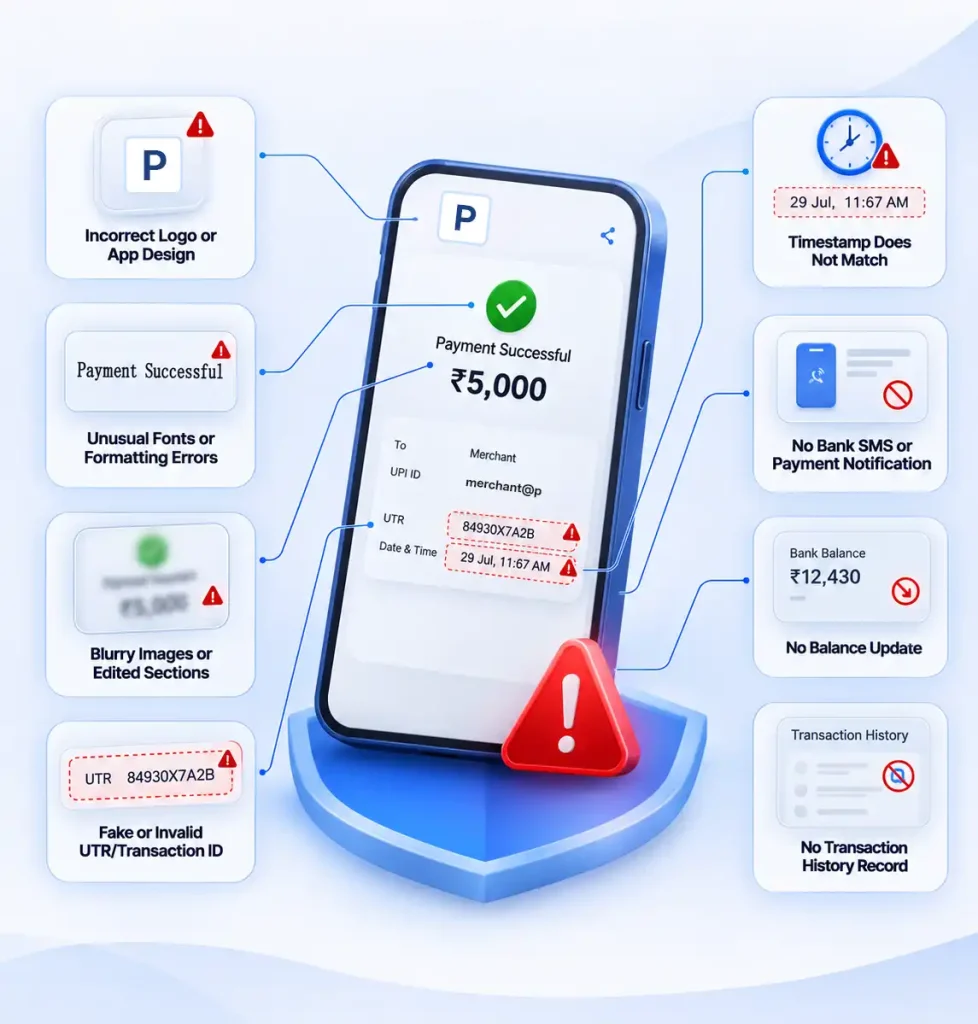
In this scam, fraudsters create or edit payment confirmation screens to make it appear as though they have successfully transferred money. They then share these screenshots with shopkeepers, freelancers, delivery partners, or online sellers as proof of payment.
These fake screenshots often look almost identical to genuine payment confirmations. They may display a “Payment Successful” message, transaction ID, payment amount, timestamp, and even the logo of popular UPI apps. At first glance, they can be difficult to identify, especially during busy hours when people may not have enough time to verify the transaction.
However, a payment screenshot alone is never proof that money has been credited to your account. The only reliable way to confirm a payment is by checking your bank account, UPI app, merchant dashboard, or SMS notification before handing over any product or service.
Genuine Vs Fake Payment Screenshot
| Genuine Payment Screenshot | Fake Payment Screenshot |
|---|---|
| Payment details match the actual transaction in your UPI app | Details may not match your UPI transaction history |
| Transaction ID can be verified through payment records | Fake or invalid transaction IDs may be shown |
| Payment amount matches the amount credited to your account | Amount shown may not be received in your account | Date and timestamp match the actual payment time | Timestamp may be edited or inconsistent | Payment status is reflected in your bank or UPI app | Only an image is provided as proof |
How To Verify A UPI Payment Before Delivering Goods
For businesses, shopkeepers, freelancers, and online sellers, confirming a UPI payment before handing over products or completing a service is extremely important.
A payment should only be considered complete when the amount is visible in your own payment records.
Follow these steps to verify a UPI payment:
a. Check Your Bank Account or UPI App
The most reliable way to confirm a payment is to check whether the money has actually been credited to your account.
Verify:
- The payment amount
- The transaction status
- The sender details
- The transaction date and time
If the payment does not appear in your account, do not assume it has been completed.
b. Verify Through Your Merchant App
If you use a merchant payment solution, check your merchant dashboard or payment app for confirmation.
Merchant apps usually provide:
- Completed transaction records
- Payment status
- Transaction references
- Settlement details
Always rely on your own merchant records instead of a screenshot shared by the customer.
c. Check Your Account Statement
For important or high-value transactions, verify the payment through your bank statement.
A genuine payment should appear with:
- Transaction details
- Credited amount
- Date and time
- Payment reference information
If the transaction is missing from your statement, the payment has not been completed.
d. Check Your UPI Transaction History
Open your UPI app and review recent transactions.
Confirm:
- The payment appears in your history
- The amount matches the order value
- The transaction status shows success
- The payment has been credited to the correct account
e. Wait for Official Confirmation
Banks and UPI apps usually send an SMS or app notification when money is successfully credited.
If you have not received any confirmation, take a few moments to verify the payment before releasing goods or completing the service.
Best Practice: During busy hours, avoid relying on verbal confirmation or payment screenshots. Spend a few extra seconds checking your own payment records; it can save you from significant financial loss.
Do's and Don'ts to Avoid Fake UPI Payment Fraud
| Do's | Dont's |
|---|---|
| Always verify payments through your bank account or UPI app before delivering goods | Never trust a payment screenshot as proof of payment |
| Check your UPI transaction history regularly | Don't enter your UPI PIN to receive money |
| Verify the recipient or sender's name before making or accepting payments | Don't scan unknown QR codes claiming you will receive money | Use only official banking and UPI apps downloaded from trusted app stores | Don't download apps or click on links shared by unknown people | Report suspicious transactions to your bank immediately | Don't share your UPI PIN, OTP, passwords, or banking credentials with anyone | Enable SMS and app notifications to monitor every transaction | Don't ignore suspicious payment requests or collect requests | Take a few extra seconds to verify high-value transactions | Don't let anyone pressure you into completing a transaction quickly |
RBI Guidelines on Unauthorised Electronic Banking Transactions
The Reserve Bank of India (RBI) has issued guidelines to protect customers from unauthorised electronic banking transactions, including fraud involving UPI payments. These guidelines explain when a customer may be eligible for a refund and how much liability they may have, depending on how quickly the fraud is reported to the bank.
The most important thing to remember is that reporting a fraudulent transaction immediately can significantly reduce your financial loss. If you notice an unauthorised UPI transaction, contact your bank through its official customer care channels without delay and keep a record of your complaint.
Customer Liability Under RBI Guidelines
| Time Taken to Report The Fraud | Customer Liability |
|---|---|
| Within 3 working days | Zero liability in eligible cases of unauthorised electronic transactions. The bank is required to credit the disputed amount back to the customer's account as per RBI guidelines. |
| Within 4 to 7 working days | Customer liability is limited and may range from ₹5,000 to ₹25,000, depending on the type of bank account and the transaction. |
| After 7 working days | Customer liability will be determined according to the bank's approved policy, and the customer may have to bear a larger portion—or all—of the financial loss. |
What Should You Do If You Notice an Unauthorised UPI Transaction?
If you suspect that you have become a victim of a fake UPI payment scam, take these steps immediately:
- Report the transaction to your bank using its official customer care number, mobile banking app, internet banking portal, or by visiting the nearest branch.
- Call the National Cyber Crime Helpline (1930) or report the incident on the National Cyber Crime Reporting Portal to initiate the complaint process as quickly as possible.
- Keep all transaction records, including payment screenshots, SMS alerts, UPI transaction IDs, complaint reference numbers, and any communication with the fraudster.
- Monitor your account regularly for any additional unauthorised transactions and inform your bank immediately if you notice further suspicious activity.
Tips to Stay Protected
While RBI’s guidelines help protect customers after an unauthorised transaction, prevention is always the best approach. To reduce the risk of UPI fraud:
- Enable multi-factor authentication wherever available.
- Never share your UPI PIN, OTP, passwords, or banking credentials with anyone.
- Verify every incoming payment through your bank account or UPI app, rather than relying on screenshots.
- Regularly monitor your bank account and transaction history for any unusual activity.
- Report suspicious transactions immediately, as early reporting can reduce your liability under RBI guidelines.
The Role Of Identity Verification In Preventing Digital Payment Fraud
While staying alert and following safe payment practices can help individuals avoid fake UPI payment scams, businesses also play a critical role in preventing digital payment fraud. As digital transactions continue to grow, organisations need robust verification processes to identify fraudulent users, reduce financial risk, and build trust with customers.
Identity verification and fraud prevention solutions help businesses detect suspicious activities early, making it more difficult for fraudsters to misuse digital payment systems.
a. Identity Verification Helps Build Trust
Many payment-related frauds begin when scammers create fake identities or misuse stolen information to access digital services. Verifying a user’s identity before allowing them to transact helps businesses ensure they are dealing with genuine individuals.
Effective identity verification can help organisations:
- Verify customer identities during onboarding
- Detect fake or synthetic identities
- Reduce identity-related fraud
- Improve trust and security across digital transactions
By confirming the identity of users at the right stages, businesses can minimise opportunities for fraud while providing a safer experience for genuine customers.
b. Secure Merchant Onboarding Reduces Fraud Risks
Digital marketplaces, payment platforms, and financial institutions often onboard thousands of merchants and partners. Without proper verification, fraudulent businesses or bad actors may gain access to these platforms.
A robust merchant onboarding process helps organisations:
- Verify business credentials
- Validate authorised representatives
- Screen merchants against relevant databases
- Reduce the risk of fraudulent merchant accounts
This helps create a more secure ecosystem for businesses and consumers alike.
c. KYC Verification Strengthens Digital Payments
Know Your Customer (KYC) verification is one of the key safeguards against financial fraud. By verifying the identity of customers in accordance with regulatory requirements, businesses can reduce the likelihood of fraudulent accounts being created or misused.
Strong KYC processes help organisations:
- Verify customer identity documents
- Confirm identity information
- Meet regulatory compliance requirements
- Reduce impersonation and account misuse
When combined with ongoing monitoring, KYC forms an important layer of defence against digital payment fraud.
How AuthBridge Helps Businesses Strengthen Fraud Prevention

As digital payments continue to evolve, businesses need more than reactive measures to combat fraud. They require comprehensive identity verification and risk management solutions that help prevent fraud before it occurs.
AuthBridge supports organisations with solutions designed to strengthen trust and reduce fraud across the customer lifecycle, including:
- Identity verification
- Digital KYC and customer due diligence
- Business and merchant verification
- Fraud risk intelligence
- Authentication solutions
- Ongoing monitoring and risk assessment
By combining robust verification with intelligent fraud detection, businesses can create safer digital experiences, reduce exposure to payment fraud, and build greater confidence among customers.
Conclusion
Fake UPI payment scams are becoming increasingly sophisticated, but most frauds can be prevented with awareness and careful verification. Whether it’s a fake payment screenshot, a fraudulent QR code, an unexpected collect request, or an impersonation attempt, the common objective is to trick users into acting without verifying the transaction.
The safest way to protect yourself is to verify every payment through your bank account or UPI app before delivering goods, sharing sensitive information, or approving any request. Never rely solely on screenshots, WhatsApp messages, or verbal confirmations as proof of payment.
For businesses, implementing robust identity verification, merchant onboarding, KYC, and fraud prevention measures can significantly reduce the risk of digital payment fraud. As UPI adoption continues to grow, combining user awareness with strong verification processes is essential for creating a secure and trustworthy digital payment ecosystem.
Frequently Asked Questions (FAQs)
Yes. A UPI payment screenshot can be edited or generated using fake payment applications to make it appear as though a transaction has been completed. A screenshot alone is not proof of payment. Always verify the transaction through your bank account, UPI app, or merchant dashboard before handing over goods or services.
The safest way to verify a UPI payment is to check your own payment records. Always confirm that:
- The amount has been credited to your bank account.
- The transaction appears in your UPI app or merchant app.
- The payment status is successful.
- The transaction details match the sender and payment amount.
Never rely solely on screenshots, WhatsApp messages, or verbal confirmations.
No. You never need to enter your UPI PIN to receive money. Your UPI PIN is only required when you are authorising a payment from your account. If someone asks you to enter your UPI PIN to receive a refund, reward, or payment, it is likely a scam.
No. In most cases, scanning a QR code initiates a payment rather than receiving one. If someone asks you to scan a QR code and enter your UPI PIN to claim a refund, prize, or payment, do not proceed without verifying the request.
If someone sends you a payment screenshot, do not treat it as proof of payment. Check your bank account or UPI app to confirm whether the amount has actually been credited. If the payment is not reflected in your records, do not deliver goods or provide services until the transaction is successfully verified.
If you suspect you have been scammed:
- Contact your bank immediately through its official customer support channels.
- Report the fraud to the National Cyber Crime Helpline (1930).
- File a complaint on the National Cyber Crime Reporting Portal.
- Preserve transaction details, screenshots, messages, and complaint reference numbers as evidence.
- Continue monitoring your account for any unauthorised transactions.
Prompt reporting may help reduce financial loss and improve the chances of recovery.
Businesses can reduce the risk of payment fraud by verifying every transaction before delivering goods or services. They should rely on their own bank account, UPI app, or merchant dashboard instead of customer-shared screenshots. Implementing identity verification, merchant onboarding, KYC, fraud monitoring, and employee awareness programmes can further strengthen fraud prevention.
Yes. UPI is a secure digital payment system developed with multiple security measures. Most UPI frauds do not occur because the platform is compromised, but because fraudsters manipulate users into approving payments, sharing confidential information, or trusting fake payment confirmations. Following safe payment practices and verifying every transaction can significantly reduce the risk of fraud.
This is one of the most common situations faced by shopkeepers, freelancers, delivery executives, and online sellers.
Sometimes genuine UPI transactions may take a few minutes to reflect due to temporary banking or network delays. However, fraudsters also exploit this uncertainty by claiming that the payment is “processing” or “will reflect shortly.”
Before handing over any product or completing a service:
- Check your UPI app and bank account to see if the payment has been credited.
- Verify the transaction in your payment history instead of relying on the sender’s phone.
- If the amount is not visible in your account, wait until you receive official confirmation from your bank or UPI app.
Never release goods based solely on a customer’s assurance that the payment is “on the way.”
Yes. A scammer can display a fake or randomly generated transaction ID in a screenshot or edited payment confirmation. Seeing a UTR number does not mean the payment has been successfully processed.
A genuine transaction ID should correspond to an actual transaction that appears in your bank or UPI app. If the payment cannot be found in your transaction history, the transaction ID alone should not be considered proof of payment.
There can be legitimate reasons, such as temporary delays caused by banking systems or network issues. However, this is also one of the most common excuses used by fraudsters.
Instead of relying on what appears on the customer’s device:
- Verify the payment in your own UPI app or bank account.
- Wait for the transaction to appear in your history.
- Confirm that the credited amount matches the payment.
Your records, not the sender’s screen, should determine whether the payment has been received.
Yes. Modern editing tools and fake payment applications can create screenshots that closely resemble genuine payment confirmations. They often include app logos, transaction IDs, timestamps, payment amounts, and “Payment Successful” messages, making them difficult to distinguish at first glance.
This is why businesses should never rely on the appearance of a screenshot. The only reliable confirmation is money actually credited to your account.
Fraudsters often target businesses that handle a large number of transactions throughout the day. During busy hours, staff may not have enough time to verify every payment carefully.
Small businesses are particularly vulnerable because they may:
- Serve multiple customers simultaneously
- Accept instant UPI payments
- Deliver products immediately after payment
- Depend on visual payment confirmations during peak hours
Taking a few extra seconds to verify payments can prevent significant financial losses.
A genuine UPI payment that has been successfully credited to your account cannot normally be reversed simply because the sender requests it.
However, if a transaction is disputed or involves fraud, banks may investigate the matter according to applicable regulations and legal procedures.
If the payment has not been credited to your account, do not assume it has been completed based on screenshots or verbal confirmation.
Most fake UPI payment scams rely on psychology rather than technology. Fraudsters know that people are less likely to verify transactions when they feel rushed.
Some common pressure tactics include:
- “I’m getting late, please hand over the product.”
- “The payment is successful on my side.”
- “The bank servers are slow today.”
- “You’ll receive it in two minutes.”
- “I’ve already shared the screenshot.”
These statements are designed to discourage verification. A genuine customer should not object if you take a moment to confirm that the payment has reached your account.
Most genuine UPI payments are processed within seconds. However, delays can occasionally occur due to high transaction volumes, bank maintenance, or temporary technical issues.
If a payment has not been credited:
- Wait a few minutes and refresh your UPI app or bank account.
- Ask the payer to check the transaction status in their app instead of sending another payment immediately.
- If the payment still does not appear after a reasonable time, verify the transaction with your bank or payment service provider before releasing goods or services.
A delay does not automatically mean a scam, but it should never replace verification. If your records do not show a successful credit, treat the payment as unconfirmed until you receive official confirmation.