Blue-collar and White-collar are terms used to differentiate between two different types of employees based on the nature of their work, acquired skills, educational backgrounds, and the type of work environment they typically operate in.
The terms “blue-collar” and “white-collar” originated in the early 20th century, reflecting the common shirt colours worn by manual workers and office workers, respectively. Historically, blue-collar jobs were associated with physical labour in industries such as manufacturing, construction, and mining. In contrast, white-collar workers typically held positions in settings like corporate offices, involving administrative or managerial tasks. Over the decades, these roles have evolved with changes in technology and the economy, leading to a blur in the traditional distinctions between these sectors.
Who Are White-Collar Employees?
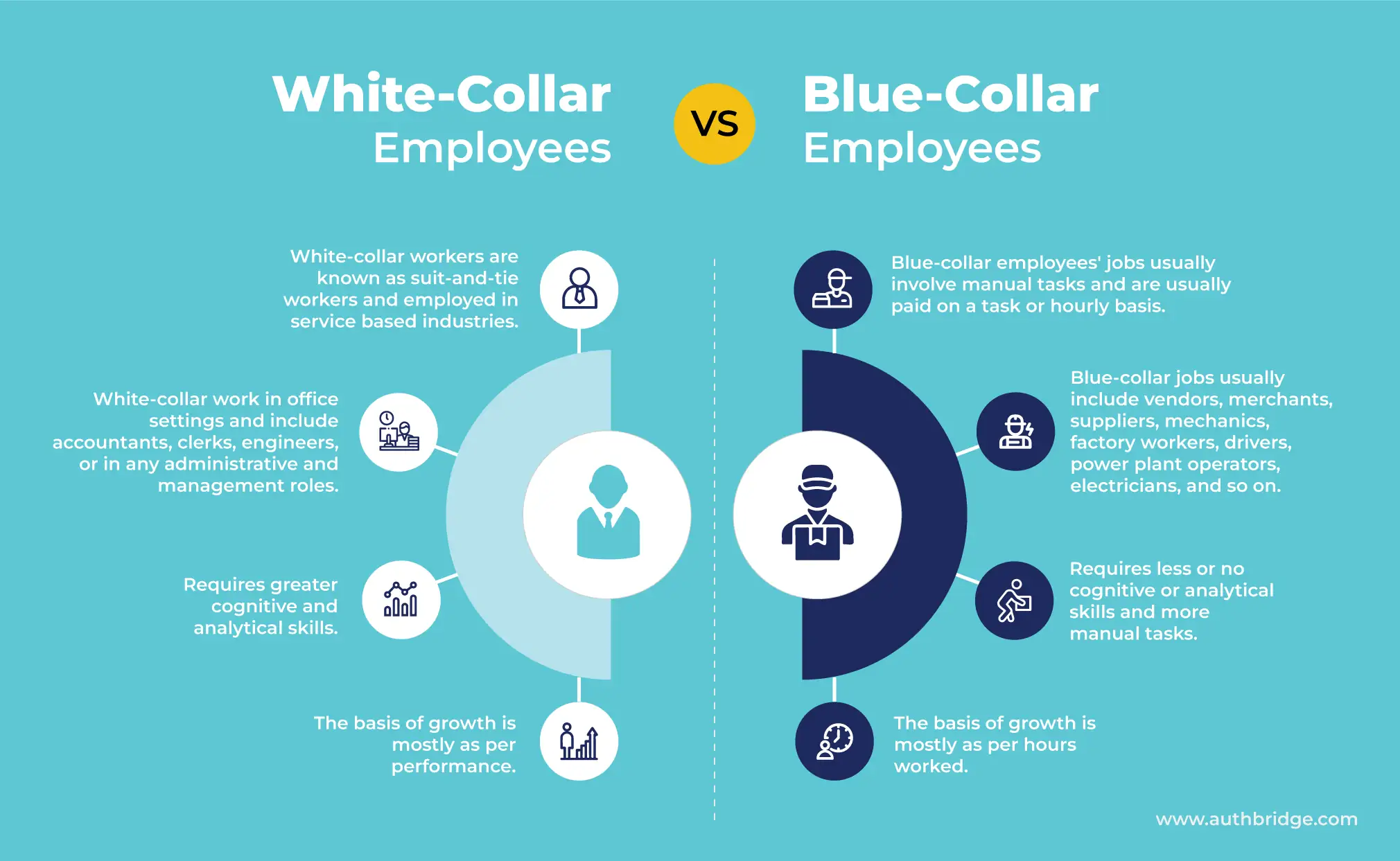
White-collar employees typically work in office settings and perform tasks that require cognitive and analytical skills, such as accountants, lawyers, managers, engineers, and other professionals.
They have college degrees or specific certifications that may have specialized training in their field of expertise. They are often salaried employees and work in a corporate setting.
Globally, the average salary for white-collar employees can vary significantly depending on the country, industry, and experience level. In developed countries, white-collar workers often earn higher salaries than those in developing nations. For instance, in the United States, white-collar professionals such as software engineers, managers, and executives can earn significantly higher than the average national income. In contrast, in many European countries, while the earnings might be lower than in the U.S., comprehensive social security and benefits might supplement these salaries.
The average salary for white-collar jobs varies widely by sector and experience in India. As of 2023, the average monthly salary in India is approximately ₹31,900 (about $387). This figure can be higher in sectors like IT, finance, and management, where skilled professionals might earn substantially more. Conversely, entry-level positions in administrative roles or customer service might earn closer to the average or below.
For specific roles in India, such as IT professionals or corporate managers, salaries can range from ₹2,97,150 and more annually, depending on the exact nature of the job and the company’s scale. These figures reflect a broad spectrum of white-collar occupations, highlighting the diversity in earnings based on role, industry, and geographic location within India.
Who Are Blue-Collar Employees?
Blue-collar employees, on the other hand, typically work in jobs that involve manual tasks or physical work, such as suppliers, drivers, construction workers, mechanics, electricians, factory workers, and other industrial workers.
These employees usually have vocational or technical training, and their work often involves working with tools, equipment, and machinery. They are often paid hourly wages and may be employed on a temporary or seasonal basis.
Globally, the average salary for blue-collar workers varies widely based on the country, industry, and specific occupation. For example, in the United States, the average hourly wage for blue-collar workers as of early 2024 is approximately $25.69, with wages ranging significantly based on specific sectors and regions. In countries like China, the average monthly salary of blue-collar workers in various sectors in 2022 was about 6,078 yuan (approximately $880), reflecting different economic scales and labour market conditions.
In India, the average salary for blue-collar workers also varies by industry and location but is generally lower compared to Western countries due to different economic conditions. As of 2023, the average blue-collar worker in India earns around ₹3,45,729 annually (approximately $4,200). This figure can differ significantly based on the city and sector. For instance, in Mumbai, the average annual salary for a blue-collar worker is slightly higher at about ₹3,73,663 (approximately $4,536). These salaries reflect the vast disparities in wages across different regions and industries within India.
Infographic: Blue-Collar vs. White-Collar Worker Comparison
![]()
![]()
Blue Collar And White Collar Employees BGV Solution By AuthBridge
AuthBridge’s robust background verification solution powers your white-collar and blue-collar screening process with real-time verification capabilities. By leveraging database-driven checks, businesses can conduct thousands of verifications in minutes and yield accurate results 10X faster.

Why Should You Conduct Your BGV With AuthBridge?
- Bulk background checks in minutes
- Customizable and integrable solution
- Quick, scalable, and seamless verification and onboarding journeys
- Proprietary databases and domain expertise
With AuthBridge, identity checks and online criminal record checks can be performed in real-time but other checks like Police Verification and Education verification might take some time as there is a dependency on the Government and other agencies for information.