


Introduction
Hiring the right people is one of the most important decisions any organisation makes. A strong team drives productivity, innovation, and long-term business success.
As companies grow and hiring becomes faster and more frequent, the chances of encountering inaccurate information, exaggerated experience, or unverified credentials can increase. Even a single hiring mistake can impact workplace productivity, team trust, and an organisation’s reputation.
To reduce these risks, many businesses are strengthening their hiring processes by verifying the information candidates provide during recruitment. By validating key details such as identity, education, and employment history, organisations can ensure they are making well-informed hiring decisions and bringing trustworthy individuals into their workforce.
These verification practices have become an essential part of modern recruitment strategies, helping companies maintain transparency, build safer workplaces, and protect their long-term credibility. This is where background verification plays a critical role in ensuring that every hiring decision is based on accurate and verified information.
In this blog, we’ll take a closer look at what background verification is, how it works, and why it has become a crucial step in today’s hiring process.
What is Background Verification?
Background verification is the process of confirming the accuracy of the information shared by a candidate during the hiring process. This involves checking a person’s identity, education, employment history, criminal records, and other relevant details to ensure that the information shared is genuine and trustworthy.
In simple words, this helps validate who a candidate is and whether their credentials are authentic before making a final hiring decision.
Also Read: Top 5 Background Screening Companies in 2026
Importance of Background Screening
a. Helps Reduce Hiring Risks
Nearly 85% of employers have discovered discrepancies in candidate resumes, especially when it comes to education and past work experience. Sometimes, the information presented is exaggerated or inaccurate. That’s when background verification helps organisations confirm these details, ensuring that candidates truly have the qualifications and experience they claim.
b. Creates a Safer Workplace
A safe work environment is important for employee well-being and organisational stability. Conducting background checks, such as criminal record verification, helps companies identify potential risks before hiring. This allows employers to make informed decisions and maintain a secure and respectful workplace for all employees.
c. Protects the Company’s Reputation
If an employee with false credentials or unethical behaviour joins the organisation, it may damage trust with clients, partners, and other employees. That’s when thorough background verification helps companies avoid such situations and maintain their credibility.
d. Makes Hiring Faster and More Reliable
With advancements in technology such as automation and AI, background verification has become much faster and more efficient. These modern verification systems allow organisations to verify candidate details quickly and accurately, helping HR teams complete hiring processes without unnecessary delays.
e. Builds a More Trustworthy Workforce
When organisations take the time to verify candidate information, they build a culture of transparency and accountability. Employees feel more confident working in an environment where hiring decisions are based on verified information and fair processes.
By implementing robust background verification processes, companies can ensure they hire the most suitable candidates, protect their operations, and maintain a safe and productive work environment. This proactive approach helps minimise risks, enhance hiring accuracy, and build a trustworthy workforce.
Types of Background Screening Checks
Background verification is not just a single check. It usually involves multiple checks that help employers confirm different aspects of a candidate’s profile. Each type of verification focuses on a specific area to ensure that the information provided by the candidate is accurate and trustworthy.
Provided below are some of the most common types of background verification checks used during the hiring process:
a. Identity Verification
Identity verification is usually the first step in the background verification process. It confirms that the candidate is genuinely who they claim to be.
This check typically involves verifying official identification documents such as Aadhaar, PAN card, passport, or other government-issued IDs. It also helps employers confirm basic personal details and sometimes identify whether the individual’s name appears in any public legal or litigation records.
By verifying a candidate’s identity, employers can prevent identity fraud and ensure transparency in the hiring process.
b. Criminal Record Check
A criminal background check helps organisations determine whether a candidate has any past criminal records, pending cases, or legal issues.
This type of verification is important for maintaining workplace safety and protecting company assets. For example, if a company is hiring a delivery agent, driver, or customer-facing employee, it is essential to ensure the individual does not have a criminal history that could pose a risk to customers or colleagues.
Conducting criminal checks allows employers to make responsible hiring decisions and maintain a safe working environment.
c. Address Verification
Address verification confirms the current and permanent residential address provided by the candidate.
This check helps employers validate the authenticity of the candidate’s location and maintain accurate employee records. In some cases, verification may involve digital checks or physical visits to confirm that the address is genuine.
Accurate address information is also useful for communication, documentation, and future record-keeping.
d. Employment Verification
Employment verification confirms the candidate’s previous work experience. Employers typically verify details such as:
- Name of previous organisations
- Job title or designation
- Employment duration
- Reasons for leaving
This process helps companies ensure that the candidate truly has the experience they claim and prevents cases where individuals exaggerate or falsify their job history.
e. Education Verification
Education verification confirms whether the academic qualifications mentioned by the candidate are genuine.
During this process, employers verify details such as:
- Degree or certification obtained
- Name of the educational institution
- Year of graduation
- Academic performance (if required)
This check helps identify cases where candidates may have submitted fake degrees or inflated their academic credentials to secure a job.
f. Credit Background Check
A credit background check evaluates a candidate’s financial history and credit behaviour. It typically reviews factors such as outstanding debts, loan repayment history, and overall creditworthiness.
This type of verification is especially important for roles involving financial responsibilities, banking, accounting, or access to company funds. It helps employers assess whether a candidate demonstrates responsible financial behaviour.
g. Drug Testing
Drug testing is conducted to determine whether a candidate has consumed illegal drugs or substances. This check is more common in industries where safety is critical, such as transportation, healthcare, manufacturing, or logistics.
Drug screening helps organisations maintain a safe, healthy, and productive work environment while ensuring compliance with industry regulations.
h. Reference Checks
Reference checks involve speaking with former managers, colleagues, or professional references provided by the candidate.
These conversations help employers gain insights into the candidate’s work ethic, behaviour, teamwork, and professional performance. Reference checks often provide valuable qualitative information that may not appear on a resume.
By conducting these different types of background verification, organisations can gain a complete and reliable picture of a candidate’s profile. This allows employers to make informed hiring decisions, reduce risks, and build a trustworthy workforce.
If your organisation is looking for reliable verification services, you can explore our guide on the Best Background Verification Company in Pune.
Which Industries Conduct Background Verification?
Background verification is not limited to a specific industry. Today, organisations across sectors rely on background checks to ensure they hire trustworthy and qualified employees. Whether a company handles sensitive data, financial transactions, or direct customer interactions, verifying candidate credentials helps reduce risks and maintain a safe working environment.
Here are some key industries where background verification plays an essential role:
a. Information Technology (IT) and ITES
In the IT and IT-enabled services sector, employees often work with confidential client data, proprietary software, and intellectual property. Conducting background verification helps companies ensure that employees handling sensitive information have a reliable and trustworthy background.
b. Healthcare
Background verification is especially important in the healthcare industry, where employees are responsible for patient care and medical services.
Hospitals and healthcare institutions verify the education, licenses, and professional history of doctors, nurses, and medical staff to ensure they are qualified and ethically responsible. These checks help protect patient safety and ensure compliance with healthcare regulations and professional standards.
c. Education
Educational institutions must create a safe and secure environment for students. Conducting background checks helps schools, colleges, and universities ensure that teachers and staff members do not have a history of misconduct or criminal activity.
Thorough verification also helps institutions maintain their credibility and reputation by hiring professionals who are both qualified and trustworthy.
d. Retail
In the retail industry, employees often handle cash, inventory, and direct customer interactions. Background verification helps businesses reduce risks such as theft, fraud, or misuse of company resources.
By verifying candidate records, retail organisations can hire employees who maintain professional conduct and build positive relationships with customers.
e. Manufacturing
Manufacturing environments require strict workplace safety and operational discipline. Verifying employee background helps companies identify potential risks and ensure that individuals working on production floors have the necessary qualifications and a responsible work history.
Background checks also help maintain quality standards by confirming the credentials of employees responsible for production, supervision, and quality control.
f. Telecommunications
Telecommunications companies manage large volumes of customer data and communication networks. Background verification helps ensure that employees involved in technical operations, customer support, or data management are trustworthy.
This is important for protecting sensitive information, preventing data breaches, and maintaining compliance with data privacy regulations.
g. Banking and Financial Industry
In the banking and financial sector, employees frequently handle financial transactions, confidential client information, and sensitive financial systems. Because of this, background verification is a critical step in the hiring process.
These checks help organisations prevent fraud, ensure compliance with financial regulations such as KYC (Know Your Customer) requirements, and build trust with clients who rely on financial institutions to protect their assets.
Across all these industries, background verification helps organisations reduce hiring risks, maintain compliance, and build a trustworthy workforce. As businesses continue to grow and operate in increasingly complex environments, thorough background checks have become a standard and essential part of responsible hiring practices.
How the Background Verification Process Works
Background verification may sound complex, but in reality, it follows a clear and structured process designed to confirm the authenticity of a candidate’s information.
Although the exact process may vary slightly depending on the organisation or verification provider, most background checks follow these key steps:
a. Candidate Consent and Information Collection
The process begins when the candidate provides consent for the background verification. In many countries, including India, employers must obtain the candidate’s permission before conducting any checks.
At this stage, candidates are asked to submit important details and documents such as:
- Identity documents (Aadhaar, PAN, passport, etc.)
- Educational certificates
- Previous employment details
- Address proof
- Professional references
This information forms the foundation for the verification process.
b. Verification of Submitted Information
Once the required details are collected, the verification team begins validating the information provided by the candidate. This may involve:
- Contacting previous employers to confirm job roles and tenure
- Verifying academic credentials with universities or institutions
- Checking government records to confirm identity details
The aim is to ensure that every key detail mentioned by the candidate is genuine.
c. Database and Record Checks
In addition to verifying documents, organisations may also conduct checks against public and official databases. These checks can include:
- Criminal record searches
- Global watchlist screenings
- Financial or credit history checks (for certain roles)
These screenings help identify any potential risks that could affect the organisation.
d. Analysis and Verification Reporting
After all checks are completed, the results are carefully analysed and compiled into a detailed verification report.
The report typically highlights:
- Verified information
- Any discrepancies found
- Areas requiring further clarification
This allows HR teams and hiring managers to review the results and make informed hiring decisions.
e. Final Hiring Decision
Based on the background verification report, the employer evaluates whether the candidate meets the company’s standards and policies. If everything is verified successfully, the hiring process moves forward.
However, if significant discrepancies are found, the employer may request clarification from the candidate or reconsider the hiring decision.
Overall, the background verification process helps organisations hire with greater confidence and transparency. By validating candidate information before onboarding, companies can reduce hiring risks, maintain compliance, and build a workforce they can trust.
How AuthBridge Conducts Background Verification
Modern background verification is no longer limited to manual calls and paperwork. With advanced technology and digital platforms, companies like AuthBridge make the verification process faster, more accurate, and more transparent.
Provided below is how AuthBridge performs some of the most important background checks:
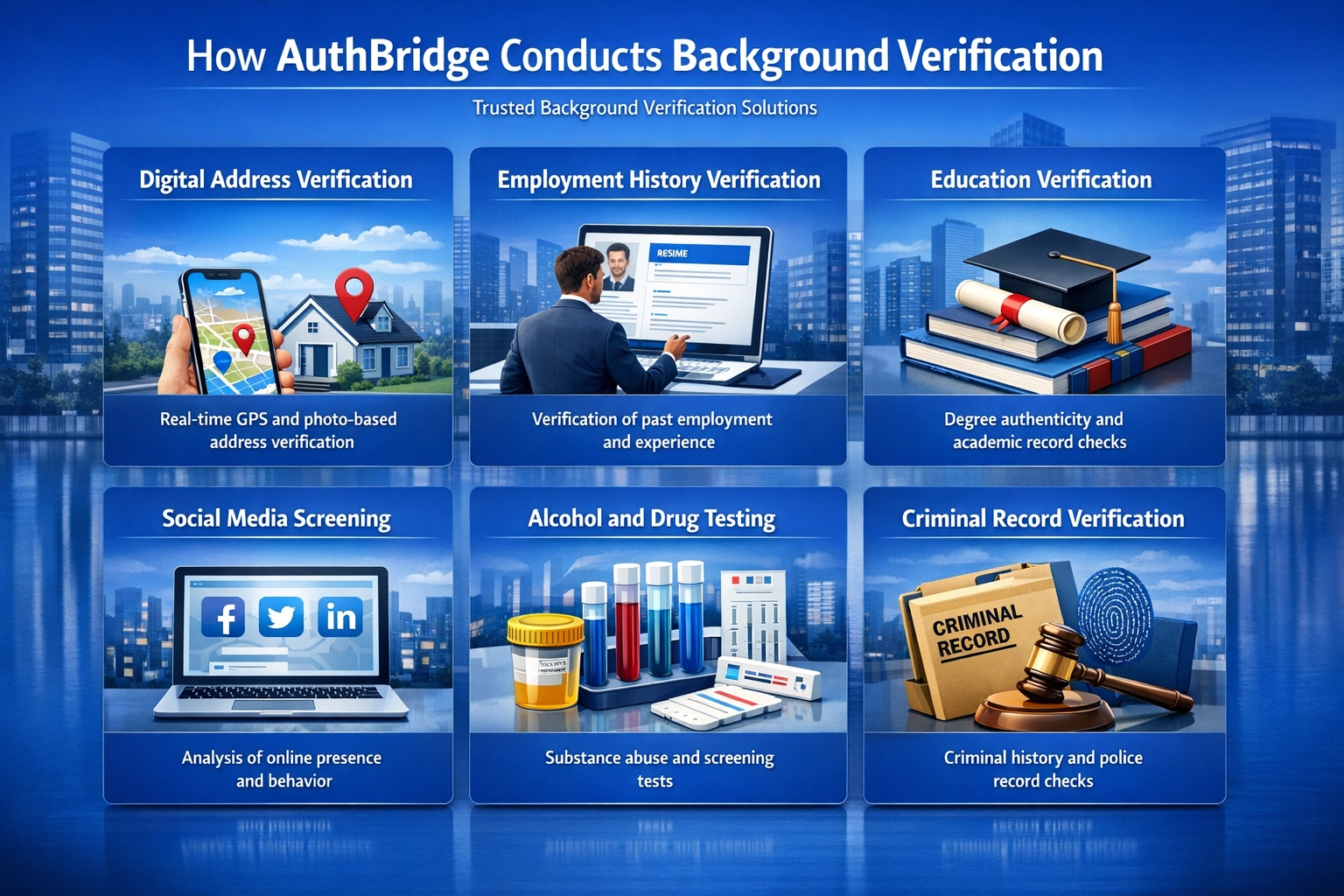
a. Digital Address Verification
Address verification helps confirm if the candidate’s residential details are genuine. AuthBridge uses a combination of digital tools and field verification to ensure accuracy.
How it works:
- Digital Submission: Candidates securely upload their address proof documents through AuthBridge’s platform.
- Document Analysis: Advanced OCR (Optical Character Recognition) technology scans the documents and extracts relevant information.
- Geolocation Verification: Geotagging technology captures the exact coordinates of the address to validate its authenticity.
- Field Verification: In some cases, trained field agents visit the location and upload geotagged photos and data through the AuthBridge mobile app.
- Automated Checks: The system compares location data with the submitted address to ensure accuracy.
This multi-layered approach helps ensure that the address provided by the candidate is legitimate and verifiable.
b. Employment History Verification
Employment verification confirms whether a candidate’s past work experience is genuine.
How it works:
- Request Submission: The employer submits a verification request along with the candidate’s details.
- Document Collection: Relevant employment documents are collected from the candidate or employer.
- Database Screening: Candidate information is checked against AuthBridge’s extensive database.
- Direct Employer Contact: Previous employers are contacted to verify job title, tenure, and other employment details.
- AI-Based Analysis: AI tools analyse the collected data to identify inconsistencies or discrepancies.
- Verification Report: A detailed report is generated and shared with the employer.
This process helps organisations confirm that candidates truly have the experience they claim.
c. Education Verification
Education verification ensures that the academic qualifications listed by the candidate are genuine.
How it works:
- Candidate Input: The candidate provides details such as institution name, roll number, and graduation year.
- Digital Verification: Platforms like DigiLocker allow secure access to university records.
- Identity Confirmation: Candidates verify their identity through Aadhaar authentication and OTP validation.
- Secure Document Retrieval: Verified degrees, marksheets, and certificates are retrieved directly from official databases.
This digital approach reduces the risk of fake degrees or manipulated academic documents.

d. Social Media Screening
Social media screening helps organisations understand a candidate’s public online behaviour and identify potential reputational risks.
How it works:
- Screening Request: The employer submits candidate details and available social media profiles.
- Technology-Based Analysis: AI and automation tools scan publicly available social media activity.
- Profile Review: Analysts review platforms such as LinkedIn, Twitter, and Instagram.
- Content Assessment: Content is evaluated for potential red flags such as inappropriate posts, discriminatory comments, or harmful behaviour.
- Risk Scoring: The system assigns a risk score based on the findings.
- Detailed Report: Employers receive a balanced report highlighting both positive and negative indicators.
This helps companies protect their brand reputation and workplace culture.
e. Alcohol and Drug Testing
Drug and alcohol testing is commonly used in industries where safety and compliance are critical, such as manufacturing, logistics, and healthcare.
How it works:
- Test Scheduling: AuthBridge coordinates with the candidate to schedule a convenient testing appointment.
- Sample Collection: Certified professionals collect samples such as urine, blood, hair, or saliva in a controlled environment.
- Laboratory Testing: Samples are analysed in accredited laboratories using standardised procedures.
- Quality Review: A Medical Review Officer evaluates the results to ensure accuracy and rule out false positives.
- Confidential Reporting: Final results are securely shared with the employer.
This process helps organisations maintain a safe and compliant workplace.
f. Criminal Record Verification
Criminal verification helps employers determine whether a candidate has any past legal cases or criminal records.
How it works:
- Case Initiation: Candidate details such as name and address are entered into the verification system.
- Algorithm-Based Search: Advanced algorithms scan multiple legal and public databases for potential matches.
- Initial Screening: The system generates possible matches based on similarity scores.
- Manual Verification: Experts review the results to ensure accuracy and avoid false matches.
- Final Reporting: Verified findings are compiled and shared with the employer.
This process helps organisations make responsible hiring decisions and maintain workplace safety.
By combining advanced technology, automation, and expert analysis, AuthBridge ensures that background verification is fast, reliable, and scalable. This allows organisations to confidently hire candidates while minimising risks and maintaining compliance.
Conclusion
A strong background verification process not only protects businesses from potential fraud or reputational damage but also helps create a safer and more transparent workplace.
With advancements in technology, background verification has also become faster, more accurate, and easier to manage. Modern solutions allow organisations to conduct multiple checks efficiently while maintaining compliance with data protection and privacy regulations.
Partnering with a trusted background verification provider like AuthBridge enables businesses to streamline their hiring processes while ensuring that every candidate is thoroughly vetted. By combining advanced technology, secure platforms, and industry expertise, AuthBridge helps organisations hire with greater confidence and build teams they can trust.
Ultimately, background verification is not just a hiring formality; it is a strategic step toward building a secure, credible, and future-ready organisation.
Frequently Asked Questions (FAQs)
- Data Accuracy: Ensuring the accuracy and authenticity of the data collected from various sources.
- Timeliness: Completing verifications within a strict timeline to meet hiring deadlines.
- Compliance: Adhering to legal and regulatory requirements, including data privacy laws.
- Complexity: Managing the complexity of verifying diverse information across different regions and industries.
- Data Security: Protecting sensitive candidate information from breaches and unauthorised access.
- Integration with HR Systems: Seamlessly integrating verification processes with the client’s HR management systems.
- Communication with Employers: Maintaining effective communication with previous employers to obtain verification information.
- Verification of International Records: Verifying records from foreign institutions and organisations can be time-consuming and complex.
- Candidate Cooperation: Ensuring candidates provide complete and accurate information for verification.
- Cost Management: Managing the costs associated with extensive background checks without compromising quality.
Yes, Background Verification (BGV) services do cost money. The cost of these services can vary based on several factors:
- Scope of Verification: The more comprehensive the verification, the higher the cost.
- Volume of Checks: Companies that require verification for a large number of candidates may receive bulk pricing, which can lower the cost per check.
- Turnaround Time: Expedited verification services often come at a premium due to the need for faster processing.
- Geographic Coverage: Verifications that require checks in multiple countries or regions may incur additional costs due to the complexity and resources needed.
- Level of Detail: More detailed checks, such as in-depth reference interviews or detailed financial background checks, will be more expensive.
The employer informs the employee of the failure cause; minor issues may allow the employee to continue working with precautions, otherwise, the candidate is not hired.
Conducting background checks in India requires a thorough and compliant approach to avoid common pitfalls. One significant mistake is having an inadequate verification scope, such as skipping crucial checks like criminal or financial backgrounds. Adhering to local laws, like the IT Act and GDPR, is essential to avoid legal issues, and using outdated or incorrect data sources can lead to inaccurate results.
Timeliness and accuracy are key; delays can disrupt hiring, and ignoring red flags without investigation can lead to poor decisions. Proper documentation and understanding of verification results are vital for transparency. Avoiding these mistakes enhances the reliability of background checks, ensuring better hiring decisions and compliance with legal requirements.
Typically, a background verification process takes between a few hours and a few days, depending on the depth and scope of the check.
Yes, employee consent is mandatory before conducting any background verification.