

Hiring the wrong person is expensive. It drains time, disrupts team morale, and in some industries, it can expose your organization to legal and financial risk. Yet despite these consequences, bad hires happen every day across the United States — and in many cases, they could have been prevented. The single most reliable safeguard available to employers? A thorough employment verification check before making any offer final.
Understanding how employment verification works and why it matters is no longer optional for HR professionals. It’s a foundational part of responsible hiring in today’s competitive and compliance-driven job market.
The True Cost of a Bad Hire in the USA
Most hiring managers know that onboarding a new employee takes time and resources. What’s less understood is just how deep the financial damage runs when that hire turns out to be the wrong fit — or worse, dishonest about their credentials.
Some interesting facts
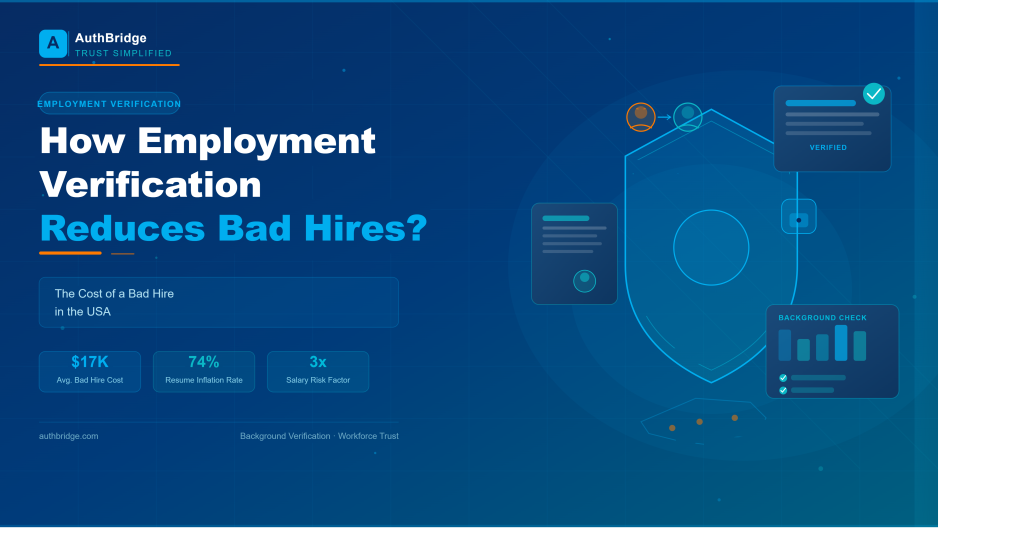
- $17,000 – Average cost of a single bad hire (SHRM estimate)
- 75% – Of HR managers report being affected by a bad hire
- 85% Of job applicants lie on their resumes in some form
According to a CareerBuilder survey, 75% of employers said they had hired the wrong person for a position. More striking is the data from the U.S. Department of Labor, which estimates that a bad hire can cost a company up to 30% of the employee’s first-year earnings. For a mid-level manager earning $80,000, that’s $24,000 — gone.
These numbers don’t factor in the hidden costs: damage to team culture, customer relationships, productivity loss during transition, and the legal exposure from negligent hiring claims. When the background is murky, the risks multiply.
What Employment Verification Actually Covers
Many people confuse employment verification with a simple reference call. In reality, a proper candidate’s background check encompasses a structured, multi-layer review of an applicant’s professional and personal history. Let’s break down what a comprehensive check typically includes:
Core components of employment verification:
- Confirmation of previous job titles and dates of employment
- Verification of educational degrees and certifications
- Criminal background screening at county, state, and federal levels
- Professional license validation (healthcare, finance, legal, etc.)
- Credit history review (for roles involving financial responsibility)
- Social Security Number (SSN) trace and identity verification
- Reference interviews with former supervisors or colleagues
Each of these layers serves a specific purpose. An applicant might list a prestigious title that was never formally assigned. They might claim a degree from a university they attended but never graduated from. Without systematic verification, these discrepancies go undetected — and the employer bears the consequences.
Resume Fraud Is More Common Than You Think
A 2023 report by HireRight found that 85% of employers uncovered a lie or misrepresentation on a candidate’s resume or job application during the screening process. That’s not a small anomaly — it’s an industry-wide problem. The most commonly falsified details include employment dates (to cover gaps), job titles, reasons for leaving, and academic credentials.
According to the Society for Human Resource Management (SHRM), nearly 53% of all job applications contain inaccurate information. Background screening catches a significant portion of these discrepancies before they become your organization’s problem.
In regulated industries — healthcare, financial services, childcare, transportation — credential fraud doesn’t just create internal problems. It can trigger federal investigations, license revocations, and civil liability. The 2022 case of a hospital system in Ohio that employed a nurse with a suspended license, resulting in patient harm, underscores how employment verification is ultimately a matter of public safety.
Verified vs. Unverified Hiring: A Direct Comparison
To understand the practical impact of employment verification, it helps to compare how hiring decisions unfold with and without a formal screening process.
| Factor | Without Verification | With Employment Verification |
| Resume accuracy | ✗ Accepted on trust | ✓ Confirmed against records |
| Criminal history | ✗ Unknown unless disclosed | ✓ County, state & federal check |
| Degree / certifications | ✗ Diploma copies unverified | ✓ Direct institutional confirmation |
| Gap in employment | ✗ Often concealed | ✓ Surfaced by date cross-checks |
| Legal compliance | ✗ Negligent hiring risk | ✓ EEOC & FCRA compliant process |
| Turnover cost | ✗ High — bad hires exit quickly | ✓ Reduced with quality filtering |
| Time-to-productivity | ✗ Unpredictable | ✓ Higher with qualified candidates |
How Technology Is Transforming Background Screening?
The days of faxing paperwork to HR departments and waiting two weeks for a callback are largely behind us. Modern employment verification platforms have automated much of the process, reducing turnaround times from weeks to hours while improving accuracy through data aggregation and AI-assisted record matching.
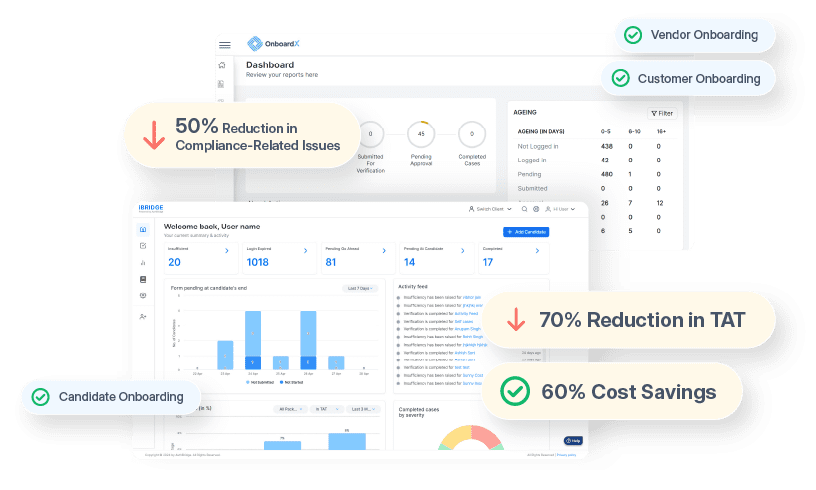
This is where specialized verification providers like Authbridge have made a meaningful difference for organizations navigating the complexity of large-scale hiring. Authbridge delivers tech-enabled background verification solutions that allow employers to run parallel checks — education, employment, criminal, and identity — through a single integrated platform. Rather than chasing down verification manually, HR teams receive consolidated, audit-ready reports that hold up under regulatory scrutiny.
Authbridge’s approach is particularly relevant for organizations operating in high-volume or compliance-sensitive environments. When a retail chain needs to onboard 500 seasonal workers in three weeks, or a fintech startup must meet RBI and SEC-equivalent documentation standards before going live, having a structured, scalable verification workflow isn’t a luxury — it’s a prerequisite for operational readiness.
Legal Obligations Every U.S. Employer Must Know
Employment screening in the United States is governed by the Fair Credit Reporting Act (FCRA), which sets the legal framework for how background checks are requested, conducted, and communicated to candidates. Key obligations include obtaining written consent before initiating a check, providing a pre-adverse action notice before making a rejection decision, and allowing candidates to dispute inaccurate findings.
The Equal Employment Opportunity Commission (EEOC) adds another dimension: blanket exclusion based on criminal records can constitute disparate impact discrimination if not tied to specific, job-related justifications. This means verification must be purposeful — applied consistently, proportionally, and with documented rationale. A proper employment verification program isn’t just about catching fraud; it’s about doing so in a way that is legally defensible and ethically sound.
The ROI of Getting It Right the First Time
According to the Aberdeen Group, organizations with formal background screening programs experience a 23% lower first-year turnover rate compared to those without one. Retention is where the real return on investment lives. When you hire someone who is exactly who they claim to be — qualified, credentialed, with a clean professional record — the investment in onboarding pays off over the long run.
Think of employment verification not as a cost center but as a risk management tool. The $200–$400 you might spend on a thorough background check is a fraction of the $17,000 or more that a bad hire costs in lost productivity, rehiring, and legal exposure. Framed that way, it’s one of the most straightforward returns in all of HR.
Final Thoughts: Build a Culture of Verification
Reducing bad hires isn’t just a process improvement — it’s a mindset shift. Organizations that treat employment verification as a standard, non-negotiable step in hiring signal something important to the market: they take their people seriously, and they protect the individuals already on their team from the damage that an unqualified or dishonest colleague can cause.
In a U.S. labor market where 11 million job openings compete for qualified candidates and the cost of turnover continues to climb, getting the verification step right is one of the few things entirely within an employer’s control. Use it wisely, use it consistently, and partner with platforms that make it seamless. The quality of your workforce begins long before the first day of work — it begins the moment a background check is initiated.