



Introduction To ESG Audit
What Is An ESG Audit?
An ESG audit is a comprehensive assessment of a company’s Environmental, Social, and Governance (ESG) practices. It involves the systematic review of an organisation’s policies, practices, and performance in these three key areas. The audit evaluates whether the company complies with ESG regulations, adheres to best practices, and meets the expectations of stakeholders, including investors, customers, employees, and regulatory authorities, instead of Greenwashing.
ESG audits are extremely important for businesses aiming to align themselves with the increasing global focus on sustainability and corporate responsibility. As climate change, social inequality, and corporate governance become key areas of concern for governments, investors, and the public, businesses are increasingly held accountable for their actions in these domains. This makes ESG audits an important tool for long-term business success, especially going forward in 2026 and beyond.
The Importance & Need Of ESG Audit In India
In India, the importance of ESG audits has been amplified by a series of new regulations and global sustainability commitments, like the country’s 2070 Net Zero target. With the country’s growing emphasis on environmental responsibility, social equity, and good governance, businesses must ensure they are transparent and accountable in their practices.
India has made huge strides in introducing regulations to measure and manage environmental impact. For example, the recent introduction of the GHG Emission Intensity Target Rules 2025 mandates that Indian businesses track their carbon emissions and work toward defined emission reduction targets. These rules, which aim to bring companies in India in line with global climate goals, require them to accurately measure their emissions and report them to regulators.
Moreover, companies are increasingly being asked to disclose their social responsibility efforts and governance structures in response to growing investor demand for sustainable investments. According to a NASSCOM report, 70% of investors are now prioritising ESG factors when making investment decisions.
How ESG Audits Help In Business Sustainability
ESG suits can significantly help companies showcase their efforts towards sustainability and attract potential investments for the future. By conducting regular ESG audits, companies can:
- Meet Regulatory Compliance: Ensure compliance with national and international standards for sustainability and governance, such as the BRSR and the GHG Protocol.
- Attract Sustainable Investment: Enhance their attractiveness to responsible investors who prioritise ESG performance when making investment decisions.
- Improve Operational Efficiency: Identify areas for improving resource efficiency and reducing costs, such as waste management, energy consumption, and water use.
- Strengthen Corporate Reputation: Build trust with customers, partners, and stakeholders by demonstrating transparency and a commitment to ethical business practices.
- Manage Risks: Identify and mitigate environmental, social, and governance risks that could impact the business, from climate-related risks to supply chain sustainability.
Important ESG Standards And Reporting Frameworks
ESG frameworks set clear guidelines for measuring, reporting, and reducing environmental impact, improving social conditions, and ensuring sound governance practices.
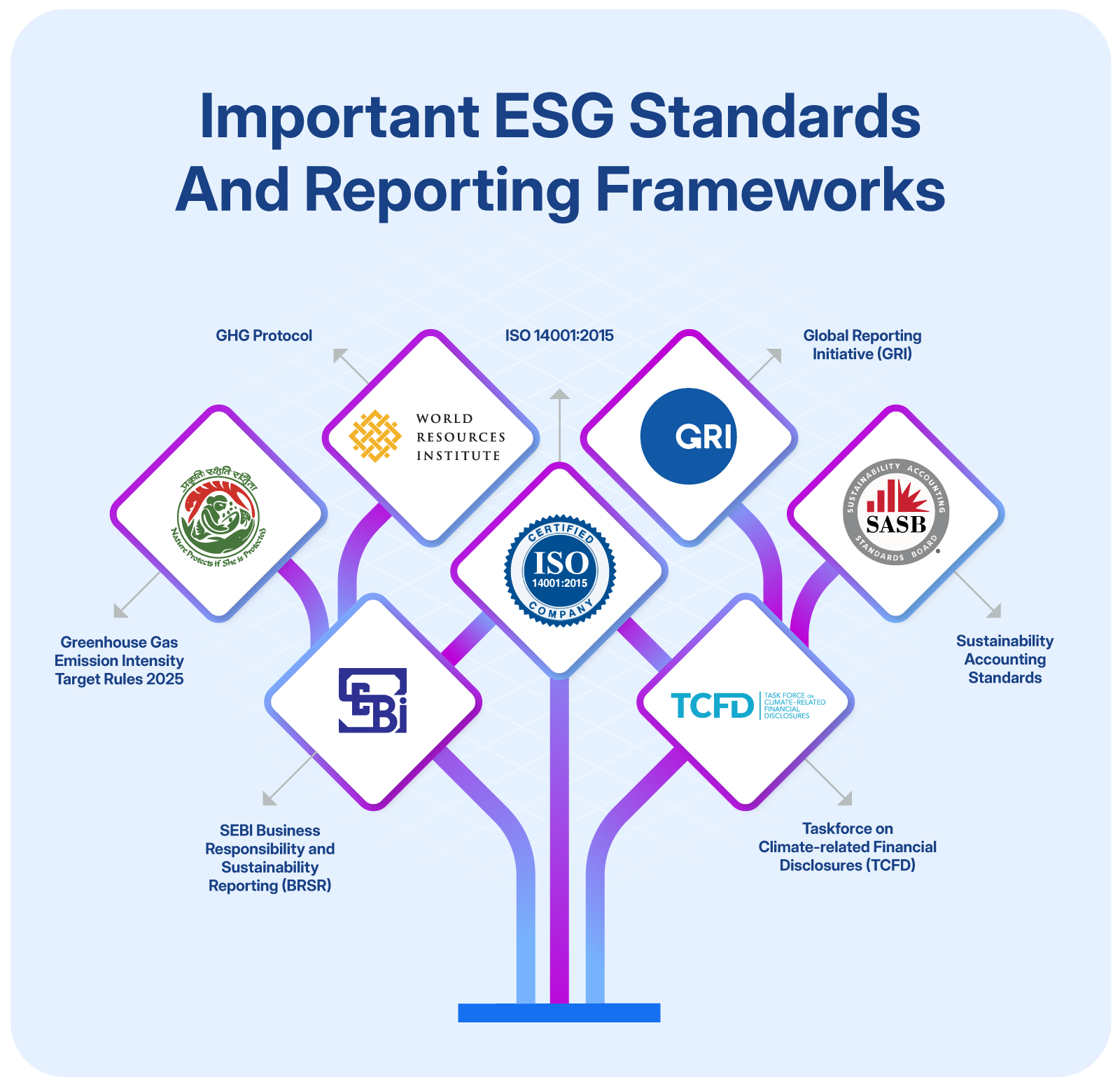
Here, we outline the key ESG frameworks and regulations, focusing on their role in shaping compliance and sustainability efforts in India.
SEBI Business Responsibility and Sustainability Reporting (BRSR)
Introduced by: Securities and Exchange Board of India (SEBI)
Scope: The BRSR framework applies to listed companies in India, mandating the disclosure of their environmental, social, and governance (ESG) practices in a standardised format.
The BRSR was introduced to replace the previous Business Responsibility Report (BRR) under SEBI’s Listing Obligations and Disclosure Requirements (LODR) regulations. The BRSR framework, implemented from the financial year 2021-22, ensures that Indian companies provide comprehensive disclosures on their sustainability efforts. This includes carbon emissions, energy consumption, water usage, waste management, worker health and safety, community engagement, board diversity, and anti-corruption efforts.
The BRSR framework includes two parts:
- BRSR Core: A simplified version for the top 1000 listed companies by market capitalisation.
- BRSR Plus: More detailed disclosures for the remaining companies.
Greenhouse Gas Emission Intensity Target Rules 2025
Introduced by: Ministry of Environment, Forest and Climate Change (MoEFCC)
Scope: These rules apply to high-emission industries such as cement, aluminium, steel, pulp and paper, and chlor-alkali.
The GHG Emission Intensity Target Rules 2025 are India’s first legally binding regulations on industrial carbon emissions. These rules require specified industries to reduce their emission intensity (measured in tonnes of CO₂ equivalent per unit of product) compared to a baseline year (2023–24). The rules target a 20% reduction in carbon intensity by 2030. The framework allows companies to earn carbon credits if they exceed their reduction targets, which can then be traded on the carbon market.
GHG Protocol
Introduced by: World Resources Institute (WRI) and World Business Council for Sustainable Development (WBCSD)
Scope: The GHG Protocol provides globally recognised guidelines for businesses and governments to measure, manage, and reduce their greenhouse gas emissions across three “scopes”:
- Scope 1: Direct emissions from owned or controlled sources.
- Scope 2: Indirect emissions from the generation of purchased electricity consumed by the company.
- Scope 3: Other indirect emissions from sources not owned or controlled by the company, such as supply chains and product usage.
The GHG Protocol is the standard framework for measuring and reporting emissions in a consistent manner that is globally recognised. Using the GHG Protocol allows companies to quantify and disclose their carbon footprint, enabling them to manage and reduce emissions efficiently.
ISO 14001:2015
Introduced by: International Organisation for Standardisation (ISO)
Scope: ISO 14001:2015 is a globally recognised standard for Environmental Management Systems (EMS). It provides a framework for businesses of all sizes to manage and reduce their environmental impact.
The ISO 14001 standard outlines the criteria for setting up an EMS that helps companies minimise their environmental footprint, ensure compliance with regulations, and improve their sustainability efforts continuously. It requires companies to focus on resource efficiency, waste reduction, energy use, and emissions control.
Global Reporting Initiative (GRI)
Introduced by: Coalition for Environmentally Responsible Economies (CERES) and the Tellus Institute, in partnership with the United Nations Environment Programme (UNEP)
Scope: The GRI standards are the most widely used sustainability reporting framework globally. They focus on economic, environmental, and social impacts and guide businesses in reporting on a broad range of sustainability issues.
The GRI Standards are intended to help businesses report on their sustainability practices transparently and comprehensively. Companies are encouraged to disclose both positive and negative impacts, ensuring that stakeholders can make informed decisions. By adhering to GRI, companies can enhance their transparency, demonstrate their commitment to sustainability, and attract sustainable investment.
Sustainability Accounting Standards Board (SASB)
Introduced by Jean Rogers in 2011
Scope: SASB provides industry-specific standards for sustainability disclosures. It focuses on material issues that affect financial performance across 77 industries.
The SASB Standards are designed to help companies disclose financially material sustainability information in a way that is comparable across industries. These standards focus on climate change, water management, human capital management, and other key issues that influence a company’s financial performance. In India, SASB standards are particularly relevant for sectors like energy, finance, and manufacturing, which face unique sustainability challenges.
Taskforce on Climate-related Financial Disclosures (TCFD)
Introduced by: The Financial Stability Board (FSB) in 2015
Scope: The TCFD provides recommendations for disclosing climate-related risks and opportunities in financial filings.
The TCFD Recommendations are designed to help companies disclose how climate-related risks affect their governance, strategy, risk management, and financial performance. It encourages businesses to disclose how climate change impacts long-term strategy and capital planning.

How ESG Audits Help Companies Comply with Regulatory Requirements
Ensuring Compliance with India’s GHG Emission Intensity Target Rules
The GHG Emission Intensity Target Rules 2025 introduced by the Bureau of Energy Efficiency (BEE) require high-emission industries such as cement, aluminium, steel, and energy to reduce their carbon intensity by 20% by 2030, relative to a baseline year of 2023–24. This regulatory framework mandates that companies track and report their emissions accurately, making ESG audits indispensable in the process.
Through ESG audits, companies can:
- Accurately measure and verify their emissions: ESG audits ensure that businesses track their carbon emissions in line with the GHG Protocol, which is the global standard for measuring and managing greenhouse gas emissions. This measurement is essential for reporting emissions in a consistent manner that aligns with regulatory expectations.
- Identify areas for emissions reduction: ESG audits help companies identify key areas where they can reduce carbon emissions. For instance, an audit might highlight energy inefficiencies in manufacturing processes or excess energy consumption in production lines, providing insights into how businesses can adopt cleaner technologies or improve energy efficiency.
- Ensure proper reporting for compliance: Once the emissions are accurately measured and reported, ESG audits validate the data, ensuring that it meets the regulatory standards and is ready for submission to government authorities. These audits help verify that businesses are not only compliant with the GHG Emission Intensity Target Rules but are also positioning themselves as leaders in climate risk management.
Without these audits, businesses risk non-compliance and potential penalties, especially as the Indian government increases its monitoring of emissions and introduces stricter enforcement mechanisms under the Carbon Credit Trading Scheme.
Supporting Compliance with SEBI’s BRSR Guidelines
ESG audits play a crucial role in ensuring that companies meet BRSR compliance by:
- Verifying the accuracy of ESG disclosures: ESG audits provide third-party validation of the data disclosed under BRSR, helping businesses ensure that their carbon footprint, water usage, waste management, and employee welfare practices are reported accurately and honestly.
- Identifying gaps in sustainability practices: The audit process helps identify discrepancies between reported ESG data and actual practices. For example, a company might report reduced water consumption but might have inefficient water management practices that have not been fully implemented. ESG audits highlight such gaps and suggest corrective actions.
- Improving stakeholder trust: Through verified disclosures, businesses build greater trust with investors, regulators, and consumers. Regular ESG audits ensure that companies’ sustainability efforts are not only compliant with SEBI guidelines but are also consistent with best practices in global ESG reporting.
Aligning with International Standards: GRI, SASB, and ISO 14001
As India’s companies continue to grow and expand globally, aligning with international standards is becoming increasingly important. Global Reporting Initiative (GRI) and Sustainability Accounting Standards Board (SASB) are two such frameworks that help businesses disclose their sustainability performance in a structured and globally recognised manner. By aligning with these frameworks through ESG audits, Indian businesses ensure they remain competitive on a global scale while adhering to national regulatory standards.
The Role of TCFD in Climate Risk Management
ESG audits based on TCFD help businesses:
- Disclose climate risks: ESG audits verify that companies are properly identifying and disclosing physical risks (e.g., exposure to extreme weather events) and transition risks (e.g., regulatory changes related to carbon pricing).
- Assess financial impacts: ESG audits ensure that companies have included climate risks in their financial planning and capital allocation, in line with TCFD recommendations.
- Build investor confidence: By transparently disclosing climate risks, businesses can gain investor trust, especially as climate risk is becoming an essential consideration for sustainable investment.
Steps Involved In ESG Audits
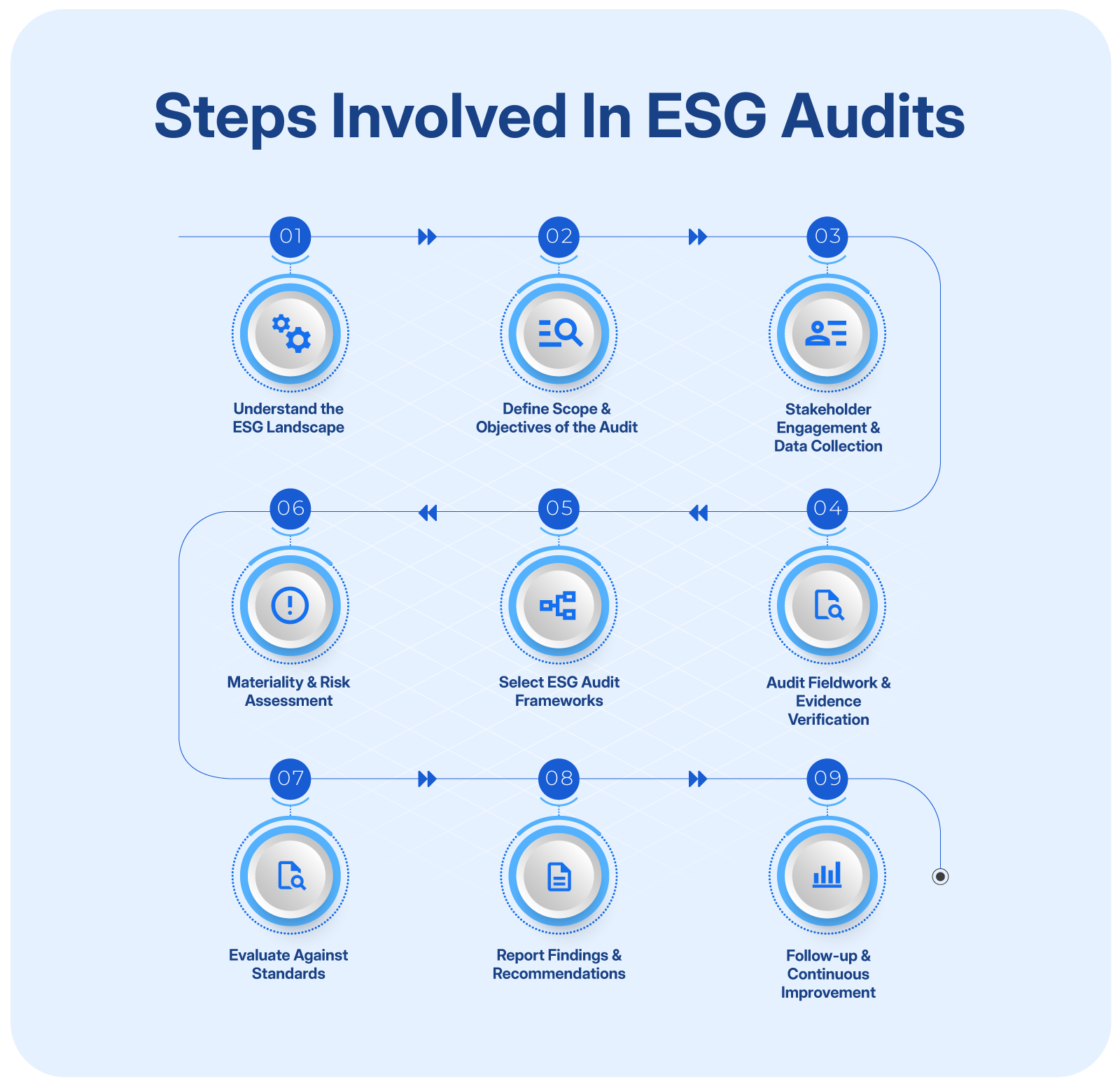
1. Understand the ESG Landscape
This step involves getting a clear understanding of the company’s current position regarding ESG factors. This includes reviewing the company’s existing ESG strategy, identifying potential ESG risks, and understanding the expectations of stakeholders (such as investors, customers, and employees). It helps the audit team to understand where the company stands on sustainability, governance, and social practices, setting the stage for the audit process.
2. Define Scope & Objectives of the Audit
This step is about defining which areas of ESG the audit will cover. Will the audit focus on all three pillars, Environmental, Social, Governance, or just one? The goals of the audit are also set here: Is the audit for compliance verification, to identify risks, or to improve reporting accuracy? Clearly defining the scope ensures the audit is aligned with the company’s objectives and that resources are used effectively.
3. Stakeholder Engagement & Data Collection
In this phase, the audit team engages with key stakeholders (e.g., company leaders, employees, suppliers) to gather insights into the company’s ESG practices. They also collect all relevant data, such as environmental impact reports, employee welfare policies, governance structures, and sustainability initiatives. Collecting reliable data and feedback from various sources helps the auditors understand the true picture of the company’s ESG performance.
4. Materiality & Risk Assessment
In this step, the auditors assess which ESG issues are most material (or important) to the company. For example, a company in the energy sector may focus more on its carbon emissions, while one in the tech industry may focus on data privacy and cybersecurity. The auditors also identify potential risks that could harm the company’s sustainability or reputation. Materiality assessment helps prioritise ESG issues that need attention, ensuring that the audit focuses on the most significant areas.
5. Select ESG Audit Frameworks
This step involves selecting established ESG frameworks (like the ones we mentioned above) for the audit. These frameworks provide structured, industry-recognised guidelines for measuring and reporting ESG performance, ensuring that the audit results are consistent and reliable.
6. Audit Fieldwork & Evidence Verification
This is the core audit phase where auditors collect evidence to verify whether the company’s ESG practices match the information reported. This may include reviewing documents like energy consumption reports, employee health and safety data, governance policies, and examining records for compliance with environmental laws or labour standards. Verifying the data and checking for consistency ensures that the reported ESG performance is accurate, complete, and trustworthy.
7. Evaluate Against Standards
Once the data is collected and verified, auditors compare the company’s ESG performance to the standards and criteria outlined in the selected frameworks (like GRI, SASB, or TCFD). This step identifies areas where the company meets the standards and where there are gaps. This evaluation helps to highlight areas where the company is excelling or needs improvement in terms of ESG practices. It also shows the level of compliance with global standards.
8. Report Findings & Recommendations
After completing the audit, the auditors prepare a report that documents the findings. This report includes:
- Positive outcomes: Areas where the company is performing well.
- Weaknesses or gaps: Areas where the company falls short of ESG expectations or where improvements are needed.
- Recommendations: Concrete steps the company can take to improve ESG practices, meet regulatory requirements, or align with industry standards.
The report serves as a roadmap for the company to understand its ESG performance and improve where necessary. It can also be used to communicate with stakeholders (like investors or regulators) about the company’s ESG efforts.
9. Follow-up & Continuous Improvement
After the audit, the company should follow up on the audit recommendations by taking action to correct deficiencies or improve practices. Continuous monitoring may be needed to track progress. The company might set up regular internal ESG audits to ensure ongoing compliance and performance improvement. An ESG audit is not a one-time event. The follow-up ensures the company continues to improve its ESG practices, address new risks, and stay aligned with changing regulations.
Why Should Companies Invest In ESG Audits?
As India pushes ahead with sustainability regulations, businesses must keep pace with changing laws and rising expectations from investors, customers, and employees. The introduction of GHG Emission Intensity Target Rules 2025 and SEBI’s BRSR guidelines have made it clear: companies that fail to integrate sustainability into their operations are at risk of falling behind.
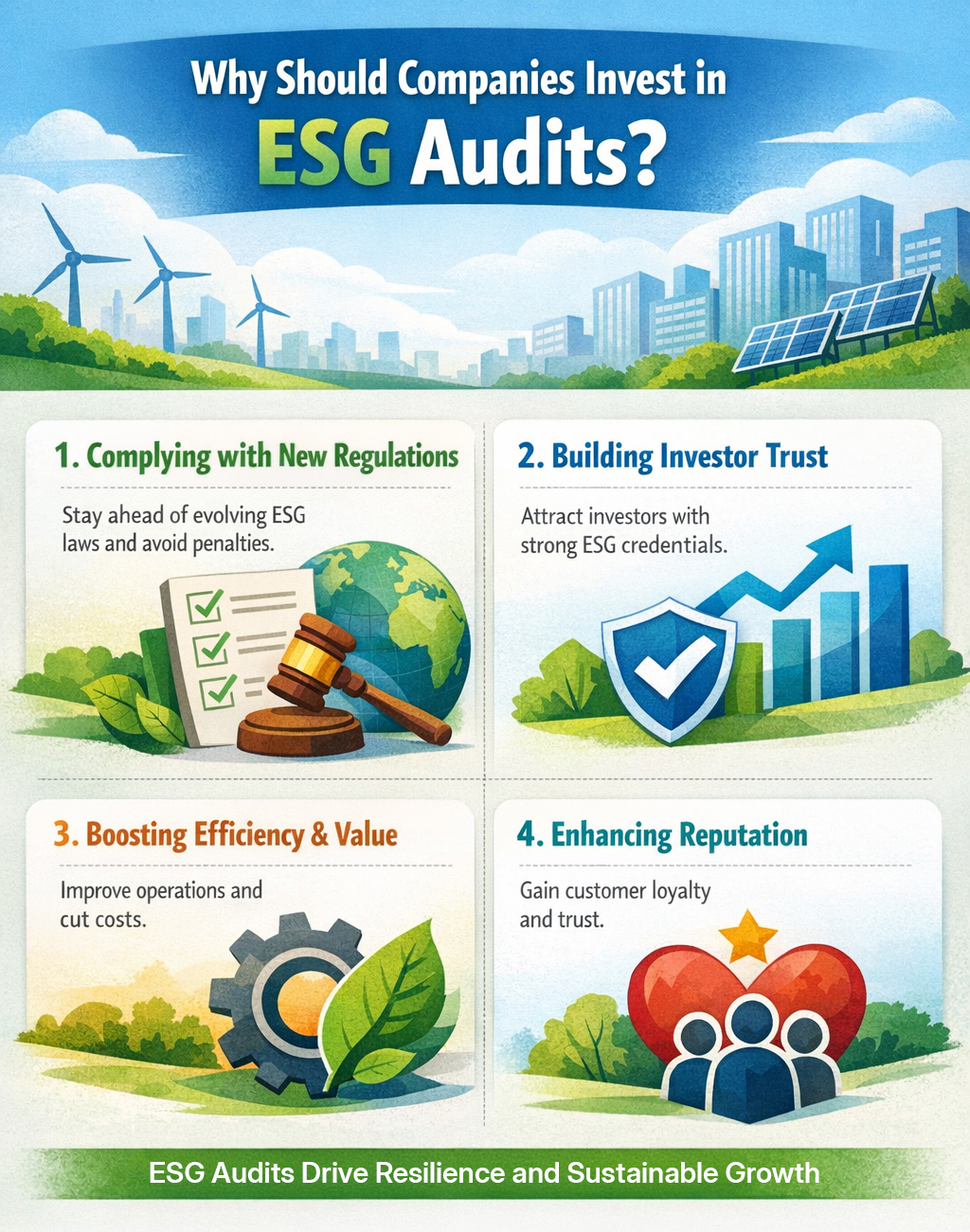
In this context, ESG audits are fast becoming a necessity for business resilience and growth.
The Growing Pressure To Comply With New Regulations
Sectors like cement, steel, and energy have to cut their carbon intensity by 20% by 2030. This is a huge shift, and for businesses, it means that the GHG reduction target is mandatory.
But here’s the thing: these GHG targets are just the beginning. Over the next few years, we’ll see an acceleration in environmental regulations, and businesses will need to keep pace with ever-evolving laws. This is where ESG audits play a crucial role. By ensuring accurate carbon emissions reporting, identifying compliance gaps, and spotting opportunities for emissions reduction, ESG audits ensure that businesses exceed their regulatory targets, positioning themselves as leaders in corporate sustainability.
Think of an ESG audit as a compass. It’s about knowing where you stand in relation to compliance and understanding what needs to change to meet both current regulations and future expectations. Without it, companies risk falling short on regulatory demands or, worse, facing penalties or reputational damage from non-compliance.
Building Investor Trust and Gaining Market Confidence
Today’s investors are not just looking at financial returns, but sustainability as well. ESG performance is now a key factor in investment decisions. So, how can businesses make themselves attractive to investors? By proving they are on top of their ESG game. Investors want clear, reliable data on a company’s environmental practices, social impact, and governance structure.
An ESG audit ensures that businesses can provide verified and transparent ESG data that’s not just compliant with regulations like BRSR but also aligned with global standards. Whether it’s carbon emissions, employee well-being, or corporate governance, investors expect businesses to be open about their sustainability practices.
When investors see that a company has verified ESG data, backed by independent audits, they are more likely to view the company as a safe bet, reducing their perceived risk. For businesses aiming to raise capital or attract long-term investments, ESG audits are a gateway to credibility and a stronger market position. It’s not just about avoiding greenwashing; it’s about genuine transparency that builds trust with current and future investors.
Operational Efficiency and Long-Term Value
While compliance and investor confidence are the most immediate drivers for ESG audits, there’s a strategic benefit that’s often overlooked: operational efficiency. ESG audits highlight areas where businesses can improve and optimise their operations.
Take energy consumption as an example. An energy audit through an ESG framework might reveal opportunities to reduce energy waste, adopt renewable energy, or optimise manufacturing processes. These improvements, while reducing environmental impact, also lead to cost savings—something every business can appreciate. Similarly, waste management, water use, and resource allocation are areas where ESG audits can bring substantial efficiency improvements, all of which contribute to long-term sustainability and profitability.
As consumer preferences shift toward sustainable brands, companies that adopt proactive ESG strategies will enjoy competitive advantages in the marketplace. An ESG audit provides the roadmap to get there, helping businesses understand what’s working, what’s not, and where growth opportunities lie.
Enhancing Reputation and Customer Loyalty
In today’s market, customers are paying more attention to the sustainability practices of the brands they support. Whether it’s about reducing carbon footprints, ensuring fair labour practices, or improving product traceability, consumers want to align with companies that share their values. ESG audits play a crucial role in ensuring that businesses are not only compliant with regulations but also able to communicate their sustainability efforts clearly to their customer base.
When a company can demonstrate that its sustainability claims are backed by verified audits, it builds trust and loyalty with customers. In sectors like retail or consumer goods, where customer loyalty is crucial, the ability to show commitment to environmental stewardship and social responsibility through audited ESG data can be a game-changer.
How AuthBridge Helps Streamline ESG Audits For Businesses In India?
At AuthBridge, we understand the complexities of ESG compliance and the importance of accurate reporting. Our ESG audit services are designed to help businesses navigate the complexities of environmental regulations, social responsibilities, and governance best practices.
Our work with clients like GHCL, a leading chemical fertiliser company, showcases the impact of effective ESG auditing. By streamlining their ESG readiness, we enabled them to align their sustainability practices with global standards while improving their operational efficiency and reporting credibility.
As businesses continue to face mounting pressure from regulators, investors, and customers, AuthBridge offers the expertise and tools needed to ensure compliance, mitigate risks, and create lasting value through strategic ESG audits.
Conclusion
As regulations around sustainability get stricter, businesses must move beyond compliance to ensure long-term resilience. ESG audits are essential for not only meeting environmental regulations but also for improving operational efficiency, building investor trust, and achieving sustainable growth.
This blog has been verified by a certified expert in ESG performance measurement, ensuring that all insights are factually accurate and aligned with industry standards. AuthBridge is committed to guiding your business through the complexities of ESG audits, ensuring you not only comply with the law but also thrive in a sustainable future.