
The rise of remote hiring has fundamentally changed how American companies build their teams. Today, a software engineer in Mumbai, a marketing strategist in Berlin, or a financial analyst in São Paulo can be just as much a part of your workforce as someone sitting two floors below you. But with this global talent pool comes a critical responsibility that many employers underestimate — verifying international work experience with the same rigor they apply to domestic candidates.
As someone who has worked in the U.S. employment industry for over a decade, I can tell you this is where many companies cut corners, and where the consequences can be severe. According to a 2023 HireRight Employment Screening Benchmark Report, nearly 85% of employers uncovered a lie or misrepresentation on a resume during the screening process. When international candidates are involved, that number climbs further due to the added complexity of cross-border verification.
Before we go deeper, here are the core screening solutions your HR team should be working with for every hire — domestic or international:
- Employment Verification Check — Confirm job titles, dates, and responsibilities directly with past employers.
- Education Verification Check — Validate degrees, diplomas, and certifications from institutions abroad.
- Criminal Background Check — Essential for roles involving sensitive data, finances, or vulnerable populations.
- NATCRIM (National Criminal Database Check) — A broad multi-jurisdictional criminal search across U.S. databases.
- Reference Check Service — Gather structured feedback from prior managers and colleagues.
- Credit History and Bankruptcy Check — Relevant for finance and fiduciary roles.
- Drug Screening Solution — Ensure workplace safety standards are upheld across the board.
- Motor Vehicle Record (MVR) Check — For roles involving driving or fleet management.
- Introducing FIRM™ (Identity Fraud Solutions) — Detects fraudulent identities at the point of hire before onboarding.
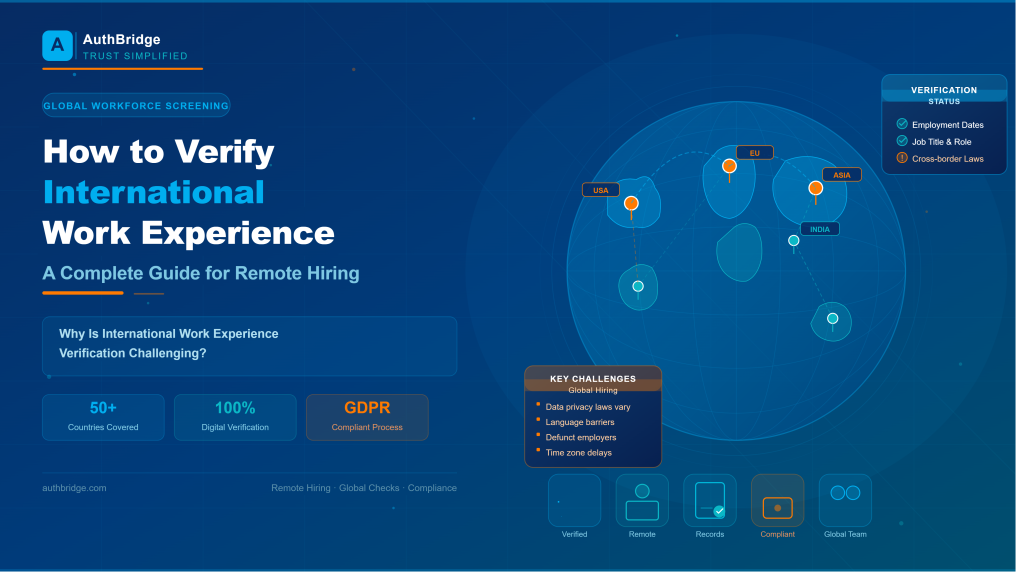
Why Is International Work Experience Verification Challenging?
Verifying a candidate’s work history in the United States follows a somewhat predictable path — call the HR department, confirm the dates and title, move on. When you extend that process overseas, you’re suddenly dealing with:
- Language barriers that make written communication difficult
- Time zone differences that slow response times from weeks to months
- Varying record-keeping norms — in some countries, employment records are held by government bodies, not companies
- Defunct employers — businesses that no longer exist, especially in volatile economies
- Privacy laws like GDPR in Europe that restrict how much information employers can legally share
- Document authenticity challenges — fake diplomas, fabricated employment letters, and inflated job titles are a global problem
The stakes are real. A 2022 survey by the Society for Human Resource Management (SHRM) found that 56% of organizations reported having made a bad hire in the previous year, with the average cost of a bad hire estimated at $17,000 or more. For senior roles, that number can easily exceed $240,000 when you factor in onboarding, training, and team disruption.
Step-by-Step: How to Verify International Work Experience
1. Start with a Structured Employment Verification Request
The first step is always direct outreach — contacting the candidate’s previous employer. Ask for:
- Official confirmation of employment dates
- Job title held and department
- Reason for leaving (where legally permissible)
- Eligibility for rehire
Send requests in writing and follow up with a phone call. If you’re hiring in non-English-speaking regions, have translation support ready or work with a local verification partner.
2. Request and Authenticate Supporting Documents
Ask candidates to provide:
- Employment letters or contracts from previous employers
- Pay stubs or tax documents (where applicable)
- References from direct supervisors
- Work permits or visa documentation, if relevant
Cross-reference these with what the candidate has stated on their resume. Even minor inconsistencies in dates or titles should be flagged for follow-up.
3. Leverage Third-Party Background Screening Partners
This is where working with a specialized provider makes a significant difference. Platforms like AuthBridge maintain established relationships with verification networks across multiple countries, allowing them to contact foreign employers, authenticate documents, and provide turnaround times that would be impossible for an internal HR team to match independently.
4. Use International Reference Checks
References from international colleagues are invaluable, but they require a structured approach. A good reference check isn’t just asking “Was this person a good employee?” It’s asking behavioral, situational, and performance-specific questions that reveal how someone actually worked.
5. Cross-Reference with LinkedIn and Professional Networks
While not a substitute for formal verification, cross-referencing a candidate’s stated experience with their LinkedIn profile, industry databases, or professional association memberships can surface inconsistencies quickly. Dates that don’t align, titles that differ, or employers that don’t exist are red flags worth investigating.
Domestic vs. International Work Experience Verification: Key Differences
| Factor | Domestic Verification | International Verification |
| Average Turnaround Time | 1–3 business days | 5–15+ business days |
| Language Barrier | None | Frequent — may require translation |
| Legal/Privacy Restrictions | FCRA (Fair Credit Reporting Act) | GDPR, local data privacy laws |
| Document Authentication | Generally straightforward | May require apostille or notarization |
| Employer Reachability | High | Variable — depends on country |
| Risk of Falsification | Moderate | Higher — harder to verify directly |
| Database Availability | Extensive (SSA, IRS, etc.) | Limited — often no centralized records |
| Cost | Lower | Higher — due to complexity and reach |
Understanding Legal Compliance for International Screens
U.S. employers using consumer reporting agencies for background checks must comply with the Fair Credit Reporting Act (FCRA) — even when screening international candidates hired domestically or remotely. Additionally, if your candidate is based overseas, you must also be aware of:
- GDPR (Europe): Restricts how personal data is processed and shared
- PIPEDA (Canada): Canada’s equivalent of GDPR for personal information
- PDPA (various Asia-Pacific countries): Governs personal data protection in Singapore, Thailand, and others
- Labor Laws by Country: Some jurisdictions prohibit employers from confirming or denying employment to third parties without written consent
This is exactly why working with a compliance-aware verification partner is non-negotiable. AuthBridge operates with awareness of both U.S. FCRA obligations and international data privacy frameworks, which matters enormously when your candidate pipeline spans multiple jurisdictions.
Common Red Flags During International Employment Verification
After years in this field, certain patterns consistently emerge as warning signs:
- Employment dates that overlap suspiciously with educational timelines
- Employers that cannot be located through any directory, database, or online source
- Sudden gaps in employment that the candidate hasn’t addressed proactively
- Job titles that are unusually senior for the candidate’s stated years of experience
- References who seem to have a scripted response or cannot recall specific details
- Documents that appear freshly typed, lack proper letterheads, or carry inconsistent formatting
None of these automatically disqualifies a candidate, but each one warrants a deeper conversation and a more thorough investigation.
How Remote Hiring Has Raised the Bar for Screening
Remote hiring has democratized talent acquisition in extraordinary ways. A U.S. startup can now compete with Silicon Valley giants by hiring engineers in Eastern Europe or data scientists in Southeast Asia — and win. But with this access comes accountability.
When a remote hire fails — whether due to skill inflation, misrepresented credentials, or undisclosed professional misconduct — the damage isn’t just operational. It’s a trust issue. Your team has worked alongside someone whose qualifications were never what they claimed. That erodes morale, creates legal exposure, and in certain industries (finance, healthcare, childcare), poses genuine safety risks.
The solution isn’t skepticism toward international talent. It’s a smarter, more systematic approach to verification that treats every candidate — regardless of geography — with the same standard of due diligence.
Comparison: In-House Verification vs. Third-Party Screening Providers
| Criteria | In-House HR Team | Third-Party Provider (e.g., AuthBridge) |
| International Network Access | Limited | Extensive — global partner network |
| Compliance Expertise | Variable | Built-in FCRA + international frameworks |
| Turnaround Speed | Slow for international checks | Optimized through established channels |
| Cost (per hire) | Higher at scale | More cost-effective |
| Document Authentication | Manual and time-consuming | Automated + expert review |
| Scalability for Remote Hiring | Difficult | Designed for high-volume and global use |
Frequently Asked Questions (FAQs)
Q1. Can a U.S. employer legally conduct background checks on international candidates?
Yes, U.S. employers can conduct background checks on international candidates, but they must comply with both U.S. laws (particularly the FCRA if using a consumer reporting agency) and the relevant data privacy laws of the country where the candidate resides. Always obtain written consent before initiating any background check, and work with a provider familiar with international legal frameworks.
Q2. How long does international employment verification typically take?
It varies widely depending on the country, industry, and availability of the former employer. In general, international verification takes anywhere from 5 to 15 business days, though checks in certain regions (e.g., parts of Africa, South Asia) can take longer. Using a specialized provider with in-country contacts significantly shortens this timeline.
Q3. What documents should I request from a candidate with international work experience?
At a minimum, request employment offer or appointment letters, relieving letters or experience certificates, pay stubs or bank statements (if verifying compensation), and a valid government-issued ID. For roles requiring professional licensing, also request certified copies of relevant credentials.
Q4. What happens if a former international employer no longer exists?
This is more common than you’d expect, particularly for candidates from economies with high business turnover. In such cases, pivot to secondary verification methods: tax records, professional references who can corroborate employment, and any government employment records available in that jurisdiction. Document your verification effort thoroughly — regulators want to see that due diligence was attempted, not just that it succeeded.
Q5. Is it necessary to verify education credentials alongside work experience?
Absolutely. In fact, for international candidates, education verification is often where the most significant discrepancies surface. Diploma mills and credential fraud are serious problems in several regions. Running an Education Verification Check in tandem with employment verification gives you a complete and accurate picture of the candidate’s background — which is exactly what sound remote hiring demands.