

When it comes to hiring the right talent, employers in the United States are navigating an increasingly complex landscape. Resume fraud is not a fringe problem — it’s a widespread reality. According to recent data, as many as 107 million Americans have falsified their resumes to secure employment. In this environment, conducting a thorough employment verification check before extending a job offer isn’t just good practice — it’s essential risk management.
But here’s where many HR professionals and hiring managers get confused: employment verification and reference checks are not the same thing. Both are critical components of a robust hiring process, yet they serve fundamentally different purposes, draw from different sources, and reveal very different kinds of information. Understanding where one ends and the other begins can mean the difference between a confident hire and a costly mistake.
What Is Employment Verification?
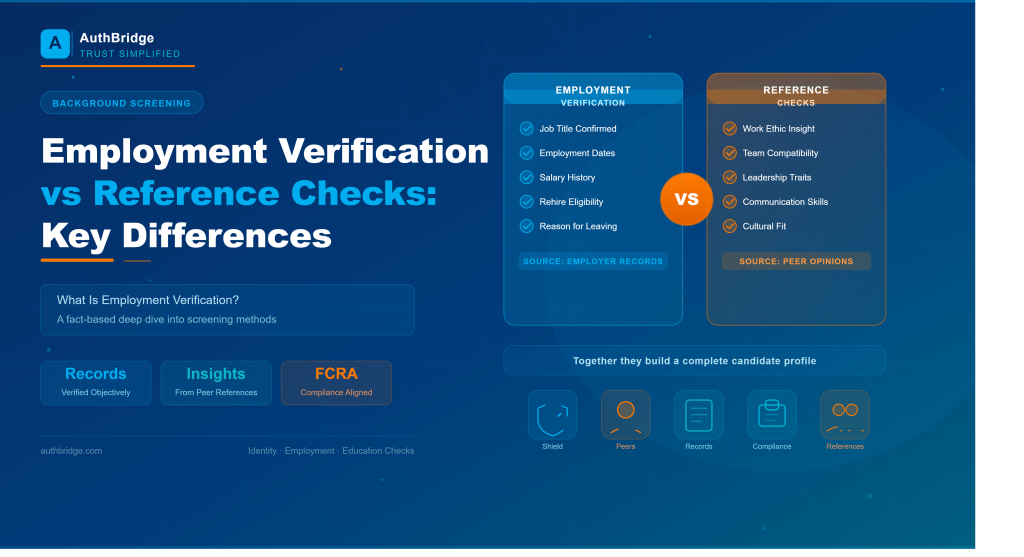
Employment verification is a factual, document-driven process. Its entire purpose is to confirm whether the information a candidate has provided on their resume or job application is accurate. This includes verifying:
- Job titles held at previous employers
- Dates of employment (start date, end date)
- Reason for leaving (in jurisdictions and situations where this is disclosed)
- Eligibility for rehire
- Departments or divisions worked in
The process typically involves directly contacting previous employers, accessing third-party verification databases, or using the Social Security Administration’s verification tools for identity-linked employment records. It is objective, structured, and largely binary — the information either checks out or it doesn’t.
A proper candidates background check goes well beyond just employment history. It forms the backbone of a multi-layered screening process that might also include a candidate’s Criminal Background Check to identify undisclosed legal history, or a candidate’s education verification check to confirm degrees and certifications that were listed on the application.
Why Employment Verification Matters More Than Ever?
The numbers are hard to ignore. Research shows that 87% of discrepancies detected during background checks fall within employment and academic verifications. Meanwhile, 46% of reference and credential checks reveal a discrepancy between what applicants claimed and what the screening actually uncovered. And perhaps most jarring: 1 in 4 background checks uncovers some form of discrepancy between what candidates claim and what is actually true.
These aren’t just embarrassing oversights. Bad hires cost companies real money. US companies lose an estimated $400 billion a year due to employee fraud and theft, and businesses lose $50 billion annually from employee theft alone. The investment in thorough pre-hire screening pays dividends that are hard to overstate.
What Is a Reference Check?
A reference check is an entirely different animal. Where employment verification deals in facts, reference checks deal in perception — specifically, the perception of former supervisors, managers, or colleagues who worked directly with the candidate.
During a reference check, a recruiter or HR professional contacts individuals listed by the candidate and asks questions about:
- Work ethic and reliability
- Interpersonal skills and team dynamics
- Problem-solving and performance under pressure
- Specific accomplishments or contributions
- Subjective strengths and areas for development
The goal is to understand what kind of employee this person was — something that a date and job title simply cannot tell you. A candidate might have genuinely worked at a company for three years in a specific role, and yet have been a poor performer, a difficult colleague, or someone who left under uncomfortable circumstances. Employment verification won’t surface. A candid reference conversation might.
Employment Verification vs Reference Checks: Side-by-Side Comparison
| Feature | Employment Verification | Reference Check |
| Primary Purpose | Confirm factual accuracy of resume claims | Assess candidate’s qualitative performance and character |
| Information Type | Objective / Factual | Subjective / Opinion-based |
| Source | Previous employers, databases, government records | Former supervisors, colleagues, mentors |
| What It Confirms | Job title, employment dates, rehire eligibility | Work ethic, personality, team dynamics |
| Legal Sensitivity | Moderate (FCRA compliance required) | Higher (risk of defamation, discrimination claims) |
| Speed | Can often be completed in hours to days | Typically 2–5 business days depending on availability |
| Risk Detected | Résumé fraud, identity misrepresentation | Poor performance, cultural misfit, behavioral red flags |
| Required for Compliance | Often required (especially for regulated industries) | Generally best practice, not always mandated |
| Candidate’s Control Over It | Low — verified independently | High — candidate selects references |
This table illustrates something important: these two processes are complementary, not interchangeable. Skipping one in favor of the other creates blind spots that could haunt an organization long after the offer letter is signed.
Common Mistakes Employers Make
Treating reference checks as a formality. Many employers go through the motions of calling references only to ask surface-level questions and accept vague answers. If done carelessly, reference checks add no real value to the process.
Skipping employment verification because “it takes too long.” This is a dangerous shortcut. Given that the most common resume lies involve altering dates of positions held (50%), followed by exaggerating responsibilities (32%), skipping verification leaves employers exposed to candidates who have constructed fictional career histories.
Relying solely on candidate-selected references. Candidates naturally provide references who will speak positively about them. Some organizations address this by conducting “back-channel references” — reaching out to mutual connections not listed by the candidate. However, this approach carries its own legal and ethical considerations and should be handled carefully.
Not understanding FCRA obligations. In the United States, background checks conducted by third-party screening companies are governed by the Fair Credit Reporting Act (FCRA). Employers must obtain written consent from candidates before initiating a background check and must follow specific adverse action procedures if screening results factor into a hiring decision.
How AuthBridge Brings Precision and Speed to the Entire Process
This is where the right verification partner changes everything.
AuthBridge, founded in 2005, has spent nearly two decades building the infrastructure, technology, and expertise that the background verification industry demands. What started as a mission to formalize verification practices from the ground up has evolved into one of the most trusted names in background screening globally. Today, AuthBridge is trusted by over 3,000 clients across 140 countries, conducts 15 million background checks every month, and maintains a proprietary database of over 1 billion records — giving it the depth and reach that few competitors can match.
What sets AuthBridge apart is not just scale — it’s accuracy. The company’s advanced AI-driven technology, combined with a team of seasoned specialists, delivers nearly 100% background verification accuracy. For employers who understand what a single bad hire can cost, that’s not a marketing claim — it’s a meaningful operational advantage.
AuthBridge’s verification suite covers the full spectrum of what a rigorous hiring process requires:
- Employment History Verification — Direct confirmation of past roles, tenure, and rehire eligibility
- Criminal Background Checks — Comprehensive searches across federal, county, and state court records
- Education Verification — Validation of degrees, certifications, and academic credentials
- Identity Verification — Ensuring the person being screened is who they claim to be
- Reference Checks — Structured, professional reference interviews that go beyond surface-level conversations
- Drug Screening — DOT-compliant and non-DOT options with nationwide collection sites
The company holds ISO 9001 and ISO 27001 certifications, reflecting its commitment to both quality management and data security — two non-negotiables in an industry that handles sensitive personal information every day. For US-based businesses, AuthBridge operates through authbridge.us, offering background check services tailored to American compliance requirements, including full FCRA adherence.
For HR teams that have struggled with slow turnaround times, inconsistent vendor quality, or the headache of managing verification manually, AuthBridge’s platform integrates seamlessly with leading HRMS and ATS systems — meaning the screening process fits into your existing workflow rather than disrupting it.
The Bottom Line
Employment verification and reference checks each have a specific job to do in the hiring process. Verification answers the question: “Is this person’s history what they say it is?” Reference checks answer a different question: “Is this person someone we want on our team?” The smartest hiring decisions are built on both.
In a job market where resume dishonesty is demonstrably widespread, and where the consequences of a bad hire extend far beyond a wasted salary, investing in rigorous background screening isn’t a nice-to-have. It’s a strategic imperative.
AuthBridge has spent nearly 20 years helping organizations — from startups to Fortune 500 companies — hire with confidence. Whether you need a single employment verification or a comprehensive multi-check screening package, their technology and expertise are built for the task.