
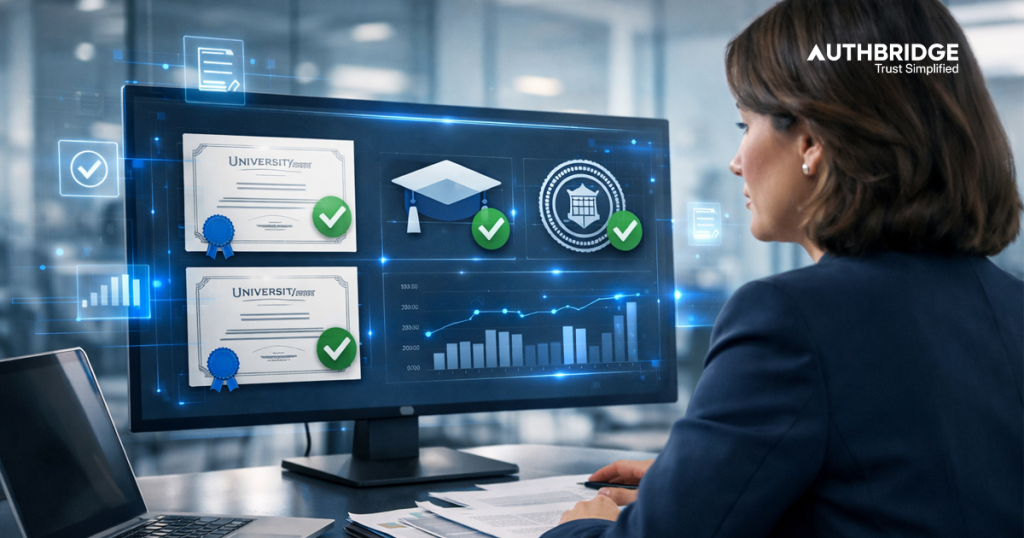

Introduction
Hiring in India has changed noticeably over the past decade. Companies are recruiting faster, handling significantly larger volumes of applications, and competing for highly specialised skills. Candidates, on the other hand, are more mobile, better prepared, and often present qualifications from multiple institutions, cities, or even countries. Thus, making the right hiring decisions isn’t just limited to evaluating experience or performance in interviews, but ensuring that the information shared by candidates is accurate and genuine.
One of the most persistent challenges that employers face is credential misrepresentation. Cases of exaggerated qualifications, altered mark sheets, and completely fabricated degrees are no longer viewed as rare exceptions. They appear across industries and job roles, creating risks that businesses cannot afford to ignore.
This is precisely where education verification plays a central role. Education checks add a layer of assurance and fairness to hiring decisions. More importantly, it functions as a preventative control, identifying inconsistencies before they evolve into larger business challenges.
This blog delves deep into how education verification works, what it protects against, and why employers increasingly rely on it.
What is Education Verification?
Education Verification is simply the process of checking whether a person’s educational qualifications are real and correctly presented. In simple terms, it answers a very basic but important question: Are these academic claims genuine and issued by a recognised institution? This verification step is a standard component of modern hiring and due diligence practices, helping organisations establish factual clarity around educational achievements.
Why Education Verification Is Critical for Employment Decisions
Hiring decisions shape the future of any organisation. Every new hire influences productivity, workplace culture, compliance exposure, and even customer trust. While interviews and skill assessments help employers understand a candidate’s suitability, they do not always confirm the accuracy of the information presented. This gap is precisely why education verification for employment has become an essential part of modern hiring practices.
Employers today encounter several recurring challenges that highlight the importance of verification:
a. Academic Claims Cannot Be Evaluated Through Interviews Alone
Interviews are designed to evaluate communication, knowledge, and problem-solving ability. However, they cannot independently confirm whether a degree, certification, or academic record is genuine. A candidate may present documents and speak convincingly, but without verification, there is no objective assurance that the stated qualifications are authentic. Education verification closes this gap by validating the credentials directly with issuing institutions or authorised sources.
b. Credential Misrepresentation Is More Common Than Expected
Discrepancies in educational details are observed across industries and roles. These may include overstated qualifications, incorrect completion years, or inconsistencies in academic history. Such discrepancies are rarely visible during routine résumé screening, making structured verification an important safeguard.
c. High-Risk Roles Demand Greater Scrutiny
In sectors such as healthcare, financial services, education, and other regulated industries, academic qualifications often play a crucial role in determining eligibility. Unverified credentials in these roles may trigger compliance risks or legal complications. As a result, employers place greater emphasis on verifying educational backgrounds for such positions.
Common Types of Education Fraud
Irregularities in academic credentials can take many forms. Some are easy to recognise, while others are far more subtle and only come to light during verification. Being aware of these common patterns helps employers understand why structured education checks are necessary.
a. Fake Degrees
Fake degrees refer to certificates that are completely fabricated or falsely linked to legitimate institutions. These documents are often designed to closely resemble legitimate credentials, making them difficult to identify through appearance alone. Without proper validation, such qualifications may go unnoticed during initial screening.
b. Qualifications from Unrecognised Institutions
In some situations, the qualification itself may exist, but the issuing institution lacks proper accreditation or regulatory recognition. Such credentials may hold little or no legal or professional value despite appearing valid. For employers, this creates a hidden risk, particularly when roles require formally recognised education.
c. Exaggerated Academic Claims
Credential discrepancies are not always about completely fake documents. Candidates may sometimes exaggerate academic details by claiming a higher degree, altering specialisations, or modifying graduation timelines. Even seemingly minor changes can influence hiring decisions and lead to mismatches between job requirements and actual qualifications.
d. Tampered Mark Sheets and Transcripts
Academic records are sometimes altered to modify grades, remove academic gaps, or change personal details. These changes are rarely detectable through visual inspection alone and typically require verification against institutional data.
These examples highlight a simple yet crucial hiring reality: educational documents require independent validation. A structured education verification process helps employers distinguish genuine qualifications from misleading representations, reducing avoidable organisational risks.
How an Education Verification Background Check Works
Step 01: Document Collection and Data Validation
This process typically begins with collecting a candidate’s academic documents and essential details. These may include:
- Degree or diploma certificates
- Mark sheets or transcripts
- Name of the university, institution, or board
- Year of completion or passing
- Course, programme, or specialisation
This stage is not just about collecting paperwork. The aim is to capture precise details that will later be validated. Even small differences in spelling, dates, or course names can affect verification results, so accuracy here is very important.
Step 02: Verifying with the Issuing Institution
Once the details are recorded, verification requests are sent to the institution that issued the qualification. Depending on the candidate’s background, this may involve:
- Universities or colleges
- School boards or examination authorities
- Professional or technical certification bodies
The institution is asked to confirm basic but critical facts, whether the candidate was enrolled, completed the programme, and was awarded the stated qualification. Some institutions respond to digital systems, while others rely on manual record checks.
Step 03: Cross-Checking Official Databases
Where digital records are available, official databases and registries are also reviewed. These sources help verify:
- Whether the institution is officially recognised or accredited
- Whether the qualification exists and is legitimate
- Whether the academic records are consistent
However, not all institutions maintain comprehensive online records; database checks are often combined with direct institutional verification.
Step 4: Identifying and Reviewing Discrepancies
If any inconsistencies are found during verification, they are examined and categorised. Common outcomes may include:
- Data mismatch: Differences in names, dates, or qualification details
- Unverified records: Information that cannot be confirmed
- Negative verification: Records that do not match institutional data
- Document concerns: Signs of possible alteration or irregularity
This structured review helps employers clearly understand the nature of any issue instead of facing unclear or confusing results.
An education verification background check, therefore, acts as a reliability filter in hiring. It enables employers to confirm academic claims, detect discrepancies early, and make decisions based on verified information rather than documents alone.

Challenges in Education Verification in India
Education verification in India has improved with digitisation, yet the process still comes with certain practical difficulties:
a. Manual Verification Systems
A large number of universities and boards still follow traditional, manual verification procedures. Instead of instant digital responses, verification requests may require administrative processing, physical record checks, or departmental approvals. This naturally leads to differences in response times across institutions.
b. Limited Availability of Digital Academic Records
Although digitisation is increasing, not all academic data is stored in easily accessible online databases. Older records, regional institutions, or legacy systems may require offline validation. In such cases, verification depends on direct communication with the institution.
c. Differences in Names and Document Details
Variations in spelling, use of initials, name changes, or inconsistent documentation formats often create complications. Even when credentials are genuine, mismatches between submitted documents and institutional records can require additional clarification and checks.
d. Verification of International Qualifications
Candidates with foreign degrees introduce an additional layer of verification. Employers must confirm not only the authenticity of the qualification but also the recognition status and equivalency of the issuing institution within the Indian context, which makes the process more detailed.
e. Variations in Verification Timelines
Verification timelines can differ based on multiple factors, including institution responsiveness, record accessibility, and the verification method used. Some checks may be completed quickly, while others may take longer due to administrative dependencies.
These challenges highlight an important reality: education verification is not always a uniform or instantaneous process. A structured and well-managed verification approach helps organisations navigate these complexities while maintaining accuracy and reliability.
Frequently Asked Questions (FAQs)
Education verification check is the process of confirming the authenticity of a candidate’s educational qualifications. This involves verifying the degrees, diplomas, and certificates claimed by the candidate from the respective educational institutions.
The process of education verification check in India typically involves:
- Document submission: The candidate provides copies of their educational certificates and transcripts.
- Direct verification: Contacting the educational institutions directly to confirm the authenticity of the documents.
- Database check: Cross-referencing the candidate’s details with databases of accredited institutions and degrees.
- Third-party agencies: Engaging third-party verification agencies that specialize in conducting thorough education checks.
For an education verification check in India, candidates usually need to submit:
- Copies of their degree certificates
- Mark sheets or transcripts
- Enrollment numbers or registration details
- Any additional supporting documents requested by the employer or verification agency
Yes, online degrees are verified in a similar manner to traditional degrees in India. The verification process involves confirming the legitimacy of the issuing institution and the authenticity of the degree. Accredited online programs from recognized institutions are treated the same as traditional programs.
Some common challenges in education verification in India include:
- Difficulty in reaching educational institutions due to outdated contact information
- Delays from institutions in responding to verification requests
- The prevalence of forged documents and degrees from unrecognized institutions
- Lack of a centralized database for educational records
Yes, a candidate can fail an education verification check if discrepancies are found, such as:
- Mismatched information between the submitted documents and the institution’s records
- Forged or fake certificates
- Degrees from unaccredited or non-existent institutions
Employers benefit from conducting education verification checks by:
- Reducing the risk of hiring unqualified candidates
- Ensuring compliance with industry standards and regulations
- Maintaining a high level of trust and credibility within the organization
- Protecting the company’s reputation and avoiding potential legal issues
Education verification is not mandatory for all jobs in India, but it is a common practice for positions that require specific qualifications. Employers in sectors such as finance, healthcare, IT, and education often conduct education verifications to ensure candidates meet the necessary academic criteria.