Verify a candidate’s financial track record — credit accounts, judgments, liens, and bankruptcies — without ever seeing a credit score. Built for employers who need defensible, state-law-aware screening for roles that touch money, assets, or sensitive data.
An employee credit history check is a background screening component that reviews a candidate’s credit accounts, payment history, outstanding debts, collections, judgments, liens, and bankruptcy filings. Employers use it to evaluate financial responsibility for roles with fiduciary duty, cash handling, or access to sensitive financial systems. Under the Fair Credit Reporting Act (FCRA), employers receive a credit report summary — never the numeric credit score — and must obtain written consent before pulling it.


























Assess financial responsibility and determine if candidate is suitable for roles that involve handling money or financial assets.
Mitigate the risk of negligent hiring, theft, or embezzlement, protecting your business from financial losses.
Ensure candidates have necessary financial responsibility to handle sensitive financial information or transactions.
Assess Financial Responsibility For roles handling payroll, procurement, cash, or client funds, past financial conduct is a meaningful signal of reliability — not a moral judgment, but a risk data point alongside the rest of your background check.
Reduce Exposure to Negligent-Hiring Claims Employers can be held liable for foreseeable harm caused by an employee in a position of financial trust. A documented, FCRA-compliant credit check is part of a defensible hiring record.
Protect Fiduciary and Compliance-Sensitive Roles Banking, finance, accounting, and roles requiring bonding or security clearance often carry regulatory expectations around financial vetting — some make it a condition of the role, not a preference.
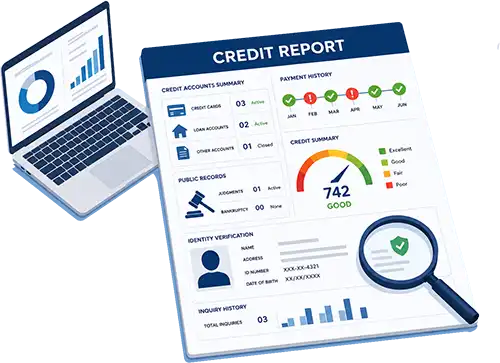
Understanding a candidate’s past financial challenges can provide critical context when evaluating their suitability for positions that require trust and accountability.


Access crucial public records to highlight any past financial difficulties, including bankruptcies and liens, that could affect an employee’s eligibility for specific roles. By identifying these issues upfront, you can make more informed hiring decisions and mitigate potential risks associated with financial misconduct.
Gauge the employee’s ability to manage their financial obligations without the need to report actual credit scores.

Our team of experts has in-depth knowledge of credit history and financial analysis.
Vast network of credit bureaus and public records databases to provide comprehensive and accurate information
Robust validation processes to ensure the reliability and integrity of the data we provide.
Leverage both federal and state-level credit records to provide a complete picture of a candidate's financial history.




Typically: credit accounts, payment history, outstanding debts, bankruptcies, judgments, and collection accounts — but not your credit score.
No — CRAs provide a credit report summary, but not the numeric FICO or credit score used by lenders.
Yes — under the FCRA (Fair Credit Reporting Act), written consent is mandatory before a CRA can provide your credit report to an employer.
No — employment-related credit inquiries are considered “soft pulls” and do not impact your credit score.
The employer must provide a pre-adverse action notice, including a copy of the report and a summary of your rights, giving you a chance to dispute inaccuracies before final action.
Most negative items stay for 7 years; bankruptcies may remain for up to 10 years.
Primarily for roles involving financial responsibility, fiduciary duty, or access to sensitive data, to assess trustworthiness and risk.
The FCRA, plus state laws — e.g., some states (like California, Illinois, and New York) restrict or limit employer use of credit reports.
Contact the CRA directly to initiate a dispute, and they must investigate within 30 days .
To begin, Tell us a bit about “yourself”
The most noteworthy aspects of our collaboration has been the ability to seamlessly onboard partners from all corners of India, for which our TAT has been reduced from multiple weeks to a few hours now.

 India
India USA
USA UAE
UAE